
Switzerland Slashes F-35 Order as Cost Overruns Expose Fragility of Western Airpower Modernisation
Escalating acquisition and sustainment costs are forcing Switzerland to recalibrate its fifth-generation airpower ambitions, exposing structural weaknesses in multinational fighter programmes and redefining the limits of democratic defence spending in Europe.

(DEFENCE SECURITY ASIA) — Switzerland’s decision to scale back its planned acquisition of the Lockheed Martin F-35A Lightning II represents not merely a procurement adjustment but a profound strategic inflection point that exposes the structural fragility of high-end Western airpower modernisation under intensifying fiscal, industrial, and geopolitical pressure.
The announcement by the Swiss Federal Council that Bern will not proceed with the originally planned purchase of 36 F-35A fighter jets underscores the widening gap between fifth-generation airpower ambition and the economic realities confronting even affluent, technologically sophisticated European states.

At its core, the controversy highlights how escalating acquisition and sustainment costs within the F-35 programme are increasingly colliding with domestic political constraints, voter-mandated budget ceilings, and democratic accountability mechanisms that few other advanced fighter programmes are subjected to so rigorously.
For Switzerland, a neutral state whose defence doctrine is anchored in territorial sovereignty, rapid reaction readiness, and strategic restraint rather than expeditionary power projection, the turbulence surrounding the F-35 procurement carries consequences far beyond fleet size, touching on autonomy, credibility, and long-term air defence viability.
The roots of the current impasse lie deep within Switzerland’s Air2030 programme, an ambitious yet politically delicate modernisation effort conceived to arrest the progressive obsolescence of the Swiss Air Force’s combat aviation backbone.
The Swiss case illustrates how fifth-generation fighter programmes are no longer evaluated solely on tactical or technological merit, but increasingly judged through the prism of long-term fiscal sustainability, political legitimacy, and the resilience of national decision-making frameworks under external cost shocks.
More critically, the episode exposes the asymmetry of power between supplier states and smaller buyers in multinational weapons programmes, where contractual flexibility, inflation pass-through mechanisms, and industrial bottlenecks often leave customer nations absorbing strategic risk they neither caused nor fully control.
In an era where air dominance is defined as much by software sustainment cycles, engine upgrade pathways, and classified data ecosystems as by kinematic performance, Switzerland’s experience underscores the hidden strategic costs embedded within ostensibly “off-the-shelf” fifth-generation solutions.
The turbulence surrounding Bern’s procurement decision also reflects a broader European dilemma, in which states seek cutting-edge deterrence capabilities while simultaneously navigating electorates increasingly sceptical of opaque defence spending and transatlantic dependency.
Ultimately, Switzerland’s recalibration signals a structural warning to the global fighter aircraft market: without greater cost transparency, industrial predictability, and sovereign sustainment options, even the most capable air combat systems risk becoming politically unsustainable liabilities rather than enduring pillars of national defence.
Air2030 and the Strategic Imperative to Replace Aging Cold War-Era Fighters
Air2030 emerged in the late 2010s as Switzerland confronted the irreversible ageing of its Northrop F-5E/F Tiger II fleet, acquired in the 1970s, and its Boeing F/A-18C/D Hornets, introduced in the 1990s and increasingly burdened by rising maintenance demands and diminishing operational relevance.
These legacy platforms had long underpinned Switzerland’s armed neutrality by enabling continuous air policing, airspace sovereignty enforcement, and rapid interception capability across the Alpine region, yet by the mid-2010s their technological limitations became incompatible with the evolving European threat environment.
The proliferation of advanced air-launched cruise missiles, long-range precision strike systems, electronic warfare platforms, and stealth-capable aircraft in Europe fundamentally altered the risk calculus for Swiss air defence planners.
Air2030 was therefore conceived not merely as a fighter replacement programme but as an integrated, layered air defence architecture combining advanced combat aircraft with modernised ground-based air defence systems capable of countering both conventional and asymmetric aerial threats.
In September 2020, Switzerland’s unique system of direct democracy placed this vision squarely before the electorate, with voters narrowly approving a ceiling of 6 billion Swiss francs for new combat aircraft procurement.
That sum, equivalent to approximately US$6.9 billion (RM32.5 billion) at current exchange rates, reflected a political compromise forged amid intense debate over national security priorities, neutrality, fiscal discipline, and the necessity of acquiring cutting-edge military technology.
The razor-thin approval margin of 50.1 percent underscored the fragility of political consensus surrounding Air2030 and foreshadowed the turbulence that would later engulf the programme.
The F-35A Selection and the Promise of Fifth-Generation Superiority
Following the referendum, Switzerland launched the New Fighter Aircraft (NFA) competition, a comprehensive evaluation process that pitted four of the world’s most advanced combat aircraft against one another under stringent technical, operational, and economic criteria.
The contenders—the Lockheed Martin F-35A Lightning II, Boeing F/A-18E/F Super Hornet, Dassault Rafale, and Airbus Eurofighter Typhoon—were assessed across performance, survivability, lifecycle cost, industrial offsets, and operational independence.
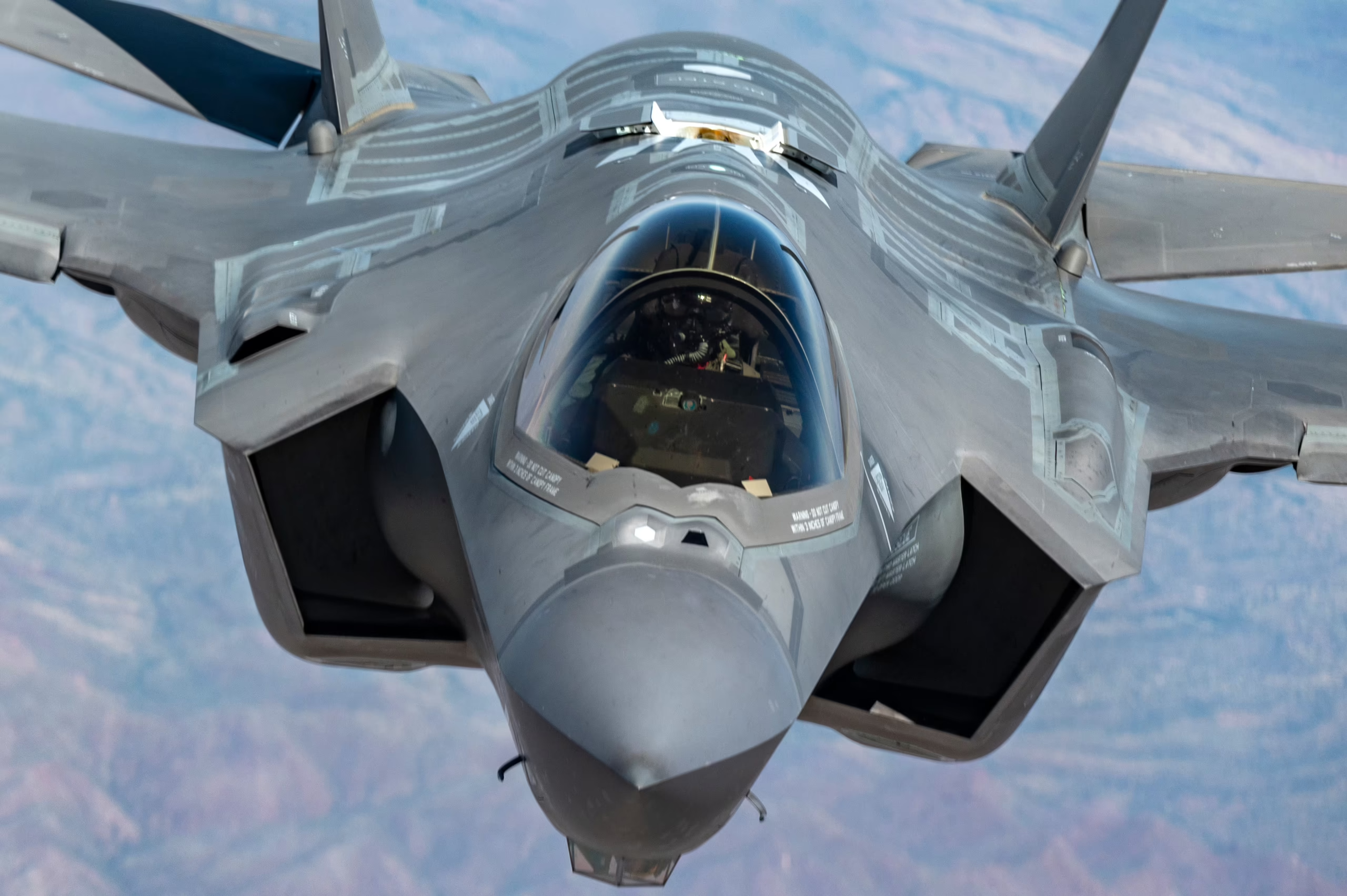
In June 2021, the Federal Council declared the F-35A the winner, citing its decisive advantage in sensor fusion, stealth characteristics, electronic warfare integration, and network-centric combat effectiveness.
The evaluation concluded that the F-35A delivered the highest overall operational value, particularly in contested airspace scenarios involving advanced surface-to-air missile systems and electronic attack environments increasingly prevalent in Europe.
Crucially, Swiss authorities also asserted that the F-35A offered the lowest projected lifecycle cost, a claim that proved pivotal in justifying the selection to a sceptical public wary of runaway defence spending.
The decision immediately ignited political backlash, with critics warning that the F-35’s deep integration into U.S.-controlled data ecosystems risked eroding Swiss neutrality by tethering national defence infrastructure to American operational architectures.
Supporters countered that the aircraft’s unparalleled situational awareness, enabled by the AN/APG-81 AESA radar, Distributed Aperture System, and multi-domain sensor fusion, was indispensable for credible deterrence in a Europe reshaped by renewed great-power competition.
In September 2022, Switzerland formalised the contract, committing to 36 F-35As at a stated aircraft cost of 5.068 billion Swiss francs, with total programme expenditures—including infrastructure, training, spares, and sustainment—remaining nominally within the 6 billion franc ceiling.
Deliveries were scheduled to begin in 2027, with full operational capability targeted by 2030, aligning with the phased retirement of the F/A-18C/D Hornets and ensuring continuity of airspace protection.
Cost Overruns, Inflation Shock, and the Collapse of the Fixed-Price Assumption
The apparent stability of the programme unravelled dramatically in 2025 as negotiations with the United States revealed that the fixed-price assurances underpinning Switzerland’s procurement calculus could no longer be upheld.
Rising global inflation, surging raw material costs, persistent supply chain disruptions, and increased labour expenses across the U.S. defence industrial base combined to erode the financial assumptions embedded in the original Letter of Offer and Acceptance.
A U.S. Department of Defense official acknowledged in August 2025 that “costs associated with the F-35 program, particularly for airframes and engines, have been trending higher than the initial estimates outlined in the F-35 Letter of Offer and Acceptance (LOA), originally offered to Switzerland.”
The official further clarified that while inflation was accounted for in contractual mechanisms, “the final price might differ from initial estimates,” citing provisions such as contractual Note 55 that allowed for post-agreement adjustments.
The revised cost estimate amounted to an additional US$610 million, equivalent to approximately RM2.9 billion, pushing Switzerland’s total programme cost to roughly 7.3 billion Swiss francs.
For Bern, this translated into an unexpected fiscal overrun of up to 1.3 billion Swiss francs, or approximately US$1.5 billion (RM7.1 billion), instantly breaching the voter-approved ceiling and triggering a constitutional and political crisis.
Swiss officials expressed frustration at what they perceived as a unilateral recalibration of contractual terms, particularly given the domestic political sensitivity surrounding the programme.
In a statement issued on December 12, 2025, the Federal Council declared: “Due to foreseeable additional costs, it is not financially viable to maintain the originally planned number of 36 F-35As.”
The statement underscored the government’s obligation to respect democratic mandates, instructing defence planners to procure the “maximum possible number” of aircraft strictly within the 6 billion franc limit.
Defence Minister Viola Amherd reinforced this position, stating unequivocally: “The will of the people will be honoured. We cannot exceed the financial framework approved by the electorate.”
Amherd further emphasised that abandoning industrial offset agreements was not an option, as these arrangements underpin domestic aerospace expertise, sustainment autonomy, and long-term economic returns.
Strategic Consequences for Swiss Air Defence and the F-35 Programme
The reduction in Switzerland’s F-35 fleet—widely estimated to fall to between 28 and 30 aircraft—has profound implications for national air defence resilience and operational endurance.
While even a reduced fleet represents a generational leap over the F/A-18C/D and F-5E/F, it falls short of the force structure envisioned in Switzerland’s 2017 “Air Defence of the Future” assessment, which projected a requirement for 55 to 70 modern fighters.
A smaller fleet constrains sortie generation rates, limits sustained operations during prolonged crises, and increases vulnerability to attrition in high-intensity conflict scenarios.
In a European security environment shaped by Russia’s war in Ukraine, expanded missile inventories, and increasingly sophisticated electronic warfare capabilities, such constraints carry tangible strategic risk.
The Federal Council has left open the possibility of future supplementary acquisitions to restore the fleet to 36 aircraft, potentially requiring additional parliamentary approval or even another national referendum by early 2026.
However, given the political fatigue surrounding Air2030 and the narrow margin of the original vote, any attempt to expand funding is likely to encounter fierce resistance.
This episode also reverberates far beyond Switzerland, reinforcing concerns among F-35 partner nations regarding cost volatility, sustainment affordability, and programme governance.
The F-35 remains the most expensive weapons system in history, with total acquisition costs exceeding US$485 billion (RM2.3 trillion) and lifecycle costs projected to surpass US$1.7 trillion (RM8 trillion) over its operational lifespan.
Recent delays in software upgrades, engine modernisation, and Block 4 capability rollouts have compounded uncertainty for international operators.
For Asia-Pacific states closely monitored by Defence Security Asia—such as Malaysia, Indonesia, and Thailand—Switzerland’s experience offers a cautionary case study in balancing fifth-generation ambition against fiscal sovereignty.
Japan’s ability to absorb similar overruns through domestic assembly lines and industrial participation highlights one potential mitigation pathway, though such arrangements require scale and political alignment that Switzerland lacks.
A Recalibration Rather Than a Retreat
Despite the turbulence, Switzerland’s recalibration does not signify a retreat from advanced airpower but rather a reassertion of democratic control over defence spending in an era of strategic uncertainty.
The episode underscores the growing tension between the escalating complexity—and cost—of modern weapons systems and the political economies of states that demand transparency, accountability, and fiscal discipline.
As inflationary pressures persist and global supply chains remain strained, similar challenges are likely to confront other F-35 operators, particularly those without the industrial leverage of larger programme partners.
For Switzerland, the immediate priority remains safeguarding airspace sovereignty while preserving political legitimacy, a balancing act that has defined its defence posture for decades.
The skies over the Alps will still see the Lightning II, but in fewer numbers than originally envisioned, reflecting a sober recalibration of ambition in the face of economic and political reality.
In that sense, Switzerland’s F-35 turbulence may prove less an anomaly than a harbinger of the future trajectory of high-end defence procurement worldwide. — DEFENCE SECURITY ASIA
