
Saudi Arabia Rushes US$3 Billion Into Pakistan in Five Days, Preventing Financial Crisis and Reshaping Gulf Power Balance
Riyadh’s US$3 billion (RM11.4 billion) emergency transfer arrived just as Pakistan faced a US$3.5 billion UAE repayment deadline, transforming a looming reserve crisis into a strategic Saudi-Pakistan alliance.

(DEFENCE SECURITY ASIA) — Pakistan entered April facing a narrowing external-account window, rising repayment pressure, and the realistic prospect that another foreign-exchange shock could derail its IMF programme before mid-year.
Saudi Arabia altered that trajectory within five days by transferring US$3 billion, equivalent to RM11.4 billion, directly into the State Bank of Pakistan through an unusually rapid two-tranche financial operation.
The speed, timing, and scale of Riyadh’s intervention carried significance far beyond emergency liquidity because the deposit arrived precisely when Pakistan faced a US$3.5 billion maturing obligation to the United Arab Emirates.
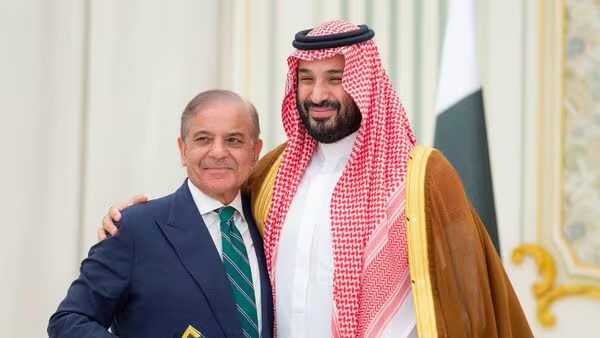
The State Bank of Pakistan confirmed that the first tranche of US$2 billion, equivalent to RM7.6 billion, arrived on 15 April, followed by a second tranche of US$1 billion, equivalent to RM3.8 billion, on 20 April.
Those transfers completed a recently agreed US$3 billion Saudi deposit package and immediately shifted Pakistan’s reserve trajectory toward the IMF target of approximately US$18 billion, or RM68.4 billion, by June.
Pakistan’s leadership framed the transfer as a stabilising measure for the external account, while Saudi officials signalled that Riyadh intended to anchor Pakistan’s economic resilience over several years.
The deposit also arrived only months after both countries formalised a Strategic Mutual Defence Agreement, reinforcing perceptions that Saudi financial support increasingly overlaps with broader geopolitical and security calculations.
Rather than representing another short-term Gulf bailout, the five-day transfer increasingly resembles the financial foundation of a deeper Saudi-Pakistan axis designed to influence South Asian and Gulf power balances.
By acting before reserve stress escalated into a balance-of-payments crisis, Saudi Arabia also strengthened Pakistan’s negotiating leverage with the IMF, China, and other bilateral creditors during the coming months of financial negotiations.
The intervention therefore signalled that Riyadh increasingly views Pakistan’s economic stability as an essential component of wider Gulf security, regional deterrence, and long-term strategic competition across South Asia and the Arabian Peninsula.
READ: Pakistan Deploys Fighter Jets to Saudi Arabia, Raising Risk of Wider Iran War Across the Gulf
A Five-Day Transfer That Prevented a Reserve Shock
The State Bank of Pakistan stated that the second tranche of US$1 billion reached its accounts on 20 April, formally completing the entire US$3 billion Saudi commitment.
That second transfer followed the earlier arrival of US$2 billion on 15 April, meaning Riyadh disbursed the full amount in only five days.
Measured in Pakistani currency, the package amounted to RM11.4 billion, with the first tranche worth RM7.6 billion and the second tranche worth RM3.8 billion.
The timing proved decisive because Pakistan simultaneously faced severe reserve pressure from a maturing US$3.5 billion obligation owed to the United Arab Emirates.
Without rapid Saudi assistance, Islamabad would have needed to drain reserves aggressively, pursue emergency borrowing, or risk breaching sensitive IMF reserve benchmarks.
The new Saudi inflow was therefore structured not as a replacement for UAE funding, but as liquidity support enabling Pakistan to meet those obligations safely.
Pakistan had already repaid roughly US$2 billion, equivalent to RM7.6 billion, to the UAE during recent days before the second Saudi tranche arrived.
The remaining Saudi funds then helped Pakistan cover the balance while preventing a sudden deterioration in reserve adequacy and market confidence.
By synchronising both tranches with the peak of repayment pressure, Riyadh demonstrated an unusually deliberate and coordinated approach to Pakistani financial stabilisation.
IMF Targets, Foreign Exchange Reserves, and Debt Management
Before the Saudi transfers arrived, Pakistan’s foreign-exchange reserves stood near US$16.4 billion, equivalent to approximately RM62.3 billion, according to late-March figures.
The additional US$3 billion immediately pushed reserve expectations toward the IMF programme target of roughly US$18 billion, or RM68.4 billion, by June.
Reaching that threshold matters strategically because it represents approximately 3.3 months of import cover, a level viewed internationally as a minimum financial buffer.
A failure to approach the IMF target could have triggered exchange-rate volatility, higher borrowing costs, rating pressure, and renewed concerns regarding Pakistan’s repayment capacity.
The Saudi transfer therefore improved more than headline reserve numbers because it strengthened Pakistan’s ability to manage Eurobond maturities and external debt servicing.
Islamabad now gains additional flexibility to address future obligations without immediately resorting to expensive commercial borrowing or destabilising emergency austerity measures.
Finance officials argued that the inflow reinforces reserve adequacy and demonstrates that Pakistan retains credible external financing partners despite persistent macroeconomic vulnerabilities.
State Bank Governor Jameel Ahmad also indicated that macroeconomic conditions have improved faster than expected, suggesting the reserve position may stabilise sooner.
The Saudi package consequently strengthened Pakistan’s bargaining position in future IMF reviews because international lenders prefer evidence of reliable bilateral financial backstops.
Saudi Arabia Extends Its Financial Footprint in Pakistan
The new US$3 billion transfer did not emerge in isolation because Saudi Arabia simultaneously extended an existing US$5 billion facility for another three years.
That extension removed the previous requirement for annual rollover negotiations and reportedly keeps the Saudi facility in place until at least 2028.
Combined with the new deposit, Saudi Arabia’s total financial exposure to Pakistan now approaches approximately US$8 billion, equivalent to RM30.4 billion.
A separate agreement signed in Washington on 17 April extended the maturity of an earlier US$3 billion Saudi Fund for Development deposit.
The agreement was concluded on the sidelines of the World Bank and IMF Spring Meetings, underscoring its broader international financial significance.
Saudi Fund for Development chief executive Sultan bin Abdulrahman Al-Marshad signed the extension alongside State Bank Governor Jameel Ahmad.
Pakistan’s Finance Minister Muhammad Aurangzeb attended the signing, reinforcing that Islamabad viewed the agreement as strategically important rather than purely technical.
The cumulative effect of these measures is that Saudi Arabia has become Pakistan’s single largest cash depositor and arguably its most important external financial partner.
That position gives Riyadh substantial influence over Pakistan’s macroeconomic resilience, debt-management timetable, and long-term external financing architecture.
Saudi Arabia and the UAE Are Pursuing Different Pakistan Strategies
The Saudi intervention unfolded against an important Gulf contrast because the UAE continued demanding repayment of its maturing obligations from Pakistan.
Abu Dhabi therefore adopted a more commercial and transactional posture, while Riyadh presented itself as the long-term guarantor of Pakistani stability.
That divergence reflects different strategic calculations regarding influence, leverage, and regional positioning within South Asia and the wider Gulf security environment.
Saudi Arabia appears increasingly willing to use financial instruments to reinforce political influence and preserve Pakistan as a strategically aligned partner.
The UAE, by contrast, has prioritised balance-sheet discipline and appears less willing to extend unconditional liquidity during periods of Pakistani financial stress.
Those differing approaches subtly alter the Gulf balance of influence inside Islamabad because Pakistan now depends increasingly on Saudi rather than Emirati support.
For Pakistan, greater Saudi backing reduces excessive reliance upon any single creditor while improving negotiating leverage with other external partners.
For Saudi Arabia, the deposit reinforces its broader effort to maintain leadership within the Islamic world while competing quietly with alternative Gulf influence networks.
The result is a gradual recalibration in which Riyadh, rather than Abu Dhabi, increasingly shapes Pakistan’s economic and strategic decision-making environment.
READ: Saudi Arabia Blocks Pakistan’s US$1.5 Billion Sudan Arms Package, Threatening Sudan Army’s Bid for Air Superiority
Economic Support Is Becoming Part of a Wider Defence Relationship
The Saudi deposit also carries deeper geopolitical significance because it arrived after the September 2025 Saudi-Pakistan Strategic Mutual Defence Agreement.
That agreement declared that aggression against either country would be treated as aggression against both, creating a far closer bilateral security framework.
Saudi financial support therefore increasingly overlaps with defence cooperation, military training, and Pakistan’s longstanding role as a security provider for the Kingdom.
Pakistan has historically supplied military advisers, trainers, and operational support to Saudi Arabia, especially during periods of elevated regional tension.
By strengthening Pakistan’s economy, Riyadh also protects the operational reliability of a nuclear-armed partner positioned between the Gulf, Iran, and South Asia.
Saudi Arabia appears to view Pakistan as an increasingly valuable strategic hedge while it simultaneously diversifies partnerships beyond exclusive reliance upon the United States.
For Islamabad, the Saudi deposits provide more than temporary liquidity because they create economic ballast during heightened tensions with Iran and persistent domestic instability.
The transfer also helps protect critical regional projects, including energy flows, remittance networks, Gulf investment corridors, and wider confidence surrounding the China-Pakistan Economic Corridor.
The rapid five-day disbursement therefore signals that Saudi Arabia is no longer merely supporting Pakistan’s economy but actively underwriting a longer-term geopolitical partnership.
The US$3 billion transfer, together with the extended US$5 billion facility, ultimately represents a Saudi decision to convert financial leverage into enduring strategic influence across South Asia and the Gulf.
