
Pakistan Air Force Eyes Bayraktar Kızılelma UCAV as India Pushes Boeing MQ-28 Ghost Bat — South Asia’s AI Fighter Drone Arms Race Could Reshape Indo-Pacific Airpower
Pakistan Air Force interest in Türkiye’s Bayraktar Kızılelma Loyal Wingman UCAV and India’s parallel Boeing MQ-28 Ghost Bat discussions signal the emergence of a high-stakes AI warfare competition capable of reshaping South Asian and Indo-Pacific military balance.

(DEFENCE SECURITY ASIA) — Twelve years ago, South Asian airpower calculations largely centered around fighter squadron inventories, but the accelerating emergence of AI fighter drone ecosystems increasingly suggests future strategic advantage may depend upon autonomous combat aircraft operating inside networked warfare architectures.
The appearance of Pakistan Air Force Chief Air Chief Marshal Zaheer Ahmed Baber Sidhu alongside the Bayraktar Kızılelma UCAV during his recent Türkiye visit immediately generated strategic attention because military symbolism increasingly functions as geopolitical signaling within modern defense diplomacy.
For military planners across the Indo-Pacific security environment, the significance extends beyond imagery because Loyal Wingman and Collaborative Combat Aircraft programs increasingly represent force multipliers capable of reshaping airpower without proportionally expanding pilot inventories.

Pakistan Air Force engagement with Turkish aerospace programs and the Bayraktar Kızılelma UCAV reflects a broader geopolitical shift in which emerging military powers increasingly seek autonomous defense ecosystems beyond traditional Western military-industrial structures.
India’s parallel assessment of Boeing MQ-28 Ghost Bat Collaborative Combat Aircraft technology suggests both rivals increasingly view AI fighter drones and Loyal Wingman systems as decisive instruments of future airpower architecture.
The broader implications extend beyond Islamabad and New Delhi because South Asia arms race dynamics increasingly intersect with larger Indo-Pacific security calculations involving China, Quad members and future regional force posture developments.
Military planners increasingly assess that military drone technology and autonomous combat aircraft could transform operational doctrine because sensor fusion and AI-enabled mission execution now generate effects previously requiring larger manned fleets.
The possibility of Pakistan Air Force and India Air Force deployment of competing UCAV ecosystems consequently introduces uncertainty into future regional deterrence equations.
Neither Islamabad nor New Delhi has publicly announced formal acquisition agreements, creating unresolved questions regarding industrial participation, logistics architecture and technology transfer structures.
The absence of procurement confirmation nevertheless has not prevented military observers from interpreting recent military engagements as indicators of rapidly evolving strategic intentions.
Official messaging remains centered on aerospace cooperation and emerging technologies while broader geopolitical interpretations continue expanding across defense circles.
The accelerating momentum surrounding Bayraktar Kızılelma and Boeing MQ-28 Ghost Bat increasingly suggests South Asia could emerge as the next major operational laboratory for AI warfare experimentation.
Pakistan Air Force-Türkiye Cooperation Signals a Wider Strategic Realignment
Air Chief Marshal Zaheer Ahmed Baber Sidhu’s recent Türkiye visit immediately attracted attention because it involved engagement with senior military and industrial leadership directly associated with advanced unmanned systems development.
Meetings involving Turkish Air Force Commander General Ziya Cemal Kadıoğlu, Defence Minister Yaşar Güler and Baykar CTO Selçuk Bayraktar suggest cooperation extending beyond traditional diplomatic symbolism.
Official emphasis surrounding unmanned aerial systems, military drone technology and aerospace innovation strongly suggests discussions increasingly focused on future combat architectures.
Photographs showing Pakistan Air Force officials near Bayraktar Kızılelma platforms rapidly fueled speculation because defense delegations rarely showcase advanced systems without broader strategic messaging implications.
Pakistan and Türkiye already possess established relationships involving UAV development and operational collaboration, creating favorable conditions for expanded industrial cooperation.
Existing industrial familiarity frequently reduces future procurement friction because logistical trust networks often accelerate military integration timelines.
Defense analysts increasingly assess possible local assembly arrangements because co-production can generate long-term wartime resilience and sustainment advantages.
For Islamabad, industrial participation potentially carries greater strategic value than aircraft numbers because domestic manufacturing strengthens defense autonomy.
Pakistan Air Force already possesses MUM-T operational exposure involving Turkish and Chinese systems, potentially creating doctrinal advantages during transition toward Loyal Wingman architectures.
The broader strategic signal increasingly suggests Pakistan seeks entry into a larger AI warfare ecosystem rather than pursuing another conventional aircraft acquisition.
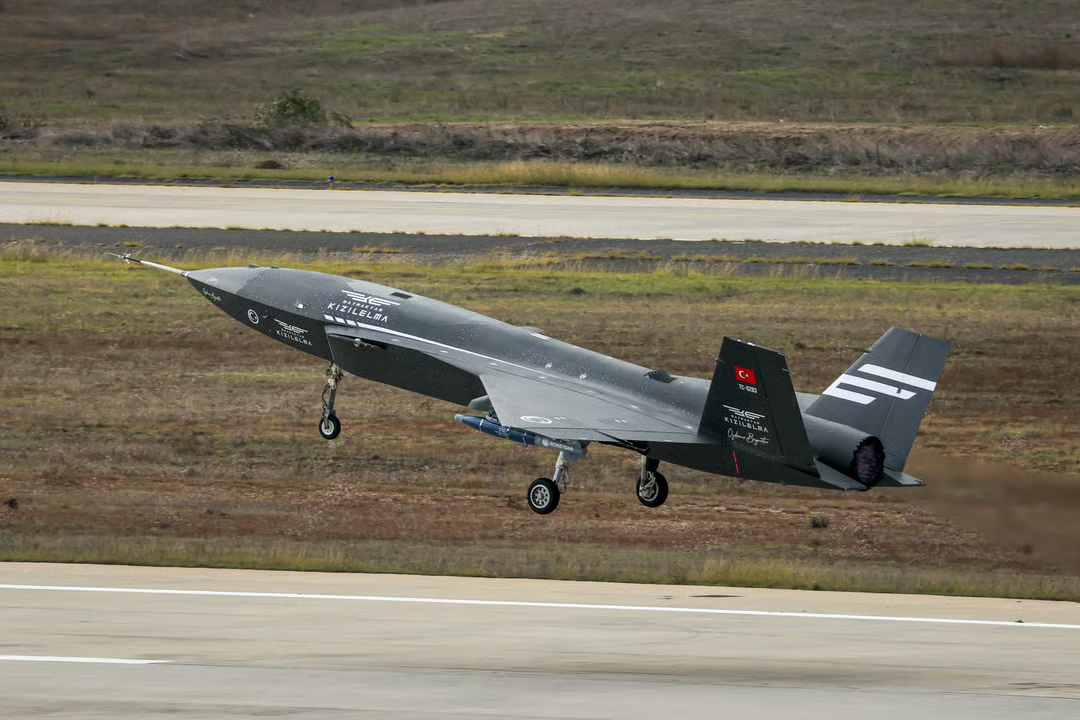

Bayraktar Kızılelma UCAV Expands the Definition of an AI Fighter Drone
Unlike earlier UCAV generations optimized primarily for surveillance missions, the Bayraktar Kızılelma stealth drone increasingly resembles an AI-enabled fighter platform designed specifically for contested airspace and Manned-Unmanned Teaming operations.
Its combination of artificial intelligence autonomy, Loyal Wingman functionality and MUM-T architecture places the aircraft within a unique category of autonomous combat aircraft.
Combat radius estimates approaching five hundred nautical miles provide operational reach supporting missions across strategically significant environments.
Maximum speeds approaching Mach 0.9 further differentiate Bayraktar Kızılelma from slower UAV systems historically designed around endurance-oriented priorities.
Payload capacity approaching 1,500 kilograms additionally enables mission flexibility involving reconnaissance, electronic warfare and precision strike operations.
Integration of the MURAD AESA radar significantly expands situational awareness and targeting effectiveness within highly contested environments.
Internal weapons bays simultaneously enhance survivability because stealth drone architecture remains essential within penetration-oriented operational concepts.
Mass production milestones further suggest Baykar increasingly transitioned Kızılelma from experimental ambitions toward practical deployment realities.
The first serial-production aircraft reportedly conducted flight activity during January 2026 while deliveries to Turkish forces were planned during the first quarter.
Indonesia’s export agreement involving twelve Bayraktar Kızılelma aircraft and options for forty-eight additional platforms demonstrates growing international confidence in Turkish defense industry capabilities.
Gökdoğan Missile Capability Creates a Tactical Edge in Beyond-Visual-Range Combat
Perhaps the most strategically consequential Bayraktar Kızılelma capability involves integration of two Gökdoğan beyond-visual-range missiles, providing the Turkish Loyal Wingman UCAV a potentially significant advantage in autonomous air combat scenarios.
The Gökdoğan missile incorporates active radar guidance technology conceptually comparable to AIM-120 AMRAAM-class weapon architectures used across Western air forces.
Reported engagement ranges exceeding sixty-five kilometers create tactical possibilities extending beyond traditional visual combat environments.
Unlike conceptual demonstrations, Bayraktar Kızılelma has already demonstrated realistic missile release activities involving operational configurations.
Its November 2025 test reportedly achieved a historic milestone involving successful engagement of a jet-powered target drone using beyond-visual-range missile technology.
The achievement generated substantial attention because UCAV programs historically emphasized strike missions rather than autonomous aerial combat operations.
That event potentially alters doctrinal assumptions regarding future force structures and pilot survivability calculations.
Traditional fighter aircraft increasingly may operate alongside autonomous combat aircraft capable of engaging threats independently.
Current Bayraktar Kızılelma missile configurations additionally create a visible capability advantage relative to Boeing MQ-28 Ghost Bat demonstrations.
That advantage nevertheless remains tactical rather than definitive because future air superiority increasingly depends upon sensor fusion, command architecture and network resilience.
Boeing MQ-28 Ghost Bat Represents India’s Western Ecosystem Approach
India Air Force engagement with Boeing MQ-28 Ghost Bat discussions emerged through India-Australia defense consultations focused on future Collaborative Combat Aircraft and autonomous combat aircraft technologies.
The appearance of Air Vice Marshal Sanjeev Taliyan alongside Australian defense leadership highlighted increasing Indian attention toward AI fighter drone programs.
Boeing simultaneously appears interested in industrial partnerships involving technology transfer and co-production supporting India’s domestic defense objectives.
Unlike Bayraktar Kızılelma, Boeing MQ-28 Ghost Bat emerged from Australian initiatives designed around coalition-oriented operational requirements.
The aircraft prioritizes seamless integration with platforms including F-35 and F/A-18 fighter fleets reflecting broader Western ecosystem assumptions.
Its modular architecture additionally allows rapid mission adaptation involving intelligence gathering, electronic warfare and sensor-specific requirements.
MQ-28 also emphasizes endurance and mission persistence rather than fighter-style maneuverability characteristics emphasized within Turkish design philosophy.
Current developmental configurations nevertheless remain comparatively constrained regarding demonstrated missile carriage flexibility.
Testing conducted during late 2025 reportedly involved successful launch of one AIM-120 AMRAAM from an external under-fuselage hardpoint configuration.
Future Block-3 variants introducing internal weapons bays may substantially alter future comparisons involving survivability and tactical flexibility.
Kızılelma vs MQ-28 Ghost Bat: The Emerging Loyal Wingman Rivalry Could Shape Global UCAV Export Markets
The direct competition between Bayraktar Kızılelma and Boeing MQ-28 Ghost Bat increasingly extends beyond South Asia because both autonomous combat aircraft platforms are becoming symbols of competing military-industrial ecosystems and future export influence.
Unlike traditional fighter procurement programs, the emerging Loyal Wingman market increasingly emphasizes artificial intelligence integration, software adaptability and network-centric warfare compatibility rather than raw aerodynamic performance metrics.
Baykar’s Bayraktar Kızılelma currently appears positioned with an early operational advantage because serial production activity and export agreements indicate a shorter pathway toward combat deployment timelines.
Indonesia’s commitment involving twelve Bayraktar Kızılelma UCAV platforms with options for forty-eight additional aircraft also demonstrates that international defense customers increasingly seek cost-effective AI fighter drone capabilities.
The Turkish defense industry may additionally benefit because Kızılelma’s compatibility with Manned-Unmanned Teaming doctrine creates operational appeal among states unable to procure high-end Western combat aircraft.
Pakistan Air Force interest in Bayraktar Kızılelma therefore potentially reflects not merely tactical requirements but also broader calculations involving future interoperability with Turkish and Chinese aerospace ecosystems.
Boeing MQ-28 Ghost Bat, by contrast, appears designed around integration with advanced Western force structures involving aircraft such as F-35, F/A-18 and broader Collaborative Combat Aircraft operational architectures.
The Boeing MQ-28 approach emphasizes modularity, sensor fusion and endurance because future air warfare increasingly prioritizes distributed intelligence gathering and electronic warfare mission adaptability.
Current demonstrated air-to-air capability nevertheless provides Bayraktar Kızılelma with a visible headline advantage because its two Gökdoğan missile configuration presently exceeds MQ-28 Ghost Bat’s publicly demonstrated single AIM-120 AMRAAM loadout.
Future export competition between Bayraktar Kızılelma and Boeing MQ-28 Ghost Bat could therefore reshape global military drone technology markets because countries increasingly seek autonomous combat aircraft capable of delivering strategic mass at lower financial and operational costs.
The broader geopolitical consequence involves more than aircraft sales because successful Loyal Wingman exports frequently create long-term logistics dependence, software ecosystems and defense partnership structures extending across decades.
As AI warfare increasingly becomes central to future Indo-Pacific security calculations, the Bayraktar Kızılelma versus Boeing MQ-28 Ghost Bat rivalry may ultimately become one of the most important autonomous combat aircraft competitions of the decade.
South Asia’s AI Warfare Competition Could Reshape Future Airpower Balance
The Bayraktar Kızılelma versus Boeing MQ-28 Ghost Bat competition increasingly reflects a wider geopolitical contest involving military ecosystems, AI warfare architecture and future Indo-Pacific security dynamics rather than individual aircraft platforms.
Autonomous combat aircraft increasingly may provide force multiplication effects previously requiring larger fighter inventories and expensive pilot pipelines.
Lower pilot exposure risks simultaneously create operational advantages during conflicts involving integrated air defense environments.
For Pakistan Air Force, Bayraktar Kızılelma potentially complements existing Turkish and Chinese systems while expanding MUM-T operational doctrine.
India similarly seeks distributed combat architectures supporting domestic initiatives involving Collaborative Combat Aircraft and CATS Warrior programs.
Neither government currently possesses confirmed procurement agreements, creating uncertainty regarding deployment timelines and force posture outcomes.
Strategic outcomes consequently remain dependent upon command-and-control integration, logistics footprint and sensor fusion effectiveness.
Military procurement history repeatedly demonstrates that aircraft specifications alone rarely determine battlefield superiority within network-centric warfare environments.
Both platforms presently represent contrasting philosophies regarding autonomous combat implementation rather than definitive indicators of future dominance.
What increasingly appears certain, however, is that South Asia’s next major contest may involve not only pilots and fighters but interconnected artificial intelligence ecosystems redefining twenty-first-century air superiority calculations.
