
Iran Poised to Acquire China’s CM-302 Supersonic Missiles as US “Massive Armada” Enters Gulf — Strategic Balance in Strait of Hormuz at Risk
Tehran’s reported move to field Mach-4 anti-ship cruise missiles coincides with the largest US naval surge since 2003, raising escalation risks across the world’s most critical oil chokepoint.

(DEFENCE SECURITY ASIA) — Iran’s reported move to finalize procurement of China’s CM-302 supersonic anti-ship cruise missiles unfolds at a moment when the United States has surged an unprecedented naval and air armada into the Persian Gulf theatre, creating a compressed escalation environment in which missile range, reaction time, and sea-control doctrine now directly intersect with nuclear diplomacy and regional deterrence signaling.
Multiple sources familiar with the negotiations indicate that Tehran and Beijing have been engaged in advanced discussions for at least two years, with talks accelerating after last year’s brief but intense Israel-Iran confrontation, a timeline suggesting that this missile acquisition is not opportunistic but structurally embedded in Iran’s long-term anti-access/area denial recalibration.
An Iranian Foreign Ministry official, speaking anonymously, framed the rationale in strategic terms, stating, “Iran has military and security agreements with its allies, and now is an appropriate time to make use of these agreements,” a formulation that implicitly situates the CM-302 procurement within a broader Eastward pivot shaped by sanctions pressure and constrained Western arms access.

President Donald Trump has simultaneously described the expanding US deployment as a “massive Armada” heading toward Iran, reinforcing that the military buildup is not merely routine force rotation but a coercive signaling mechanism linked explicitly to Tehran’s nuclear posture and previous punitive strikes on Iranian facilities.
The convergence of these two trajectories—China’s advanced supersonic missile technology potentially entering Iran’s coastal arsenal and Washington’s dual-carrier strike group presence within operational proximity—creates a volatile strategic geometry in which engagement envelopes, missile velocity, and electronic warfare resilience now determine deterrence credibility in one of the world’s most economically critical maritime chokepoints.
The Persian Gulf’s importance, through which roughly one-fifth of global oil shipments transit via the Strait of Hormuz, magnifies the implications of any enhancement in Iran’s anti-ship strike capacity, as even incremental reductions in reaction time for US destroyers or commercial tankers can translate into disproportionate geopolitical shockwaves across global energy markets.
The CM-302’s reported 280–290 kilometer range places launch platforms deep inside Iran’s coastline yet within striking distance of vessels operating in contested waters, altering the calculus for US surface combatants equipped with layered defenses such as the Aegis Combat System, which are optimized for multi-vector threats but are fundamentally constrained by radar horizon and engagement time compression.
If confirmed, the deal would represent one of the most technologically sophisticated Chinese weapon systems transferred to Iran, signaling not only tactical reinforcement of Tehran’s naval strike doctrine but also the maturing of a China-Iran defense axis that now intersects directly with US naval power projection architecture in the Indo-Pacific and Middle Eastern theatres.
The Reported CM-302 Procurement: Timeline, Negotiation Dynamics, and Strategic Intent
Sources indicate that Iranian military and government officials have traveled to China to accelerate negotiations, underscoring the urgency Tehran attaches to fortifying its maritime deterrent amid what it perceives as expanding Western coercive pressure and sustained US naval forward deployment.
The absence of a confirmed delivery timeline introduces uncertainty into regional threat assessments, yet the advanced stage of negotiations implies that doctrinal integration planning may already be underway within Iranian naval command structures, particularly the Islamic Revolutionary Guard Corps Navy, which prioritizes asymmetric maritime disruption.
Beijing has refrained from public confirmation, with its United Nations delegation deferring inquiries to the Foreign Ministry, maintaining strategic ambiguity that allows China to balance geopolitical leverage against reputational exposure under international arms control scrutiny.
The potential transfer follows a trajectory of expanding trilateral naval exercises involving China, Iran, and Russia, indicating that the CM-302 discussion does not exist in isolation but is embedded in a pattern of maritime interoperability signaling designed to dilute Western naval dominance narratives.
Last year, the US Treasury sanctioned several Chinese entities for allegedly supplying chemical precursors to Iran’s ballistic missile programs, an allegation Beijing denied while reiterating adherence to export controls on dual-use items, illustrating the contested regulatory environment surrounding high-end weapons transfers.
If the CM-302 agreement proceeds, it may test the interpretive boundaries of international arms regimes, particularly if structured as an export variant sale framed under defensive doctrine rather than offensive force projection, a distinction frequently invoked in regional arms procurement debates.
Tehran’s pivot toward China and Russia reflects a strategic hedging mechanism designed to offset sanctions-induced procurement constraints, effectively reconfiguring Iran’s access to advanced propulsion, guidance, and data-link technologies otherwise unavailable through Western markets.
The reported deal therefore carries layered implications: operational enhancement for Iran, diplomatic friction for Beijing, and strategic recalibration for Washington, all converging within the Persian Gulf’s compressed battlespace environment.
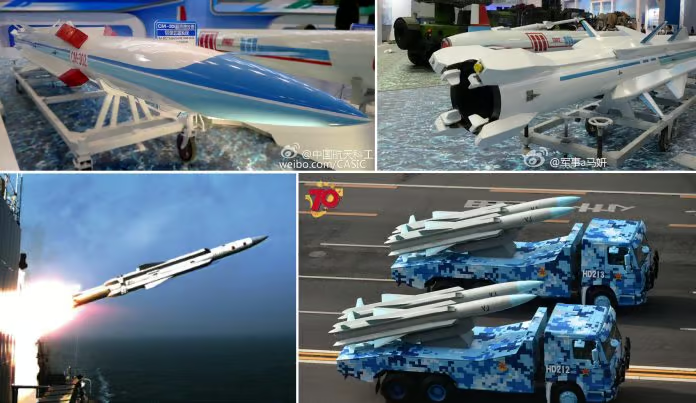
Technical Architecture of the CM-302: Supersonic Speed, Sea-Skimming Profile, and Defensive Compression
The CM-302, marketed by China Aerospace Science and Industry Corporation as one of the world’s premier anti-ship weapons, is the export derivative of the YJ-12 system and is designed explicitly to neutralize large surface combatants, including destroyers and aircraft carriers, through high-velocity terminal engagement.
With a reported operational range of approximately 280–290 kilometers, the missile enables standoff launches from coastal batteries, surface vessels, or aircraft, reducing platform exposure while extending Iran’s effective maritime denial perimeter beyond previously subsonic engagement envelopes.
Its propulsion architecture combines a solid rocket booster for initial acceleration with a liquid ramjet engine for sustained supersonic cruise, generating speeds estimated between Mach 2.5 and Mach 4, thereby compressing defensive reaction windows for targeted vessels to mere minutes.
The missile’s sea-skimming flight profile, reportedly descending to altitudes as low as 5–10 meters above the wave surface, exploits radar horizon limitations and sea clutter interference, complicating early detection and reducing engagement time for shipborne interception systems.
Mid-course data-link updates and terminal active radar guidance, supported by BeiDou satellite navigation, enhance targeting precision and resistance to electronic countermeasures, increasing the probability of successful penetration against layered naval defense architectures.
The CM-302’s warhead, reportedly weighing between 250 and 500 kilograms, carries sufficient destructive yield to inflict catastrophic damage on vessels displacing up to 5,000 tons, raising credible survivability concerns for modern destroyers operating within contested proximity.
CASIC promotes the system as capable of neutralizing high-value naval assets, including aircraft carriers, a marketing assertion that directly intersects with US carrier strike group doctrine, where layered defense and distributed lethality depend on early detection and extended engagement depth.
In Iranian service, integration of a supersonic missile with these characteristics would address a historical gap in Tehran’s anti-ship arsenal, which has largely relied on subsonic systems such as the Ghadir and Noor, thereby shifting from saturation-based harassment toward high-velocity precision disruption.
Iran’s Asymmetric Maritime Doctrine and the Evolution of Anti-Access Strategy
Iran’s pursuit of the CM-302 aligns structurally with its asymmetric warfare doctrine, which emphasizes anti-access/area denial strategies intended to raise the operational costs of superior naval forces rather than compete symmetrically with blue-water fleets.
By layering supersonic missiles with swarms of fast attack craft, coastal radar networks, submarines, and sea mines, Tehran seeks to construct a denial matrix in the Persian Gulf that complicates US force maneuverability without requiring conventional naval parity.
A report noted that, “If confirmed, the deal would strengthen Tehran’s anti-access strategy by adding a high-speed sea-skimming weapon designed to compress ship defense reaction times and complicate U.S. maritime operations,” highlighting the doctrinal synergy between missile speed and denial architecture.
The introduction of Mach-class anti-ship capability amplifies Iran’s deterrence messaging, as reaction time compression reduces the confidence margin of even advanced defensive systems, thereby increasing psychological and operational pressure on deployed carrier strike groups.
Iran’s extensive coastline, particularly along the Makran region, offers dispersed launch opportunities from mobile ground vehicles, creating target ambiguity and complicating pre-emptive neutralization efforts by adversarial forces.
Deployment aboard IRGC Navy vessels in confined Gulf waters would further blur the line between conventional naval engagement and irregular maritime harassment, increasing escalation unpredictability in high-traffic shipping lanes.
The strategic objective is not necessarily to sink vessels at scale but to generate sufficient risk density that adversarial planners must allocate disproportionate defensive resources, thereby diluting offensive freedom of maneuver.
Within this doctrinal frame, the CM-302 functions less as a singular weapon and more as a force multiplier embedded in a layered maritime disruption ecosystem calibrated for chokepoint leverage.
US Naval Surge and Carrier Strike Group Signaling: Escalation Geometry in Motion
Since late January 2026, the United States has deployed what is described as the largest naval presence in the region since the 2003 Iraq invasion, including two aircraft carrier strike groups centered on USS Abraham Lincoln and USS Gerald R. Ford.
The Lincoln is positioned in the Arabian Sea off Oman, while the Ford is transiting the Mediterranean en route to the Gulf, establishing dual-axis carrier coverage capable of projecting sustained airpower across Iranian coastal and inland targets.
Satellite imagery indicates the Lincoln operating within approximately 422 miles of Iran’s coastline, situating carrier air wings and accompanying Arleigh Burke-class destroyers within operational proximity of potential CM-302 engagement envelopes.
Additional assets include E-3 Sentry AWACS aircraft, F-15E Strike Eagles repositioned to Jordan’s Muwaffaq Salti Air Base, and F-35C Lightning II fighters embarked aboard carriers, collectively enhancing surveillance, strike, and air defense integration.
Cargo aircraft have transported equipment to bases in Saudi Arabia, Jordan, and Bahrain, reinforcing regional air defense networks and expanding logistical resilience for sustained operations.
The deployment reportedly encompasses over 150 aircraft, 14 surface warships, and between 30,000 and 40,000 troops, signaling preparedness for punitive strikes or allied protection contingencies rather than immediate ground invasion.
President Trump’s assertion, “Either we will make a deal or we will have to do something very tough like last time,” explicitly links military posture to nuclear negotiations, reinforcing that the naval surge functions as coercive leverage within a diplomatic bargaining framework.
In this context, Iran’s reported CM-302 acquisition and Washington’s maritime buildup become mutually reinforcing escalatory signals, each calibrated to shape the other’s risk perception within a rapidly narrowing strategic corridor.
China-Iran Convergence, Regional Reactions, and the Emerging Multipolar Gulf Order
The prospective missile transfer underscores a deepening China-Iran alignment that extends beyond arms procurement into energy partnerships and infrastructure cooperation under broader economic frameworks.
For Beijing, supplying a high-end anti-ship system to Tehran introduces strategic complexity, as it balances economic engagement with Iran against the risk of being perceived as materially altering the regional military balance in a manner that challenges US naval dominance.
Israel, already alert to Iran’s regional activities, is likely to view the introduction of supersonic anti-ship capability as an escalation multiplier, particularly if combined with Tehran’s support for non-state actors in adjacent theatres.
Gulf states such as Saudi Arabia and the United Arab Emirates may respond by accelerating their own maritime and missile defense procurements, potentially amplifying a regional arms cycle centered on speed, precision, and electronic warfare resilience.
Russia’s reported cargo flights delivering systems such as the 9K333 Verba air defense missile add another defensive layer to Iran’s security architecture, reinforcing a broader pattern of diversified procurement from Eastern partners.
Analysts have observed that the US buildup prioritizes air and naval forces suited for extended air campaigns rather than regime change, suggesting that both sides are calibrating deterrence without openly committing to full-scale war.
The financial dimension remains opaque, yet advanced missile systems of this category typically command significant cost structures in the tens of millions of US dollars per battery, translating into potentially hundreds of millions in aggregate procurement value, equivalent to billions in Malaysian Ringgit at an exchange rate of USD 1 = RM3.8.
As the Persian Gulf enters this phase of intensified militarization, the interaction between supersonic missile acquisition and dual-carrier strike group deployment illustrates a broader multipolar recalibration, where technological velocity, reaction compression, and alliance realignment increasingly define the strategic balance of maritime power in one of the world’s most critical energy corridors. — DEFENCE SECURITY ASIA
