
Indonesia Buys BrahMos Supersonic Missiles, Astra BVR Missiles From India as Jakarta Reshapes Indo-Pacific Maritime Deterrence
Indonesia’s acquisition of BrahMos supersonic cruise missiles and Astra beyond-visual-range missiles from India strengthens Jakarta’s anti-access warfare posture, reshapes maritime deterrence near the Malacca Strait, and expands India’s defence influence across the Indo-Pacific battlespace.

(DEFENCE SECURITY ASIA) — Indonesia’s decision to procure BrahMos supersonic cruise missiles and Astra beyond-visual-range air-to-air missiles from India marks a decisive transformation of Southeast Asia’s maritime strike architecture, because Jakarta is simultaneously strengthening anti-access coastal deterrence and long-range air combat capability amid intensifying Indo-Pacific military competition.
The agreements, finalized during Indian Prime Minister Narendra Modi’s state visit to Jakarta, establish one of the most consequential India-Indonesia defence alignments since both states accelerated maritime security cooperation under broader Indo-Pacific strategic frameworks.
Indonesia’s reported USD200 million (RM760 million) BrahMos acquisition covers two coastal-defence missile batteries configured with four launchers and 12 ready-to-fire missiles per battery, alongside supporting radar systems, transporter vehicles, logistics infrastructure, command networks, and operational support elements designed for distributed littoral strike operations.

The procurement converts Indonesia from a predominantly reactive maritime security actor into a state capable of imposing immediate supersonic anti-ship strike risk across critical sea lanes connecting the South China Sea, Java Sea, Sunda Strait, and approaches surrounding the strategically sensitive Malacca Strait corridor.
The missile agreements were concluded alongside broader bilateral understandings covering defence technology transfer, industrial cooperation, maritime security coordination, coast guard collaboration, critical minerals, digital payments integration, agricultural resilience, and potential development projects connected to Sabang Port near the Malacca Strait.
Indonesian President Prabowo Subianto simultaneously awarded Modi Indonesia’s highest civilian honour, Bintang Adipurna, underscoring how the missile agreements extend beyond procurement into broader geopolitical signalling regarding Jakarta’s evolving Indo-Pacific strategic posture.
Indonesia’s procurement of more than 150 Astra Mk1 beyond-visual-range missiles additionally makes Jakarta the first foreign operator of India’s indigenous air-to-air missile system, representing a major milestone for India’s rapidly expanding defence export ecosystem under the “Atmanirbhar Bharat” industrial strategy.
The Astra acquisition specifically enhances the combat effectiveness of Indonesia’s Sukhoi Su-27 and Su-30 fighter fleets, because integrating active radar-guided beyond-visual-range missiles substantially extends engagement envelopes against hostile aircraft operating across contested maritime airspace surrounding Indonesia’s outer island chains.
A memorandum between Indonesia’s Republikorp and India’s Bharat Dynamics Limited further institutionalizes bilateral missile cooperation through planned integration, maintenance, sustainment, and industrial collaboration arrangements intended to support long-term Indonesian operational autonomy rather than dependence upon purely external supply chains.
Indonesia’s procurement trajectory reportedly anticipates eventual expansion toward three BrahMos batteries, indicating Jakarta is constructing a layered maritime denial architecture capable of protecting critical choke points while complicating operational planning for hostile naval task groups entering disputed regional waters.
The agreements also strengthen India’s strategic objective of positioning itself as an alternative defence supplier for Indo-Pacific states seeking advanced strike systems without excessive dependency upon either Western alliance structures or Chinese military-industrial influence networks dominating regional procurement calculations.
The combined acquisition of BrahMos and Astra therefore represents not merely a transactional arms purchase, but a strategic recalibration of Indonesia’s deterrence doctrine toward integrated coastal denial, distributed maritime strike capability, and expanded regional defence-industrial partnerships with increasingly influential Indo-Pacific middle powers.
BrahMos Batteries Transform Indonesia’s Maritime Denial Strategy
Indonesia’s acquisition of BrahMos coastal-defence batteries fundamentally changes the operational geometry surrounding Southeast Asian maritime choke points because the missile’s sustained Mach 2.8 to Mach 3 flight profile dramatically compresses hostile naval reaction timelines during high-intensity regional contingencies.
The export-configured BrahMos variant supplied to Indonesia reportedly retains the Missile Technology Control Regime-compliant 290-kilometre engagement range, yet this remains strategically significant because the missile can still threaten hostile surface combatants operating near Indonesia’s archipelagic maritime approaches and commercial shipping corridors.
Unlike subsonic cruise missiles requiring extended interception windows, BrahMos sustains supersonic velocity throughout its trajectory using a hybrid propulsion architecture combining a solid-propellant booster with a liquid-fuel ramjet sustaining high-speed terminal attack profiles against maritime or hardened land targets.
Indonesia’s coastal geography substantially magnifies BrahMos operational effectiveness because mobile transporter-erector-launchers positioned along dispersed islands can generate overlapping anti-ship engagement zones capable of constraining hostile fleet manoeuvres through critical regional waterways and economically essential maritime transit routes.
The missile’s sea-skimming terminal flight profile, reportedly descending to between three and ten metres above sea level, significantly complicates radar detection and interception efforts by naval air-defence systems optimized primarily against slower subsonic cruise missile threats or conventional aircraft incursions.
BrahMos batteries also introduce a more survivable distributed force posture because mobile launchers supported by autonomous targeting systems can relocate rapidly across Indonesia’s archipelagic terrain, reducing vulnerability to pre-emptive counterstrikes during crisis escalation scenarios involving major regional naval powers.
Operational lessons from India’s reported employment of BrahMos during Operation Sindoor likely influenced Indonesia’s procurement calculations, because Jakarta increasingly prioritizes combat-proven precision strike systems capable of functioning effectively within complex electronic warfare and contested maritime battlespace environments.
The missile’s reported one-metre circular error probable accuracy, enabled through combined inertial navigation, multi-GNSS guidance, and active radar homing, allows Indonesia to threaten both naval vessels and fixed infrastructure targets with significantly greater precision than legacy coastal artillery systems previously available.
Indonesia’s BrahMos procurement also strengthens regional anti-access and area-denial dynamics because neighbouring states and extra-regional naval operators must now incorporate additional supersonic strike variables into maritime operational planning across strategically congested Indo-Pacific sea lanes and contested maritime approaches.
The agreement simultaneously strengthens India’s defence export credibility because Indonesia joins the Philippines and Vietnam as early Southeast Asian operators adopting BrahMos, thereby reinforcing New Delhi’s ambition to become a major Indo-Pacific supplier of precision-guided strike systems and advanced missile technologies.
Astra Missiles Expand Indonesia’s Air Superiority Reach
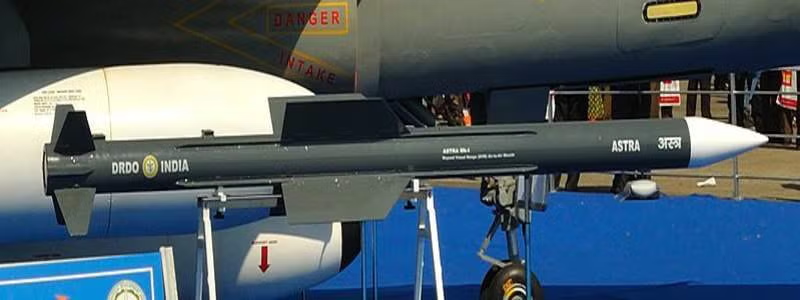
Indonesia’s procurement of Astra Mk1 beyond-visual-range air-to-air missiles significantly enhances the combat survivability of the Indonesian Air Force because the missile introduces modern active-radar-guided interception capability across Sukhoi fighter platforms previously constrained by ageing missile inventories and sustainment limitations.
Reports indicating Indonesia may acquire more than 150 Astra missiles suggest Jakarta is prioritizing sustained operational stockpiles rather than symbolic procurement, enabling prolonged air combat readiness during high-tempo regional contingencies involving maritime patrol interception or airspace denial operations near contested areas.
The Astra Mk1 reportedly employs active radar homing guidance integrated with inertial navigation and mid-course update capability, allowing Indonesian Su-27 and Su-30 fighters to engage hostile aircraft at beyond-visual-range distances while reducing exposure to adversary counter-fire during aerial engagements.
Integrating Astra missiles onto Indonesia’s Russian-origin Sukhoi platforms also demonstrates increasing defence-industrial flexibility because Jakarta is diversifying weapons integration pathways beyond traditional supplier ecosystems increasingly constrained by geopolitical sanctions pressures and evolving export-control regimes.
The missile acquisition enhances Indonesia’s layered deterrence architecture because BrahMos batteries threaten hostile naval assets while Astra-equipped fighters extend aerial denial coverage over maritime approaches, producing a more integrated cross-domain defensive posture spanning air and sea operational environments simultaneously.
Indonesia’s status as Astra’s first foreign operator additionally represents a strategic validation of India’s indigenous missile-development ecosystem, particularly for Bharat Dynamics Limited and India’s Defence Research and Development Organisation, which seek expanded export markets across Southeast Asia, Africa, and the Middle East.
The Republikorp-Bharat Dynamics memorandum further suggests Jakarta intends to develop localized sustainment and integration expertise, potentially reducing long-term operational dependency while supporting broader Indonesian ambitions to expand domestic aerospace and missile-maintenance industrial competencies over coming decades.
For Indonesia, integrating indigenous Indian missiles onto Russian-manufactured aircraft additionally reduces vulnerability associated with dependence upon singular geopolitical suppliers, particularly as sanctions regimes and global supply-chain disruptions increasingly complicate sustainment planning for mixed-origin military aviation fleets.
The Astra agreement also carries broader symbolic importance because Southeast Asian states historically relied heavily upon Western, Russian, or Chinese missile systems, whereas Indonesia’s procurement demonstrates growing regional willingness to adopt advanced Indian-developed precision-guided weapon technologies across operationally significant combat roles.
Combined with Indonesia’s modernization of maritime patrol, coastal surveillance, and naval strike assets, Astra-equipped Sukhoi fighters substantially improve Jakarta’s capacity to contest airspace surrounding outer-island territories and economically vital maritime corridors traversed daily by regional commercial and military traffic.
Sabang Port and the Malacca Strait Strategic Equation
The missile agreements gained additional geopolitical significance because they coincided with expanding discussions surrounding Sabang Port development, a strategically positioned maritime facility near the entrance to the Malacca Strait connecting the Indian Ocean with the South China Sea maritime corridor.
Sabang’s proximity to one of the world’s most economically critical sea lanes amplifies the strategic utility of Indonesia’s evolving missile posture because coastal-defence systems positioned nearby could theoretically influence maritime traffic patterns and naval operating calculations during periods of regional instability or military escalation.
The Malacca Strait handles enormous volumes of global commercial shipping and energy transport, meaning any enhancement of Indonesian coastal-denial capability near adjacent maritime approaches inevitably attracts attention from regional naval powers dependent upon uninterrupted Indo-Pacific trade and strategic sea line access.
India’s interest in expanding strategic cooperation surrounding Sabang also reflects New Delhi’s broader Indo-Pacific maritime strategy focused upon securing distributed partnerships across critical chokepoints stretching from the Arabian Sea toward Southeast Asia and the western Pacific operational theatre.
Indonesia’s missile acquisitions therefore cannot be separated from broader maritime-security calculations because BrahMos-equipped coastal batteries positioned near critical waterways create credible deterrence effects extending beyond immediate territorial defence into wider regional force-posture and sea-control considerations.
The agreements additionally strengthen maritime coordination between two major Indian Ocean states increasingly concerned about strategic competition, grey-zone maritime coercion, and naval power projection surrounding contested regional waters extending from the eastern Indian Ocean toward the South China Sea.
Indonesia continues publicly emphasizing non-alignment and strategic autonomy, yet the scale and sophistication of the BrahMos and Astra procurements demonstrate Jakarta increasingly recognizes the necessity of credible hard-power deterrence capabilities capable of supporting diplomatic balancing strategies during intensifying regional competition.
The missile deals also align with Indonesia’s broader defence modernization agenda emphasizing layered maritime surveillance, integrated coastal defence, and mobile strike capability designed to protect dispersed archipelagic territory spanning thousands of islands across strategically vital Indo-Pacific waterways and maritime approaches.
For India, expanding defence-industrial and maritime-security ties with Indonesia strengthens New Delhi’s long-term objective of building a networked Indo-Pacific partnership architecture capable of balancing regional influence without replicating rigid alliance structures associated with Cold War geopolitical blocs.
The agreements consequently reinforce a wider regional trend where middle powers increasingly pursue distributed precision-strike capabilities and diversified defence partnerships to preserve strategic autonomy amid accelerating military modernization and intensifying competition throughout the Indo-Pacific maritime battlespace.
BrahMos Technical Performance Alters Regional Naval Calculus
BrahMos remains one of the world’s fastest operational cruise missiles because its sustained supersonic velocity dramatically reduces interception timelines, forcing naval air-defence systems to engage incoming threats within compressed engagement windows frequently measured in seconds rather than minutes.
The missile’s approximately 3,000-kilogram launch weight and two-stage propulsion architecture generate substantial kinetic impact energy, allowing even conventional 200-to-300-kilogram warheads to inflict severe structural damage against hardened maritime targets, command facilities, and defended coastal infrastructure during high-speed terminal impact sequences.
BrahMos employs inertial navigation integrated with GPS, GLONASS, and India’s GAGAN augmentation systems, while active radar homing guidance supports autonomous terminal target acquisition capability within electronically contested maritime environments characterized by radar clutter, evasive manoeuvres, and electronic warfare interference.
Its capability to execute high-g terminal manoeuvres and steep-dive attack profiles further complicates interception because defending naval vessels must simultaneously track high-speed low-altitude targets capable of sudden directional changes during the final engagement phase before impact.
The missile’s distributed launch flexibility across land-based launchers, surface combatants, submarines, and aircraft substantially enhances operational unpredictability because adversaries cannot easily isolate or neutralize a singular deployment platform during escalating regional maritime contingencies or precision-strike operations.
Indonesia’s export-configured missiles remain capped at 290 kilometres under MTCR compliance restrictions, yet even this reduced range provides strategically meaningful coverage when combined with Indonesia’s dispersed archipelagic geography and ability to position mobile launchers along multiple maritime approach corridors simultaneously.
The logistics footprint associated with BrahMos operations nevertheless remains substantial because liquid-fuel ramjet sustainment, transporter support, reload procedures, radar integration, and secure communications infrastructure require robust maintenance ecosystems and trained technical personnel capable of supporting sustained operational readiness.
Indonesia’s willingness to absorb those logistical demands indicates Jakarta prioritizes operational deterrence value over lower-cost alternatives, particularly because BrahMos provides significantly shorter time-to-target profiles compared with slower subsonic anti-ship missile systems commonly available across export markets.
Future BrahMos developments including the lighter BrahMos-NG and extended-range variants may further expand operational flexibility across Southeast Asia, particularly if regional states increasingly prioritize mobile distributed precision-strike systems suitable for contested maritime and littoral operating environments.
The Indonesian acquisition therefore signals more than a conventional arms transaction because it demonstrates how advanced supersonic precision-strike capability is increasingly becoming central to Indo-Pacific maritime deterrence doctrine, force-posture modernization, and regional anti-access operational planning across strategically contested sea lanes.
