
Indonesia to Arm Sukhoi Fleet With 150+ India-Made Astra Mk1 Missiles in Major Indo-Pacific Airpower Shift
Indonesia’s acquisition of more than 150 Astra Mk1 beyond-visual-range air-to-air missiles for its Sukhoi Su-27 and Su-30 fighters marks a major Indo-Pacific airpower realignment while accelerating India’s emergence as a global missile export power.

(DEFENCE SECURITY) — Indonesia’s reported decision to procure more than 150 Indian-made Astra Mk1 beyond-visual-range air-to-air missiles for its Sukhoi Su-27 and Su-30 fighter fleet represents a strategic inflection point because Southeast Asia is now validating India’s indigenous aerospace industry through operationally relevant combat systems rather than symbolic defence diplomacy alone.
The emerging agreement, advanced during Indian Prime Minister Narendra Modi’s July 6–8 visit to Jakarta, positions Indonesia as the first foreign operator of the Astra missile family, transforming India from a regional weapons consumer into an increasingly credible exporter of advanced air combat technologies.
The reported procurement also alters the Indo-Pacific airpower equation because Indonesia is integrating a combat-proven missile architecture onto Russian-origin Flanker aircraft while simultaneously reducing long-term dependence on disrupted Russian military supply chains and politically constrained Western procurement frameworks.
Indonesian President Prabowo Subianto’s expanding defence engagement with India demonstrates Jakarta’s growing preference for strategically flexible middle-power partnerships capable of supplying high-end military technologies without imposing restrictive geopolitical alignment conditions or operational sovereignty limitations.
The Astra Mk1 acquisition emerged shortly after the missile’s reported operational employment by Indian Air Force Su-30MKI fighters during Operation Sindoor in May 2025, an episode that significantly elevated the missile’s export credibility across Asian air forces evaluating modern BVR combat effectiveness.
Regional defence planners are closely monitoring the agreement because Astra’s integration into Indonesia’s Sukhoi fleet could establish a replicable pathway for other Russian-origin fighter operators seeking affordable non-Russian missile modernisation options amid sanctions pressure and global defence-industrial fragmentation.
The missile procurement is unfolding alongside Indonesia’s ongoing BrahMos cruise missile expansion discussions with India, indicating that Jakarta’s military modernisation strategy increasingly prioritises layered deterrence capabilities spanning maritime strike operations, distributed coastal defence, and long-range air combat dominance.
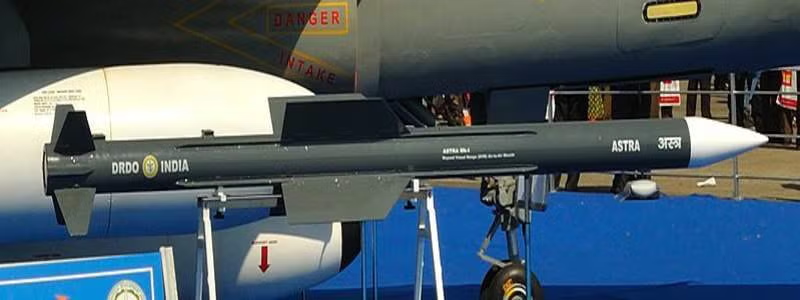
Astra Mk1, developed by India’s Defence Research and Development Organisation and manufactured by Bharat Dynamics Limited, is designed as an all-weather active radar-homing BVRAAM capable of engaging hostile aircraft beyond visual range under dense electronic warfare conditions.
The missile reportedly achieves speeds approaching Mach 4.5 while employing inertial mid-course guidance combined with terminal active radar homing and electronic counter-countermeasure systems intended to improve survivability against contested electromagnetic battlespace environments.
With an estimated unit cost between USD840,000 and USD960,000 per missile, equivalent to approximately RM3.19 million to RM3.65 million, Astra offers Indonesia a comparatively cost-effective force-multiplication capability for modernising legacy Russian-origin combat aviation infrastructure.
India’s broader defence-export ambitions also gain substantial momentum because the Astra deal provides combat-market validation for the country’s “Atmanirbhar Bharat” self-reliance initiative, particularly within the strategically sensitive aerospace and precision-guided munitions sector.
Although precise contract values and delivery schedules remain undisclosed, the proposed acquisition potentially exceeds USD126 million or approximately RM478.8 million, depending upon final missile quantities, integration packages, logistics support frameworks, and future Astra Mk2 expansion options.
Astra Mk1 Gives Indonesia a New Beyond-Visual-Range Air Combat Architecture
Indonesia’s planned Astra Mk1 procurement significantly strengthens the Indonesian Air Force’s beyond-visual-range combat capability because the missile introduces a modern active radar-guided engagement architecture optimised for high-threat electromagnetic and contested-airspace operations.
The Indonesian Air Force currently operates Russian-origin Sukhoi Su-27SK and Su-30MK2 fighters, platforms historically dependent upon older R-77 missile inventories that increasingly face sustainment uncertainty due to geopolitical sanctions, supply delays, and shrinking Russian export bandwidth.
Astra integration therefore provides Jakarta with an alternative missile ecosystem capable of extending the operational relevance of Indonesia’s Flanker fleet without requiring immediate acquisition of entirely new fighter aircraft or extensive structural airframe modifications.
The missile reportedly possesses a standard engagement range exceeding 110 kilometres during head-on engagements, while post-Operation Sindoor performance assessments indicate potential engagement envelopes approaching 160 kilometres under favourable launch conditions and elevated-altitude firing profiles.
Such range expansion materially complicates adversary air operations because Indonesian fighters equipped with Astra missiles could establish larger denial bubbles across strategically sensitive maritime corridors surrounding the Natuna Islands and southern South China Sea approaches.
The Astra system’s active radar seeker also reduces pilot workload during terminal engagements because the missile can independently prosecute targets after launch, thereby enabling Indonesian pilots to manoeuvre defensively within heavily contested air combat environments.
Equally significant is Astra’s electronic counter-countermeasure capability because modern Indo-Pacific air combat increasingly depends upon electromagnetic spectrum dominance rather than purely aerodynamic fighter performance or numerical force concentration.
India’s willingness to support integration onto Indonesian Sukhoi platforms additionally signals growing technical confidence within India’s aerospace ecosystem because successful integration requires extensive software harmonisation, avionics compatibility testing, and weapons-release certification under operational conditions.
Jakarta’s procurement decision may also influence neighbouring Southeast Asian militaries operating mixed-origin fighter fleets because Astra demonstrates how indigenous Asian defence-industrial products can increasingly compete against traditional Russian, Chinese, and Western missile ecosystems.
The broader strategic implication is that Indonesia is transitioning toward a more distributed and politically diversified combat aviation supply structure designed to preserve operational autonomy amid intensifying great-power competition throughout the Indo-Pacific security architecture.

Operation Sindoor Elevated Astra From Indigenous Programme to Export Weapon
Astra’s reported operational use during Operation Sindoor fundamentally transformed international perceptions of the missile because combat employment provides exponentially greater export credibility than controlled demonstrations, laboratory trials, or peacetime firing exercises conducted under ideal conditions.
Indian Air Force Su-30MKI fighters reportedly employed Astra missiles during aerial engagements connected to the May 2025 India-Pakistan confrontation, a development that rapidly amplified foreign military interest in India’s indigenous air-to-air missile technology portfolio.
For Indonesia, the reported combat performance likely reduced procurement risk because operational validation against real-world threats provides stronger confidence regarding seeker reliability, engagement effectiveness, and survivability under electronic warfare conditions than manufacturer performance claims alone.
The conflict also demonstrated India’s growing ability to operationalise domestically produced precision-guided weapons within complex high-intensity airpower environments involving modern electronic warfare systems and rapidly evolving aerial threat dynamics.
Regional military planners increasingly evaluate weapons through combat survivability metrics rather than brochure specifications because Ukraine, the Red Sea, and South Asian conflicts collectively exposed substantial disparities between advertised capabilities and battlefield effectiveness.
Astra’s combat exposure therefore carries strategic branding implications for India because successful operational employment strengthens New Delhi’s argument that indigenous defence systems can compete credibly within the global precision-strike and aerospace weapons marketplace.
Indonesia’s decision to reportedly move forward soon after Operation Sindoor indicates that Southeast Asian procurement authorities are increasingly responsive to demonstrated combat outcomes when evaluating modern missile ecosystems and future air combat investment priorities.
The procurement also aligns with Indonesia’s broader military modernisation doctrine because Jakarta seeks scalable combat capabilities capable of imposing operational costs upon stronger adversaries while avoiding financially unsustainable procurement dependencies or excessive external political leverage.
India benefits strategically because every successful Astra export reinforces the country’s long-term ambition to become a net security provider and defence-industrial stakeholder within the Indo-Pacific rather than remaining primarily a regional military balancing power.
If Astra performs effectively within Indonesian service, the missile could become a flagship export product for India’s aerospace sector, particularly among nations operating Russian-origin combat aircraft but seeking politically diversified weapons integration pathways.
India and Indonesia Are Building an Indo-Pacific Deterrence Partnership
The Astra agreement forms part of a broader India-Indonesia strategic convergence because both countries increasingly perceive maritime security, force modernisation, and supply-chain resilience as interconnected components of long-term Indo-Pacific deterrence architecture.
Jakarta and New Delhi are simultaneously expanding cooperation surrounding the Strait of Malacca, one of the world’s most strategically consequential maritime chokepoints through which enormous volumes of global energy shipments and commercial trade transits annually.
Indonesia’s parallel expansion of its BrahMos supersonic cruise missile inventory further illustrates how the country is constructing layered deterrence capabilities designed to complicate hostile naval and aerial operations across critical maritime approaches and archipelagic defence corridors.
The evolving defence partnership also reflects mutual concern regarding strategic instability in the South China Sea because both governments seek stronger autonomous capabilities capable of preserving regional strategic balance without direct alignment under formal military blocs.
India’s defence exports to Indonesia therefore carry significance extending beyond commercial revenue because they deepen interoperability, defence-industrial coordination, and long-term operational familiarity between two strategically influential Indo-Pacific middle powers.
Modi’s receipt of Indonesia’s highest civilian honour, the Bintang Adipurna, further underscored the political symbolism accompanying the defence agreements, particularly as both governments attempt to institutionalise deeper strategic trust across economic, maritime, and military domains.
The relationship additionally strengthens India’s Act East strategy because Southeast Asia increasingly represents a critical geopolitical arena where defence exports, infrastructure diplomacy, and maritime security cooperation collectively shape regional influence competition.
Indonesia benefits because diversified procurement relationships reduce vulnerability to geopolitical coercion, sanctions exposure, and defence-industrial bottlenecks that could otherwise constrain combat readiness during future regional crises or supply-chain disruptions.
The Astra agreement also signals growing acceptance of Indian military technology across Southeast Asia because regional governments increasingly view India as a pragmatic defence partner capable of balancing affordability, operational capability, and political flexibility.
This evolving partnership ultimately reinforces a broader Indo-Pacific trend in which regional middle powers are constructing overlapping security relationships designed to maximise strategic autonomy while mitigating dependence upon any single external military supplier or geopolitical patron.
Astra Mk2 Could Expand Indonesia’s Long-Range Air Denial Capability
Indonesian interest in the longer-range Astra Mk2 variant indicates Jakarta may already be planning a second phase of air combat modernisation focused upon extending aerial denial ranges far beyond current regional engagement envelopes.
Astra Mk2 reportedly targets engagement ranges approaching 240 kilometres, a capability that would significantly expand Indonesia’s ability to threaten hostile airborne assets before adversary aircraft approach sensitive maritime zones or critical national infrastructure corridors.
Such extended-range capabilities are strategically consequential because modern Indo-Pacific air warfare increasingly prioritises first-shot engagement opportunities supported by networked sensors, airborne early-warning aircraft, and distributed battlespace management architectures.
If integrated successfully onto Indonesia’s Sukhoi fleet, Astra Mk2 could materially strengthen Indonesian air denial posture around the Natuna Islands, where repeated Chinese maritime activities continue generating regional security friction and operational surveillance competition.
Long-range BVRAAM capability also improves force survivability because fighters equipped with extended-range missiles can engage targets earlier while remaining outside portions of hostile missile engagement envelopes or integrated air-defence coverage areas.
For India, potential Astra Mk2 exports would demonstrate substantial maturation of indigenous missile engineering capabilities because only a limited number of countries currently produce advanced long-range active radar-guided air-to-air missile systems domestically.
The export pathway could additionally accelerate India’s broader aerospace-industrial scaling ambitions because foreign orders improve production efficiency, manufacturing continuity, and research funding sustainability for future missile and combat aviation development programmes.
Regional competitors will likely monitor Astra Mk2 developments carefully because proliferation of long-range BVRAAM capability among Southeast Asian air forces could gradually alter regional aerial engagement doctrines and air superiority calculations.
Questions nevertheless remain regarding final integration timelines, seeker performance under complex electronic warfare conditions, and compatibility across different Indonesian Sukhoi variants because those technical variables significantly influence operational effectiveness.
Even so, Indonesia’s reported interest in Astra Mk2 confirms that India’s missile ecosystem is evolving beyond symbolic indigenous achievement into a potentially influential component of future Indo-Pacific airpower competition and strategic deterrence planning.
Southeast Asia’s Air Combat Market Is Entering a Post-Russian Transition Phase
Indonesia’s Astra Mk1 acquisition highlights a deeper structural transformation within Southeast Asia’s defence market because regional air forces operating Russian-origin combat aircraft increasingly require alternative missile ecosystems capable of bypassing sanctions pressure, supply instability, and long-term maintenance uncertainty.
The war in Ukraine significantly disrupted Russia’s global defence export credibility because prolonged battlefield attrition, industrial bottlenecks, and expanding Western sanctions collectively reduced Moscow’s ability to guarantee predictable delivery schedules, spare parts continuity, and future weapons integration support.
For Indonesia, sustaining operational readiness across its Sukhoi fleet increasingly depends upon diversifying munition supply chains because dependence upon ageing Russian missile inventories could progressively weaken combat availability during periods of heightened regional contingency or geopolitical escalation.
India is strategically positioned to exploit this transition because New Delhi possesses extensive operational experience integrating indigenous systems onto Russian-origin platforms, particularly through the Indian Air Force’s long-running Su-30MKI modernisation and weapons integration programmes.
That operational experience gives India a comparative advantage within export markets where countries seek modern precision-guided weapons compatible with legacy Soviet and Russian combat aircraft without undertaking prohibitively expensive fleet replacement programmes.
The Astra programme therefore represents more than a missile export because it demonstrates the emergence of an alternative Asian defence-industrial ecosystem capable of supplying advanced aerospace weapons outside traditional Western, Russian, or Chinese procurement frameworks.
Southeast Asian states are particularly sensitive to procurement flexibility because regional governments increasingly prefer diversified military partnerships designed to maximise strategic autonomy while minimising vulnerability to external political pressure or export-control restrictions.
Indonesia’s reported procurement could consequently influence future procurement calculations in countries operating mixed Russian-origin fleets, especially air forces evaluating affordable beyond-visual-range missile upgrades amid accelerating Indo-Pacific military modernisation competition.
The strategic consequence extends beyond Southeast Asia because successful Astra exports may encourage additional middle-power defence industries to pursue indigenous missile development programmes targeting cost-effective interoperability across globally dispersed Soviet and Russian aviation platforms.
If India successfully delivers, integrates, and operationally supports the Astra system within Indonesian service, New Delhi could establish itself as a long-term aerospace weapons supplier capable of reshaping portions of the Indo-Pacific precision-guided munitions market.
