
India and Thailand Escalate Indo-Pacific Airpower Cooperation as Su-30MKI and Gripen Fighters Conduct High-Intensity Joint Exercise Near the Strait of Malacca
The first international air exercise of the Indian Air Force in 2026 brings Su-30MKI and Gripen fighter jets together near the Strait of Malacca, underscoring a decisive escalation in Indo-Thai defence cooperation, maritime security integration, and Indo-Pacific airpower deterrence.

(DEFENCE SECURITY ASIA) — The joint air exercise conducted by the Indian Air Force and the Royal Thai Air Force near the strategically critical Strait of Malacca represents a deliberate and calculated escalation in Indo-Thai defence cooperation, with the deployment of India’s Su-30MKI and Thailand’s Saab JAS 39 Gripen signalling a convergence of operational doctrine, maritime security priorities, and regional deterrence posture amid intensifying Indo-Pacific power competition.
According to Indian media, “A total of 4–6 Su-30MKI fighters and a similar number of Gripens are scheduled to participate in the exercise,” a force package that reflects not symbolic engagement but a tactically meaningful configuration designed to test dissimilar air combat tactics, beyond-visual-range engagement protocols, and joint mission planning under realistic maritime-operational conditions.
As the first international air exercise undertaken by the Indian Air Force in 2026, the February 9 drill underscores New Delhi’s intent to translate its Act East policy into concrete, high-end military integration with Southeast Asian partners rather than remaining confined to diplomatic signalling or naval-only cooperation frameworks.
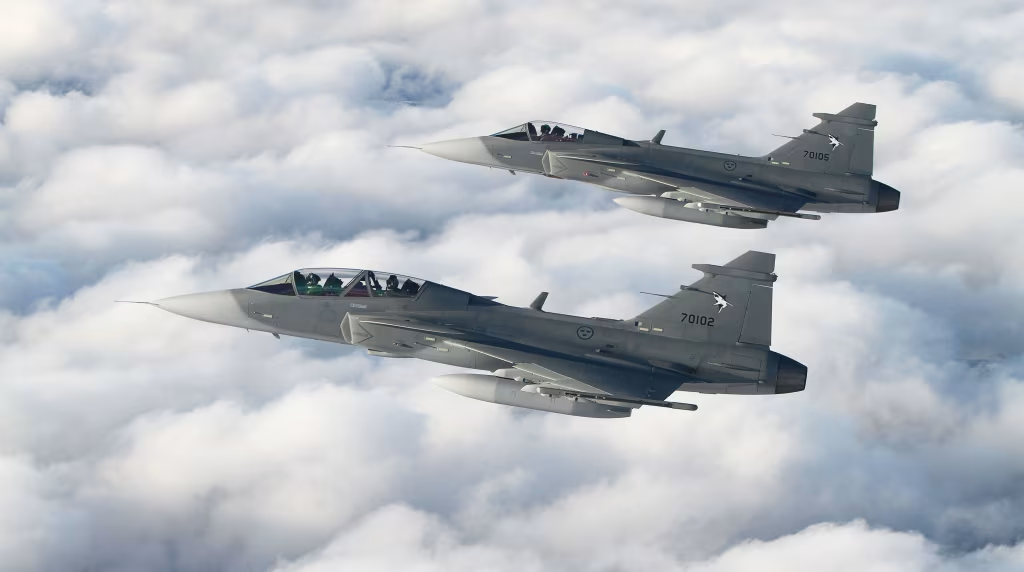
The exercise’s geographic focus near the Andaman and Nicobar Islands and the northern approaches of the Malacca Strait places it directly astride one of the world’s most vital sea lines of communication, through which more than 100,000 commercial vessels transit annually, carrying an estimated 80 percent of China’s imported energy supplies.
Within this context, the exercise is widely viewed by regional defence analysts as an implicit stabilising counterweight to increasingly assertive military postures in the South China Sea, reinforcing ASEAN-centric security architectures while avoiding overt bloc-based alignments that could destabilise regional diplomatic equilibrium.
Indian officials have consistently framed such engagements as defensive, cooperative, and stability-oriented, yet the operational profile of the Su-30MKI—particularly its long-range maritime strike capability and compatibility with supersonic cruise missiles—adds an unmistakable deterrent dimension to the exercise’s strategic messaging.
For Thailand, participation reflects a calibrated diversification of defence partnerships beyond traditional reliance on the United States, leveraging advanced European-origin platforms such as the Gripen to enhance interoperability with multiple major regional air forces without becoming strategically overcommitted to any single power bloc.
Taken together, the exercise represents not merely a bilateral training event but a strategic rehearsal for coalition air operations in contested maritime environments, with implications extending across ASEAN-India relations, Indo-Pacific deterrence stability, and the evolving role of airpower in safeguarding global maritime chokepoints.
Su-30MKI: India’s Long-Range Aerial Backbone and Maritime Strike Enabler
The Sukhoi Su-30MKI stands as the Indian Air Force’s principal instrument for asserting air dominance and maritime reach across the Indian Ocean Region, combining Russian-origin airframe robustness with extensive Indian, Israeli, and Western avionics integration that has transformed it into one of the most capable fourth-generation-plus fighters currently in operational service.
Developed by Sukhoi and manufactured under licence by Hindustan Aeronautics Limited, the Su-30MKI was inducted into Indian service in 2002 and has since expanded into a fleet exceeding 260 aircraft, forming the numerical and operational backbone of India’s combat aviation capability across both continental and maritime theatres.
The aircraft’s distinctive canard-delta configuration and thrust-vectoring AL-31FP engines provide exceptional supermanoeuvrability, enabling advanced post-stall combat manoeuvres that significantly complicate adversary targeting solutions during close-in engagements while enhancing survivability in high-threat airspace.
Equipped with the N011M Bars phased-array radar capable of detecting aerial targets at ranges approaching 400 kilometres under optimal conditions, the Su-30MKI offers substantial beyond-visual-range engagement advantages, particularly when paired with long-range air-to-air missiles and networked battlespace awareness.
Its combat radius exceeding 1,500 kilometres, extendable through aerial refuelling, allows sustained operations deep into maritime domains such as the Malacca Strait, a capability directly relevant to the February 2026 exercise and critical for persistent sea line protection and maritime interdiction roles.
The platform’s integration with the BrahMos supersonic cruise missile fundamentally elevates its maritime strike profile, providing India with the ability to conduct precision standoff attacks against high-value surface targets at speeds exceeding Mach 2.8, significantly compressing adversary reaction timelines.
“The Su-30MKI is a game-changer for India’s strategic reach,” a senior Indian Air Force official stated in recent briefings, encapsulating the aircraft’s role not merely as a tactical fighter but as a strategic instrument of regional deterrence and power projection.
Ongoing upgrades under the Super Sukhoi programme, including the planned integration of indigenous Uttam AESA radars, advanced electronic warfare suites, and next-generation weapons, are intended to keep the Su-30MKI operationally relevant well into the 2040s, effectively bridging India’s transition toward fifth-generation air combat capabilities.

Gripen in Southeast Asia: Thailand’s Network-Centric Airpower Multiplier
The Saab JAS 39 Gripen represents the Royal Thai Air Force’s strategic shift toward network-centric, cost-effective, and highly survivable airpower, offering a lightweight yet technologically advanced multirole fighter optimised for rapid deployment, coalition interoperability, and sustained operations in Southeast Asia’s complex operational environment.
Thailand acquired 12 Gripen C/D variants between 2008 and 2013 to replace ageing F-5 fighters, marking a decisive move toward modern sensor fusion, data-linked combat operations, and reduced lifecycle costs at a time of constrained defence budgets and evolving threat perceptions.
The Gripen’s delta-wing design, relaxed static stability, and fully digital fly-by-wire flight control system provide exceptional agility, allowing it to perform both air superiority and precision strike missions despite its relatively modest size and single-engine configuration.
Powered by the Volvo RM12 engine, the Gripen achieves a top speed of approximately Mach 2 and a combat radius of around 800 kilometres, enabling effective air defence and maritime patrol operations within Thailand’s strategic envelope while remaining capable of forward deployment during coalition exercises.
Its PS-05/A radar, coupled with advanced electronic warfare systems and compatibility with Meteor beyond-visual-range air-to-air missiles, provides the Gripen with formidable engagement capability against larger adversary platforms when supported by networked situational awareness.
Operationally, the Gripen’s efficiency is underscored by its low cost per flight hour, estimated at approximately USD 4,700, which equates to roughly MYR 22,000 at current exchange rates, allowing Thailand to maintain high sortie generation rates without disproportionate fiscal strain.
“The Gripen provides us with flexibility in a dynamic security environment,” an RTAF spokesperson stated during procurement announcements, highlighting the platform’s ability to adapt across mission sets while integrating seamlessly with allied air forces.
Thailand’s experience operating Gripens in multinational exercises such as Cobra Gold and Pitch Black has honed its ability to function within coalition frameworks, making the aircraft particularly well-suited for dissimilar air combat training alongside heavier platforms like the Su-30MKI in the Malacca Strait exercise.
From Diplomacy to Deterrence: The Evolution of Indo-Thai Defence Cooperation
India–Thailand defence relations are rooted in decades of diplomatic engagement and cultural exchange, yet their transformation into a strategically consequential military partnership has accelerated markedly since the early 2000s amid shifting regional security dynamics and shared maritime concerns.
The 2001 Memorandum of Understanding on Defence Cooperation established the institutional framework for joint exercises, training exchanges, and intelligence sharing, laying the groundwork for deeper operational collaboration across all three military services.
A critical milestone was achieved in 2005 with the initiation of the Indo-Thai Coordinated Patrols in the Andaman Sea, reflecting early recognition of shared vulnerabilities related to piracy, smuggling, and non-traditional maritime threats in the eastern Indian Ocean.
The elevation of bilateral ties to a Strategic Partnership in 2012 further entrenched defence cooperation as a core pillar of the relationship, aligning military engagement with broader economic and diplomatic initiatives under both countries’ regional integration strategies.
Subsequent exercises such as MAITREE for ground forces and SIAM BHARAT for naval units institutionalised habitual cooperation, while air force interactions gradually expanded through staff talks, tabletop exercises, and observer participation in multinational drills.
India’s Act East policy and Thailand’s emphasis on ASEAN centrality converged in this period, producing a shared commitment to a free, open, and inclusive Indo-Pacific that resists coercive dominance while avoiding overt militarisation.
“Our defense collaboration is pivotal for regional stability,” Indian External Affairs Minister S. Jaishankar remarked during bilateral engagements in 2022, capturing the strategic logic underpinning deeper military integration between the two nations.
The February 2026 Su-30MKI–Gripen exercise represents the most operationally advanced manifestation of this trajectory to date, translating long-standing diplomatic alignment into tangible airpower cooperation over one of the world’s most strategically sensitive maritime corridors.

Inside the Malacca Exercise: Planning, Execution, and Operational Focus
Preparations for the joint air exercise gained momentum following high-level discussions during the 2025 India–Thailand Joint Working Group on Security Cooperation, where both sides identified airpower integration as a priority domain for enhancing maritime security collaboration.
The exercise, conducted on February 9, 2026, involved Indian Su-30MKI fighters operating from Andaman and Nicobar air bases and Royal Thai Air Force Gripens deploying from Thai facilities, converging over the northern approaches of the Malacca Strait.
According to defence briefings, “The exercise will test combat interoperability, long-range missions, and aerial refuelling,” indicating a focus on realistic operational scenarios rather than symbolic fly-pasts or basic formation flying.
Force packages reportedly consisted of four to six fighters from each air force, enabling a range of tactical configurations including beyond-visual-range engagements, simulated maritime strike coordination, and joint mission planning under contested electromagnetic conditions.
The selection of the North Malacca Strait reflects its strategic significance as a maritime chokepoint linking the Indian Ocean and the South China Sea, through which a substantial proportion of global trade and energy flows transit daily.
No live weapons firing was reported, underscoring the exercise’s emphasis on tactical learning, debrief-driven capability refinement, and the exchange of operational best practices rather than kinetic demonstration.
The exercise marked the first direct fighter-level interaction between the two air forces, building on virtual engagements conducted during the COVID-19 period and signalling a return to high-tempo, in-person military cooperation.
Analysts noted that the juxtaposition of a heavyweight, long-range platform like the Su-30MKI with the agile, network-centric Gripen created an ideal environment for dissimilar air combat training, exposing both sides to contrasting doctrines, strengths, and vulnerabilities.
Indo-Pacific Implications: Airpower, Deterrence, and Strategic Signalling
Beyond its bilateral dimensions, the Su-30MKI–Gripen exercise contributes to the broader Indo-Pacific security architecture by reinforcing a multipolar balance in which regional middle powers actively shape stability rather than remaining passive observers of great power rivalry.
For India, the exercise extends operational influence into Southeast Asia, complementing naval engagements such as Milan and reinforcing New Delhi’s role as a net security provider in the eastern Indian Ocean and adjacent maritime domains.
Thailand, positioned at the intersection of US–China strategic competition, benefits from diversified defence engagement that enhances its operational flexibility while preserving diplomatic autonomy and avoiding overdependence on any single external patron.
The Malacca Strait’s susceptibility to disruption, whether through piracy, state-level coercion, or crisis-driven traffic congestion, makes joint air surveillance and response capabilities increasingly vital to regional and global economic stability.
“Enhancing interoperability here sends a message of collective security,” a Singapore-based think tank observed, highlighting the exercise’s deterrent signalling value without resorting to overt military posturing.
The pairing of Su-30MKI endurance and payload capacity with Gripen sensor fusion and rapid response capability illustrates a complementary operational model well-suited to coalition air policing and maritime security missions.
Looking ahead, successful execution could pave the way for expanded formats involving other ASEAN air forces, potentially evolving into multilateral air patrol frameworks that mirror existing naval coordination mechanisms.
In strategic terms, the exercise underscores the growing centrality of airpower in Indo-Pacific deterrence calculus, where control of the skies increasingly determines the security of sea lanes, trade flows, and regional stability. — DEFENCE SECURITY ASIA
