
India Proposes Su-30MKM Mid-Life Upgrade for Malaysia, Astra Mk-1 Integration Signals Strategic Shift in Regional Air Power
India’s proposed Su-30MKM mid-life upgrade for the Royal Malaysian Air Force—anchored by Astra Mk-1 BVR missile integration—underscores a broader geopolitical, industrial, and airpower recalibration in Southeast Asia amid sanctions pressure and Indo-Pacific strategic competition.

(DEFENCE SECURITY ASIA) — India has reportedly proposed a comprehensive mid-life upgrade for the Royal Malaysian Air Force’s Su-30MKM fleet, positioning the initiative as a strategic undertaking that extends well beyond routine platform sustainment and aircraft life-extension objectives.
The proposal carries far-reaching geopolitical, industrial, and operational implications for Malaysia’s airpower posture, particularly as the Indo-Pacific security environment becomes increasingly contested by supply-chain fragmentation, sanctions-driven sustainment risks, and intensifying great-power rivalry.
According to Indian media, India’s Secretary (East) at the Ministry of External Affairs, P. Kumaran, explicitly confirmed that New Delhi has “offered proposals for modification, upgradation and mid-life maintenance [of the Su-30MKM],” while emphasising that India is “also looking at potential for supply of naval platforms by Indian shipyards,” signalling an integrated defence-industrial approach that extends beyond aviation into maritime security cooperation.

Crucially, defence officials have indicated that the proposal encompasses “integration of Indian avionics and weapon systems such as the Astra Mk-1 beyond-visual-range air-to-air missile, along with options for future stand-off weapons integration, subject to mutual requirements and technical feasibility,” a statement that places indigenous Indian weapons at the centre of Malaysia’s future air combat architecture.
Unveiled in the strategic run-up to Prime Minister Narendra Modi’s official visit to Malaysia beginning yesterday, the offer is deliberately framed within the Comprehensive Strategic Partnership, underscoring India’s ambition to reposition itself as a dependable defence partner capable of sustaining complex Russian-origin platforms amid ongoing geopolitical disruptions affecting legacy suppliers.
From Malaysia’s perspective, the proposal arrives at a critical juncture where sustaining only 18 Su-30MKM aircraft, acquired under a US$900 million procurement contract (approximately RM4.2 billion), demands cost-effective life-extension solutions that avoid the financial burden of wholesale fleet replacement while preserving credible deterrence across maritime and air-defence domains.
The Su-30MKM remains the Royal Malaysian Air Force’s most potent multi-role fighter platform, underpinning long-range maritime strike, air superiority, and command-and-control functions, yet its hybrid avionics architecture and dependence on Russian sustainment pipelines increasingly expose Malaysia to operational risk under current international sanctions regimes.
India’s deep operational experience sustaining more than 260 Su-30MKI fighters, combined with its progressively indigenised upgrade ecosystem, positions New Delhi uniquely to address Malaysia’s sustainment dilemma while simultaneously advancing its own defence-export ambitions under the “Make in India” framework targeting US$5 billion (approximately RM23.5 billion) in annual defence exports.
Viewed holistically, this proposed mid-life upgrade is not merely a technical enhancement programme but a strategic recalibration that could redefine Malaysia’s air-combat autonomy, diversify its weapons supply chain, and anchor India more firmly within Southeast Asia’s evolving defence-industrial and security architecture.
The Su-30MKM Fleet as the Backbone of Malaysia’s Air-Combat Deterrence
The Royal Malaysian Air Force’s Su-30MKM fleet, procured in 2003 and operational since 2007, constitutes the doctrinal backbone of Malaysia’s high-end air-combat capability, combining long-range reach, heavy payload capacity, and advanced manoeuvrability to safeguard national airspace and maritime approaches across the South China Sea and strategic sea lines of communication.
Manufactured by Irkut Corporation, the Su-30MKM was uniquely customised for Malaysia with a complex fusion of Russian airframes, French and South African avionics, and locally integrated mission systems, creating a highly capable but logistically intricate platform that demands specialised sustainment expertise beyond conventional Russian support channels.
Powered by thrust-vectoring AL-31FP engines and augmented by canard foreplanes, the aircraft delivers exceptional super-manoeuvrability, enabling it to dominate within-visual-range engagements while retaining the endurance and sensor reach necessary for extended maritime patrol and air-defence missions spanning more than 1,500 kilometres of combat radius.
The aircraft’s N011M Bars PESA radar, while formidable at the time of induction, now confronts obsolescence pressures as regional air forces transition toward active electronically scanned array systems capable of superior target discrimination, electronic protection, and simultaneous multi-target engagement under contested electromagnetic conditions.
Operationally based at Gong Kedak Air Base under No. 11 Squadron, the Su-30MKM has repeatedly demonstrated its interoperability during multinational exercises such as Cope Taufan and Bersama Lima, reinforcing Malaysia’s integration within Five Power Defence Arrangement frameworks and broader coalition air operations.
However, as the fleet approaches its mid-life threshold of approximately 20 years, escalating challenges—including avionics ageing, structural fatigue, engine overhaul cycles, and restricted access to Russian spares—have amplified the urgency for a comprehensive upgrade pathway that ensures operational relevance beyond the 2030s.
The limited fleet size magnifies these challenges, as even marginal availability shortfalls can disproportionately degrade Malaysia’s air-defence readiness, making life-extension and capability enhancement not merely desirable but strategically imperative for sustaining credible deterrence.
India’s proposal directly addresses this vulnerability by offering a structured, phased modernisation approach that leverages commonality with the Su-30MKI, thereby reducing technical risk while preserving the MKM’s core operational strengths within Malaysia’s force structure.
India’s Mid-Life Upgrade Proposal and the Economics of Sustainment
India’s proposed mid-life upgrade package for the Su-30MKM draws heavily from the Indian Air Force’s “Super Sukhoi” modernisation programme, a multi-year effort valued at approximately INR 65,000 crore (around US$7.8 billion or RM36.7 billion), reflecting deep institutional knowledge in extending the combat relevance of the Sukhoi platform.
At its core, the package prioritises avionics modernisation through the replacement of ageing mission computers, cockpit displays, and electronic warfare systems with indigenous Indian alternatives designed to counter modern threat environments dominated by network-centric warfare and advanced electronic attack capabilities.
Radar enhancement options include the potential integration of India’s Virupaksha AESA radar or hybrid configurations interoperable with the existing Bars architecture, offering improved detection range, electronic counter-countermeasures, and multi-target tracking essential for contemporary beyond-visual-range combat.
Engine sustainment constitutes another critical pillar, with Hindustan Aeronautics Limited having indigenised substantial portions of the AL-31FP engine overhaul process, including hot-section components, thereby mitigating dependence on Russian supply chains increasingly constrained by sanctions and geopolitical volatility.
Structural life-extension measures, encompassing fatigue assessment, reinforcement, and certification, are designed to enable higher payload profiles and sustained high-g manoeuvres, effectively extending the airframe’s operational lifespan well beyond 2040 without compromising safety margins.
India has also proposed enhancements to sensors and survivability systems, including upgraded infrared search-and-track units, helmet-mounted displays, and modernised jamming pods capable of countering stealth-enabled and anti-access threats prevalent in the Indo-Pacific battlespace.
Financially, the upgrade is estimated at US$50–70 million per aircraft (approximately RM235–RM329 million), positioning it competitively against Western or Russian alternatives while offering greater strategic autonomy through diversified supply chains and technology transfer opportunities.
The phased implementation model, spanning certification, testing, and fleet-wide induction over approximately five years, is structured to minimise operational downtime while enabling Malaysia to progressively absorb new capabilities into its air-combat doctrine.
Astra Mk-1 Integration and the Transformation of Air-Combat Dynamics
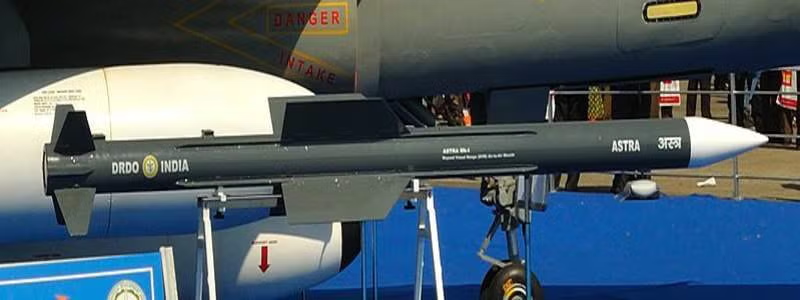
The proposed integration of the Astra Mk-1 beyond-visual-range air-to-air missile represents a transformative leap in the Su-30MKM’s air-combat lethality, aligning Malaysia’s fighter force with contemporary engagement doctrines that prioritise extended reach, high agility, and networked targeting in contested airspace.
Developed by India’s Defence Research and Development Organisation, the Astra Mk-1 weighs 154 kilograms, measures 3.84 metres in length, and employs a dual-stage guidance architecture combining inertial navigation with mid-course data-link updates before transitioning to active radar homing in the terminal phase.
With a demonstrated engagement envelope exceeding 110 kilometres, upgradable toward 160 kilometres, and terminal manoeuvrability rated at 40 g, the missile offers the Su-30MKM a decisive advantage against agile adversaries while maintaining reduced detectability through its smokeless solid-fuel propulsion system.
Compatibility with Russian AKU-58 launch pylons significantly reduces integration complexity, enabling seamless adaptation onto the Su-30MKM’s existing hardpoints without extensive structural modification or aerodynamic penalty.
Operationally fielded on India’s Su-30MKI and Tejas fighters, the Astra Mk-1 has demonstrated high reliability across live-fire trials, reinforcing confidence in its readiness as a frontline weapon rather than an experimental capability.
For Malaysia, the missile’s induction would diversify its air-to-air weapons inventory beyond the R-77, mitigating exposure to sanctions-related sustainment risks while enhancing interoperability with Indian air forces during bilateral and multilateral exercises.
Technically, integration would require software harmonisation between the missile, radar, and fire-control systems, a process India has already validated on similar Sukhoi configurations, thereby compressing development timelines and reducing certification risk.
Strategically, the Astra Mk-1 positions the Su-30MKM to contest advanced regional air threats at greater stand-off distances, reshaping engagement calculus across Southeast Asia’s increasingly congested and technologically sophisticated air domain.
| Parameter | Astra Mk-1 Specification |
|---|
| Maximum Engagement Range | ~110 km (growth potential assessed up to ~160 km under optimal launch conditions) |
| Guidance System | Inertial navigation with mid-course data-link updates, transitioning to active radar homing (ARH) in the terminal phase |
| Maximum Speed | In excess of Mach 4.5 |
| Manoeuvrability | Up to 40 g, optimised for high-agility end-game interception |
| Weight & Warhead | ~154 kg total weight, fitted with a high-explosive pre-fragmented warhead |
Strategic Ramifications for Malaysia’s Defence Posture and Regional Stability
From a national defence perspective, the Su-30MKM upgrade directly strengthens Malaysia’s ability to conduct sustained air patrols and maritime strike operations across contested zones in the South China Sea, where airpower remains a critical instrument of sovereignty assertion and deterrence.
Enhanced beyond-visual-range capability, coupled with modernised sensors and electronic warfare systems, would significantly improve Malaysia’s capacity to detect, track, and deter advanced aerial incursions without escalating to kinetic confrontation.
The programme aligns with Malaysia’s Defence White Paper emphasis on capability sustainment, self-reliance, and diversified partnerships, offering a pragmatic pathway to maintain high-end combat readiness under constrained fiscal conditions.
Economically, localised maintenance, repair, and overhaul participation—enabled through technology transfer—could stimulate domestic aerospace competencies while reducing long-term sustainment costs denominated in foreign currencies.
For India, the upgrade consolidates its emergence as a credible defence exporter and sustainment partner, reinforcing its strategic footprint in Southeast Asia while counterbalancing competing influences from traditional suppliers.
The collaboration also reinforces India’s broader Indo-Pacific strategy by embedding its defence technologies within ASEAN air forces, fostering interoperability and political goodwill without formal alliance entanglements.
Regionally, the initiative contributes to a more multipolar security environment by enabling middle powers like Malaysia to avoid over-dependence on any single supplier while maintaining credible deterrence capabilities.
While potential sensitivities remain regarding Russian intellectual property and geopolitical alignment, India’s neutral diplomatic posture and proven track record in Sukhoi sustainment mitigate escalation risks, rendering the proposal strategically palatable for all stakeholders.
India–Malaysia Defence Cooperation and the Path Toward Strategic Autonomy
The Su-30MKM upgrade proposal forms part of a broader defence-industrial agenda encompassing maritime patrol aircraft, naval platforms, and undersea warfare collaboration, reflecting a deliberate expansion of India–Malaysia security ties beyond transactional procurement.
Bilateral defence trade provides a robust economic foundation for deeper industrial collaboration, including joint ventures, co-production, and technology sharing across aerospace and maritime sectors.
Historical defence relations dating back to Malaysia’s early post-independence period have evolved into structured strategic dialogues, joint exercises, and training exchanges that now underpin trust at the operational and institutional levels.
Recent initiatives such as joint army exercises and maritime security cooperation demonstrate a convergence of strategic interests, particularly in maintaining freedom of navigation and regional stability amid intensifying geopolitical competition.
The Su-30MKM upgrade elevates this relationship by embedding Indian technologies within Malaysia’s frontline combat fleet, creating long-term interdependence that extends well beyond individual political cycles.
For Malaysia, the partnership offers a pathway toward greater strategic autonomy by diversifying defence suppliers while retaining control over operational decision-making and sustainment priorities.
For India, it validates the export maturity of its indigenous defence ecosystem and reinforces its aspiration to be a net security provider within the Indo-Pacific framework.
Collectively, this initiative represents a decisive step toward mutual self-reliance, redefining how middle powers collaborate to preserve airpower relevance, strategic autonomy, and regional stability in an era of accelerating technological and geopolitical disruption. — DEFENCE SECURITY ASIA
