
Houthi Strike Hits Italian Eurofighter at Saudi Air Base, Exposing Gulf Defences
A damaged Italian Eurofighter at King Fahd Air Base exposes vulnerabilities in Saudi air defence, European force protection and Italy’s expanding military footprint across the Gulf.
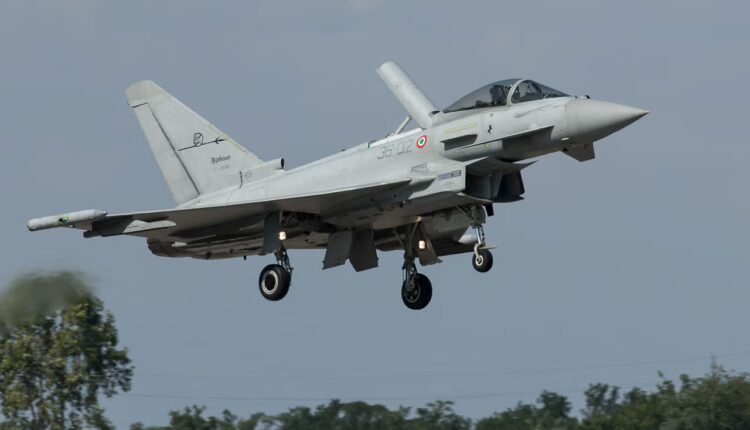
(DEFENCE SECURITY ASIA) — An Italian Air Force Eurofighter F-2000 was damaged at Saudi Arabia’s King Fahd Air Base during overnight attacks on September 17–18, transforming a dispersed European fighter deployment into direct evidence of the expanding military risks surrounding the Yemen conflict.
Italian Defence Minister Guido Crosetto confirmed that the combat aircraft was struck while parked in a decentralised area of the Ta’if installation, although no Italian personnel, vehicles, or supporting infrastructure were reported injured or damaged during the attack.
The incident carries disproportionate operational weight because the affected Eurofighter belongs to a four-aircraft Italian detachment responsible for defensive airspace missions, meaning even temporary unavailability could reduce the unit’s theoretical fighter strength by 25 percent.
Italy has described the aircraft only as “hit” and “damaged,” leaving unanswered whether the Eurofighter sustained superficial fragmentation, serious engine or avionics damage, structural impairment, or destruction sufficient to remove it permanently from the operational fleet.
No photographs, aircraft serial number, engineering assessment, damage classification, or recovery plan have been released, preventing independent determination of whether the fighter suffered a direct impact or collateral damage from an intercepted drone, missile, or falling debris.
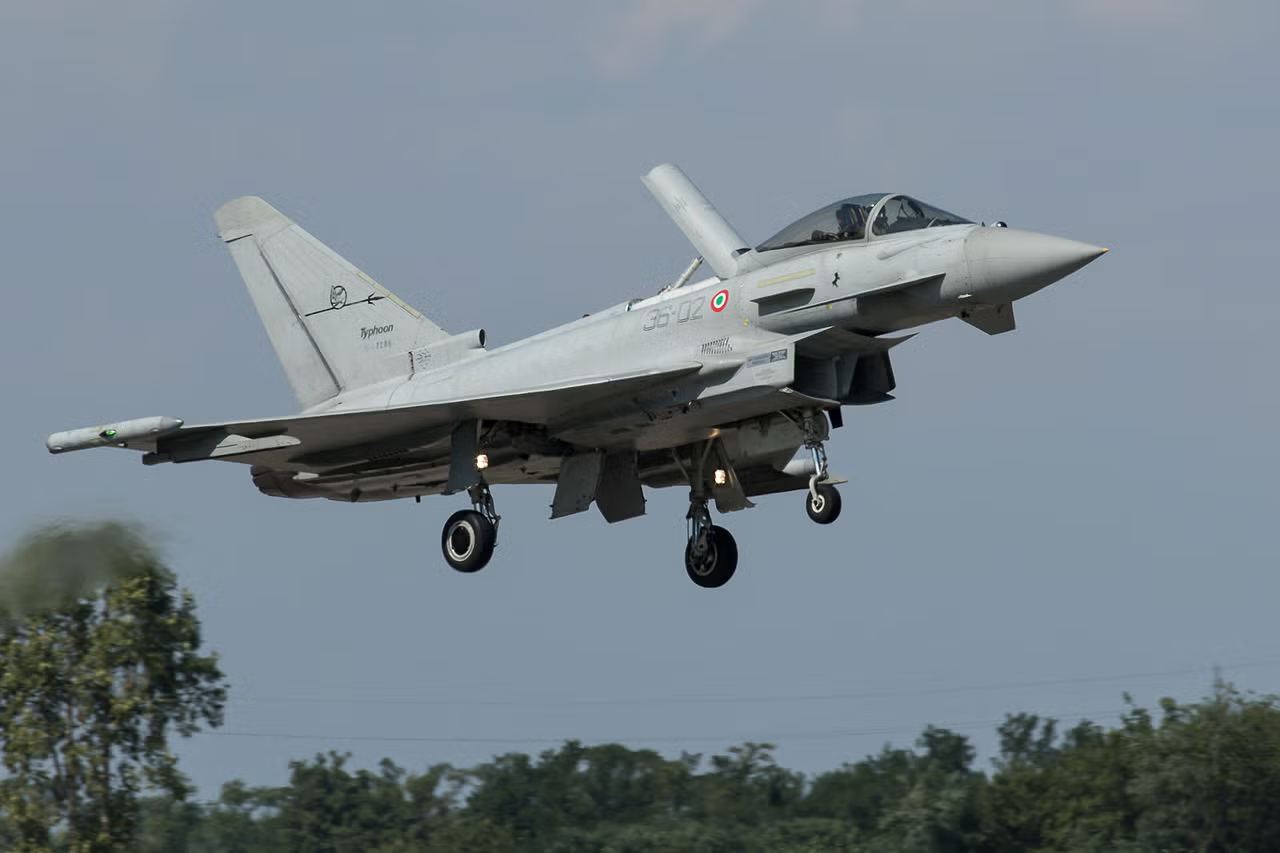
The distinction matters strategically because a direct strike would demonstrate Houthi penetration of a protected Saudi military installation, whereas fragmentation damage would still expose the persistent vulnerability of high-value combat aircraft parked within reach of low-cost aerial threats.
Crosetto said he monitored developments with Chief of the Defence Staff General Luciano Portolano before requesting updated assessments from senior military commanders regarding personnel security, the evolving operational picture, and Italy’s available force-posture options across the Gulf.
The attack places Rome’s defensive mission under intensified scrutiny because Italian Eurofighters, airborne early-warning aircraft, transport platforms, radar assets, and counter-drone capabilities were deployed to strengthen Gulf air defence rather than conduct publicly acknowledged offensive operations against Yemen.
However, the presence of Italian combat aircraft at a base identified by Houthi officials as supporting Saudi operations creates an unavoidable strategic ambiguity between defensive protection, coalition enabling, and exposure to retaliation generated by another state’s combat activities.
King Fahd Air Base hosts Saudi Eurofighters and provides infrastructure relevant to regional air operations, making the installation militarily valuable even if the Italian aircraft itself was neither deliberately selected nor specifically identified by the attackers.
The incident therefore demonstrates how expeditionary airpower can be strategically constrained before take-off, with drones, ballistic missiles, cruise missiles, or intercepted debris threatening aircraft, maintenance crews, fuel supplies, command nodes, and sortie generation on the ground.
For Italy and its European partners, the central question is no longer whether Gulf deployments provide reassurance, but whether existing dispersal, hardened protection, counter-unmanned aircraft systems, and integrated air-defence coverage can sustain credible operations under repeated attack.
(CLICK HERE): Eurofighter Typhoon Production Doubles: BAE Confirms 30-Jet-a-Year Surge as Türkiye’s £8bn Deal Reshapes NATO Air Power
Damage Uncertainty Shapes the Operational Assessment
Italy has not called the Eurofighter destroyed, written off, or permanently grounded, and any stronger characterisation would exceed the available evidence because the government has disclosed neither the affected components nor the aircraft’s post-strike airworthiness status.
The most plausible assessment from currently available information is blast, fragmentation, or debris damage to a parked fighter, although a direct and potentially catastrophic impact cannot be excluded until imagery, technical findings, or additional official details become available.
The fighter’s position in a remote or decentralised section of King Fahd Air Base suggests Italian planners had already implemented dispersal measures intended to prevent multiple aircraft from being disabled by a concentrated strike against the principal parking area.
Dispersal nevertheless reduces risk rather than eliminating it because isolated aircraft remain dependent upon exposed maintenance teams, ground-support equipment, weapons handling, fuel distribution, communications, spare parts, and secure access routes linking them to the wider installation.
If the damage is repairable locally, Italy must deliver technicians, specialised diagnostic equipment, replacement components, and potentially engine or avionics modules into an operating environment where additional Houthi attacks remain possible and force protection consumes finite resources.
If repairs require strategic transportation to Italy, the mission could face a prolonged capability reduction because moving a non-flyable Eurofighter demands complex airlift, recovery infrastructure, airframe preparation, and secure logistics coordination with Saudi military authorities.
A flyable but mission-incapable aircraft would create another possibility, allowing relocation from Ta’if while still requiring extensive maintenance before returning to combat readiness, thereby preserving the airframe without immediately restoring the detachment’s defensive capacity.
Italy’s careful terminology resembles its earlier differentiation between destroyed and damaged assets following attacks at Ali Al Salem Air Base in Kuwait, reinforcing the importance of withholding categorical conclusions until engineering inspections establish the Eurofighter’s condition.
That precedent also demonstrates that apparently similar fragmentation events can produce sharply different outcomes, ranging from repair and return flights to extensive damage and long-term non-operational status, depending upon which flight-critical systems were penetrated.
Until Rome releases its assessment, the accurate operational ceiling remains one Italian Eurofighter damaged with severity undisclosed, while claims of complete destruction, deliberate targeting, or direct penetration should be treated as unverified rather than established battlefield facts.
(CLICK HERE): Philippines Weighs 32 Eurofighter Typhoons as Indo-Pacific Fighter Race Intensifies

A Four-Jet Detachment Faces Disproportionate Pressure
The damaged aircraft belongs to Task Group Typhoon within Task Force Air–Arabia, whose four Eurofighter F-2000A fighters provide assigned air-defence capability alongside approximately 300 Italian Air Force personnel reportedly distributed between Saudi Arabia and Kuwait.
Although four fighters represent a politically visible commitment, such a compact force offers limited resilience because maintenance cycles, alert requirements, crew availability, and unexpected technical faults can rapidly reduce the number of aircraft available for immediate operations.
Removing one Eurofighter from the detachment does not automatically cut operational output by precisely 25 percent, but it narrows scheduling flexibility and increases pressure on the remaining aircraft to sustain readiness, training, defensive patrols, and contingency responses.
The Italian package also includes an E-550A Conformal Airborne Early Warning aircraft supporting surveillance, command-and-control, and recognised air-picture generation, alongside C-130J or KC-130J transports used for tactical airlift, medical evacuation, and logistical sustainment.
This architecture creates a layered defensive contribution in which airborne surveillance detects and tracks threats, command systems distribute targeting information, and Eurofighters provide kinetic interception, but every layer depends upon secure basing and resilient communications.
Italy’s current official description differs from earlier reporting that placed approximately 400 Air Force personnel across Saudi Arabia, Kuwait, and Bahrain while also identifying an AN/TPS-77 radar and ACUS-E counter-drone system within the wider deployment.
The personnel discrepancy should not automatically be interpreted as a verified drawdown because changing organisational definitions, rotations, or reporting dates may explain the difference, while Rome has not publicly provided a complete deployment ledger resolving the inconsistency.
Reported Italian land-based assets, including SAMP/T air-and-missile defence, KRONOS radars, and potentially a Skynex gun system, would broaden layered protection, but their precise locations, readiness, command relationships, and confirmed inclusion remain insufficiently documented.
The attack consequently highlights a fundamental air-defence problem: advanced fighters cannot compensate for inadequate point defence when numerous low-cost threats approach below radar horizons, overwhelm engagement channels, or generate damaging debris after successful interception.
Any Italian response must therefore protect the entire sortie-generation system rather than merely the aircraft, integrating shelters, dispersal, counter-drone sensors, electronic warfare, rapid runway repair, redundant command links, and layered kinetic interceptors around vulnerable logistics nodes.
(CLICK HERE): Germany’s AESA-Armed Eurofighter Just Broke Cover: Quadriga Tranche 4 Signals a New Era for NATO Airpower
Ta’if Becomes a Contested Gulf Airpower Hub
King Fahd Air Base at Ta’if already supports Royal Saudi Air Force Eurofighter operations, giving the installation strategic importance as a combat-airpower hub and explaining why Italian aircraft deployed there could become exposed during attacks directed against Saudi capabilities.
Houthi military spokesman Yahya Saree has claimed that Saudi F-15s and Eurofighters operating from Ta’if and Khamis Mushait were striking Yemen, providing an asserted operational rationale for targeting bases connected to the renewed Saudi-Houthi confrontation.
Those claims do not establish that the Italian Eurofighter participated in offensive missions, and Rome continues to describe its aircraft as supporting defensive airspace tasks rather than conducting strike sorties against Houthi forces or targets inside Yemen.
Nevertheless, adversary targeting decisions frequently reflect infrastructure usage rather than individual aircraft ownership, meaning foreign defensive detachments colocated with Saudi combat aviation may face the same threat environment regardless of their nationally imposed mission restrictions.
Saudi authorities separately reported intercepting a Houthi drone over Ta’if governorate, where falling debris killed a Yemeni resident, injured a Saudi woman and a Pakistani resident, and damaged civilian buildings and vehicles during the same broader period.
That account may describe the same attack wave affecting King Fahd Air Base or a related event elsewhere around Ta’if, but available information does not conclusively connect the civilian debris incident with the damage sustained by the Italian fighter.
Crosetto referred to several attacks against the air base, while unconfirmed open-source reporting discussed explosions and possible ballistic-missile activity, creating an incomplete threat picture involving potentially multiple weapons, trajectories, interceptions, and impact locations.
The uncertainty complicates defensive adaptation because protection against one-way attack drones differs from defeating ballistic missiles, cruise missiles, or coordinated salvos designed to saturate sensors and force defenders to expend costly interceptors against inexpensive threats.
Repeated targeting can also suppress air operations without destroying runways or aircraft because warning alerts, dispersal procedures, sheltering requirements, debris clearance, inspections, and interrupted maintenance collectively degrade tempo and impose cumulative personnel fatigue.
Ta’if has therefore become more than a geographical host for Italian airpower; it is now a contested node where coalition access, Saudi strike operations, European reassurance, Houthi retaliation, and regional air-defence credibility converge within one exposed logistics footprint.
Italy’s Gulf Mission Faces Political and Legal Scrutiny
Italy established Task Force Air–Arabia after the March 2026 Gulf crisis to support Saudi Arabia, Kuwait, and Bahrain through airspace surveillance, early warning, command-and-control, air defence, tactical airlift, radar coverage, counter-drone operations, and strategic-infrastructure protection.
Rome has presented the deployment as defensive support for regional partners and protection for Italian personnel and interests, but differing references to Task Force Air–Arabia and Operation Inherent Resolve have complicated public understanding of its exact legal framework.
The distinction is politically significant because Operation Inherent Resolve originated as an anti-Islamic State coalition mission, whereas defending Saudi installations against Houthi attacks represents a different operational problem with separate escalation pathways, adversaries, and parliamentary implications.
Opposition parties have argued that Saudi Arabia was not explicitly included among the countries listed in the applicable 2026 mission documentation, while the government maintains that parliamentary resolutions and committee proceedings already authorised broader Gulf air-defence support.
The damaged Eurofighter gives that dispute tangible military consequences because lawmakers are no longer debating only administrative language, but the exposure of Italian personnel and high-value combat aircraft at an installation repeatedly threatened by Houthi attacks.
Five Star Movement defence representatives Bruno Marton and Arnaldo Lomuti said they had sought explanations since July regarding risks facing Italian personnel at King Fahd Air Base and demanded that Crosetto address parliament following the incident.
Their argument links deployment transparency with force protection, while the government’s position emphasises continuity with previously approved defensive commitments, leaving parliament to determine whether operational evolution has exceeded the political scope originally presented.
The incident alone does not prove that Italy entered an offensive war, but it demonstrates that defensive forces can become parties to an active battlespace when deployed alongside host-nation aircraft conducting missions contested by an armed adversary.
Crosetto’s review could consequently produce military adjustments without immediately changing the mission’s political mandate, although relocation, reinforcement, reduction, or expansion would each carry different implications for parliamentary oversight and alliance credibility.
Rome must balance transparency against operational security because excessive disclosure could expose vulnerabilities, yet insufficient explanation risks weakening public confidence, parliamentary consent, and allied understanding of why Italian forces remain positioned inside a widening regional confrontation.
From Ta’if to Bab el-Mandeb, Italy Confronts a Wider War
The Eurofighter incident occurred as renewed Saudi-Houthi fighting followed Houthi advances along Yemen’s Red Sea coast, including Mocha and Perim Island, placing the Bab el-Mandeb maritime chokepoint under intensified strategic pressure and displacing more than 100,000 people.
Houthi forces have claimed large missile and drone attacks against Khamis Mushait, Yanbu, Aramco-related infrastructure, and other Saudi targets, while several asserted battlefield successes remain disputed or unconfirmed by Riyadh and therefore require cautious treatment.
Their claimed downing of a Saudi F-15 over Marib illustrates the information-war dimension surrounding the campaign, because released wreckage imagery may support parts of the account while Saudi authorities have not confirmed the reported aircraft loss.
For European governments, the emerging threat links air-base security with maritime commerce because attacks against Gulf installations and control over approaches to Bab el-Mandeb can simultaneously disrupt military deployments, energy routes, merchant shipping, insurance costs, and supply chains.
Crosetto has ordered Italian commanders to examine a national plan for protecting merchant ships of strategic interest rather than waiting indefinitely for an expanded response through the European Union’s Operation Aspides maritime-security framework.
The Italian FREMM frigate Carlo Bergamini was already operating around Djibouti and the Aspides mission area, although no additional warship had been publicly ordered into the strait when the Eurofighter damage was disclosed.
Italy is consequently evaluating two connected exposure problems: whether four fighters can remain effective at a Saudi base under recurring aerial attack, and whether naval forces can secure commercial transit through waters increasingly influenced by Houthi military power.
Relocating the Eurofighters could improve immediate survivability but signal reduced confidence in Saudi base protection, whereas reinforcing Ta’if could demonstrate commitment while increasing logistics requirements, interceptor expenditure, personnel exposure, and political ownership of the conflict.
Maintaining the existing posture would avoid abrupt strategic signalling, yet repeated attacks could progressively erode readiness and deterrence if adversaries conclude that European deployments remain operationally constrained by insufficient hardening or limited counter-drone capacity.
The damaged Italian Eurofighter ultimately exposes a broader transformation of the Gulf battlespace: European forces deployed for reassurance must now survive sustained precision attack, defend complex logistics networks, and navigate escalation between national protection and participation in regional war.
