
France Simulates Rafale–SCALP Deep-Strike Warfare Against Russia-Like Adversary in High-Intensity ‘Topaze’ Exercise
The French Air and Space Force leverages Rafale fighters armed with SCALP cruise missiles to rehearse dispersed basing, deep-strike retaliation, and high-intensity warfare against a Russia-like peer adversary shaped by lessons from the Ukraine conflict.

(DEFENCE SECURITY ASIA) — France’s Air and Space Force has deliberately escalated the realism of its high-intensity warfare training through the execution of Exercise Topaze, a large-scale operational drill centred on Rafale multirole fighters armed with SCALP cruise missiles, reflecting Paris’s assessment that future European conflicts will involve peer-level adversaries possessing advanced long-range strike, drone, and airbase-disruption capabilities comparable to those fielded by Russia.
The exercise, conducted on January 27, 2026, unfolded against the backdrop of the ongoing war in Ukraine, where sustained Russian long-range missile, drone, and aerospace strikes against Ukrainian air infrastructure have reshaped NATO’s understanding of survivability, dispersal, and rapid retaliatory strike requirements in a contested battlespace.
French defence planners framed Topaze as a response to what senior commanders describe as the return of “high-intensity warfare,” with General Pierre Gaudillière, Commander of the Fighter Aviation Air Brigade, explicitly stating, “We never train for nothing and since high-intensity warfare is raging on all fronts…it is in response to this kind of operational requirement that we are doing this exercise.”
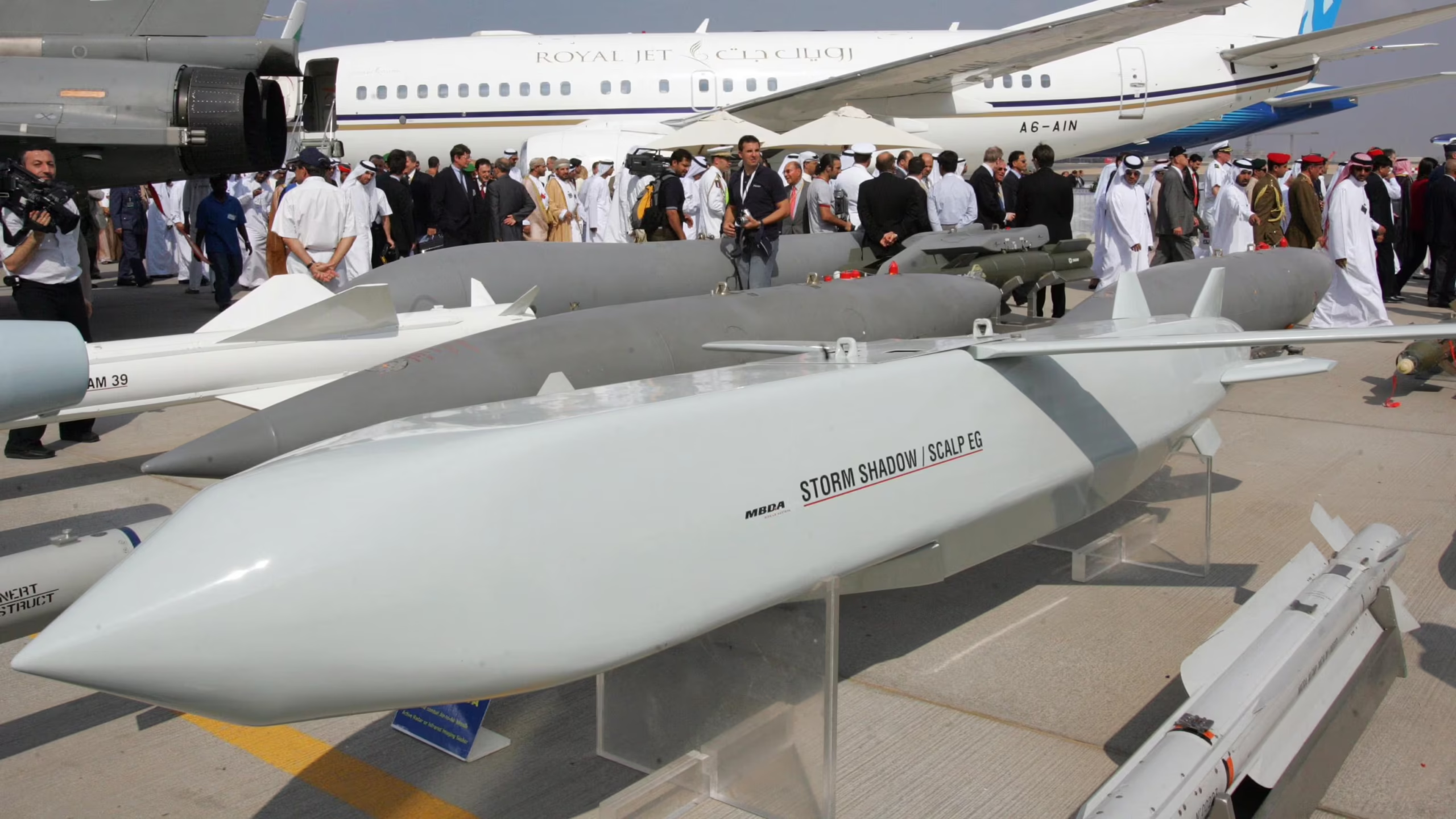
By integrating SCALP cruise missile strike simulations into a compressed dispersal-and-counterattack timeline, France signalled that it views long-range precision strike not merely as a strategic asset, but as an essential operational tool for rapidly degrading an adversary’s command, airpower, and logistical infrastructure following an attempted first strike.
The French Air and Space Force underscored that Topaze was designed to validate collective resilience under extreme time pressure, summarising the exercise’s operational philosophy as “Collective strength, squadron spirit, to act quickly, everywhere. With agility, efficiency, and resilience,” a formulation that directly mirrors NATO’s evolving emphasis on distributed air operations.
Captain Armand, a Rafale pilot directly involved in the exercise, highlighted the human and operational strain imposed by such scenarios, stating, “The goal is to be taken by surprise. The deployment at very short notice, followed by a huge team effort to configure the aircraft as quickly as possible and prepare ourselves as best we could for this mission under severe time constraints, was the hardest part.”
Strategically, Topaze represents a calculated demonstration that France intends to retain credible autonomous strike options within NATO, reinforcing deterrence messaging toward Moscow while simultaneously reassuring European allies that Paris can sustain combat operations even under conditions of degraded basing and persistent enemy pressure.
The deliberate framing of the simulated adversary as “Russia-like,” rather than an abstract threat, reflects France’s recognition that the operational lessons emerging from Ukraine are directly applicable to Western air forces, particularly regarding the vulnerability of fixed installations and the necessity of rapid, flexible, and lethal response capabilities.
By placing these messages at the core of Topaze, France positioned the exercise not as a routine training evolution, but as a strategic communication event aimed at shaping adversary perceptions, alliance confidence, and domestic understanding of the realities of modern high-intensity air warfare.
Strategic Rationale Behind France’s Topaze Exercise in the Post-Ukraine Security Environment
France’s decision to conduct Exercise Topaze must be understood within the broader transformation of Europe’s security architecture following Russia’s sustained military campaign in Ukraine, which has demonstrated that long-range strike, airbase suppression, and drone saturation are now central features of modern state-on-state conflict rather than exceptional contingencies.
The French Air and Space Force explicitly structured Topaze around a surprise-attack scenario, reflecting the operational reality observed in Ukraine, where Russian forces repeatedly sought to paralyse Ukrainian aviation by targeting runways, fuel depots, command centres, and aircraft shelters using missiles and unmanned systems.
By forcing Rafale squadrons to evacuate and redeploy within just seven hours of notification, French planners tested not only tactical responsiveness but also command-and-control resilience, logistics under stress, and the ability of aircrews and technicians to sustain combat readiness in austere, improvised environments.
This approach directly addresses a central vulnerability exposed by the Ukraine conflict, namely that air forces unable to disperse rapidly risk losing combat power before they can meaningfully contribute to the fight, regardless of platform sophistication.
France’s emphasis on decentralised operations reflects a doctrinal shift toward what NATO increasingly terms “agile combat employment,” in which survivability is achieved through mobility, unpredictability, and rapid regeneration rather than hardened infrastructure alone.
The inclusion of SCALP cruise missile strike profiles within this compressed timeline underscores France’s assessment that deterrence credibility depends on demonstrating the ability to retaliate decisively even after absorbing an initial blow, a concept central to both conventional and nuclear deterrence theory.
This logic echoes earlier French signalling exercises, including past long-range Rafale missions involving the ASMP-A nuclear missile, reinforcing continuity in Paris’s strategic messaging that Europe cannot outsource its security assumptions.
The geopolitical context surrounding Topaze also reflects France’s broader push for European strategic autonomy, with Paris increasingly arguing that Europe must possess independent strike, intelligence, and command capabilities capable of operating even if U.S. assets are stretched elsewhere.
In this sense, Topaze served not only as a military rehearsal but as a strategic declaration that France intends to remain a first-tier airpower capable of shaping outcomes in a deteriorating European security environment.

Operational Anatomy of Exercise Topaze: Dispersal, Regeneration, and Deep-Strike Simulation
Exercise Topaze began with a simulated enemy attack warning at Mont-de-Marsan airbase, compelling the rapid evacuation of aircraft, personnel, and critical equipment under conditions designed to replicate the chaos and uncertainty of an impending long-range strike campaign.
Approximately 20 Rafale fighters from the 30th Fighter Wing, supported by between 140 and 145 personnel, were dispersed across four military installations—Cognac, Cazaux, Bordeaux—and the civilian airport at Clermont-Ferrand, deliberately testing France’s ability to integrate non-military infrastructure into wartime air operations.
This dispersal phase directly mirrored operational lessons from Ukraine, where both Russian and Ukrainian forces have increasingly relied on redundancy, mobility, and civilian facilities to mitigate the vulnerability of fixed military bases.
Once redeployed, technical teams worked through the night to inspect, service, and reconfigure aircraft, simulating combat damage, system failures, and logistics disruptions in order to validate maintenance resilience under sustained operational stress.
Rafales were configured with SCALP cruise missiles, external fuel tanks, MICA infrared-guided air-to-air missiles, and Meteor beyond-visual-range missiles, reflecting a realistic loadout designed to balance deep-strike capability with self-protection against enemy interceptors.
The inclusion of three external fuel tanks alongside two SCALP missiles extended the simulated combat radius to approximately 1,500 kilometres, theoretically enabling strikes against targets as distant as Belarus from central France, thereby underscoring the strategic reach of France’s conventional strike assets.
The culminating phase of Topaze involved electronically simulated SCALP launches against enemy aircraft and infrastructure, replicating mission planning, targeting, programming, and release procedures without expending live munitions.
Each SCALP missile, costing approximately €850,000—roughly USD 920,000 or around RM 4.3 million—represents a high-value asset, making simulation a pragmatic approach for large-scale training while preserving wartime stockpiles.
Through this sequence, Topaze validated France’s ability to transition seamlessly from defensive dispersal to offensive retaliation, a capability increasingly recognised as decisive in modern high-intensity warfare.
Rafale and SCALP: Technical Synergy in High-Intensity Strike Warfare
The Dassault Rafale remains the cornerstone of France’s tactical airpower, combining multirole flexibility with advanced sensor fusion, electronic warfare, and long-range strike integration tailored for contested environments.
Powered by twin Snecma M88-2 turbofan engines, the Rafale achieves speeds of up to Mach 1.8 while maintaining a combat radius exceeding 1,000 kilometres, a figure significantly enhanced through external fuel carriage as demonstrated during Topaze.
The aircraft’s RBE2 active electronically scanned array radar provides long-range detection and tracking capabilities exceeding 200 kilometres, enabling Rafale crews to operate effectively against both aerial and surface threats.
Complementing this is the SPECTRA electronic warfare suite, which offers radar warning, jamming, decoying, and threat geolocation functions, significantly enhancing survivability against modern integrated air defence systems.
The SCALP-EG cruise missile, internationally known as Storm Shadow, represents one of Europe’s most sophisticated conventional standoff weapons, designed specifically to penetrate defended airspace and destroy high-value, hardened targets.
Weighing approximately 1,300 kilograms and carrying a 450-kilogram BROACH bunker-busting warhead, SCALP employs GPS and inertial navigation combined with infrared terminal guidance to achieve metre-level accuracy.
With an operational range of between 250 and 300 kilometres, SCALP allows Rafale aircraft to strike command centres, airfields, and infrastructure without entering the lethal engagement zones of advanced surface-to-air missile systems.
Flying at extremely low altitudes, often between 30 and 50 metres, the missile exploits terrain-following profiles to evade radar detection, a capability increasingly relevant against modern layered air defences.
The integration of SCALP into Rafale’s mission systems allows French pilots to execute complex deep-strike missions while maintaining situational awareness and connectivity with other air, land, and maritime assets, reinforcing France’s capacity for precision warfare.
Strategic Implications for NATO, Russia, and the Indo-Pacific Balance
Exercise Topaze sends a deliberate strategic signal to Russia that France possesses both the technical means and operational doctrine to survive an initial attack and respond with precision strikes against critical military infrastructure.
By rehearsing dispersed basing and long-range retaliation, France directly counters Russian reliance on systems such as Iskander ballistic missiles and Kinzhal air-launched hypersonic weapons intended to paralyse adversary airpower early in a conflict.
For NATO, Topaze enhances collective deterrence by demonstrating that European air forces can contribute meaningful strike capabilities even under degraded conditions, reducing reliance on U.S. assets during the opening phases of a high-intensity war.
The exercise also reinforces France’s role as a key security provider on NATO’s eastern flank, where French Rafales have already participated in air policing and reassurance missions in Poland and the Baltic region.
Beyond Europe, Topaze carries implications for the Indo-Pacific, where France maintains strategic interests through overseas territories and defence partnerships, and where the ability to project airpower over long distances is increasingly relevant.
Rafale exports to countries such as India, Indonesia, and Qatar mean that lessons from Topaze resonate beyond France, shaping how allied and partner air forces conceptualise survivability and strike operations against sophisticated adversaries.
The demonstrated effectiveness of SCALP-type standoff weapons also underscores their relevance in countering anti-access and area-denial strategies, particularly in regions such as the South China Sea and Taiwan Strait.
While Moscow has criticised NATO exercises as provocative, France views Topaze as a necessary response to an increasingly militarised security environment, arguing that credible deterrence reduces, rather than increases, the risk of miscalculation.
In this sense, Topaze represents both a military rehearsal and a strategic statement that France intends to remain an active shaper of global security dynamics.
Future Trajectories: Lessons, Limitations, and the Evolution of French Airpower
While Exercise Topaze successfully validated many aspects of France’s high-intensity air warfare doctrine, it also highlighted logistical and organisational challenges inherent in operating from dispersed and civilian locations under extreme time pressure.
Coordinating maintenance, security, and command functions across multiple sites revealed friction points that will require refinement in future iterations, particularly if such operations are to be sustained over extended periods.
French planners are expected to incorporate additional complexity into subsequent exercises, potentially including joint NATO participation, cyber and space domain disruptions, and live-fire elements to further enhance realism.
Technologically, France is already preparing for the next evolution of Rafale capability, with the F5 standard planned for the 2030s incorporating enhanced connectivity, artificial intelligence, and improved integration with unmanned systems.
Parallel development of the Future Combat Air System with Germany and Spain reflects France’s recognition that future conflicts will demand networked, multi-platform solutions rather than standalone aircraft.
Nevertheless, Topaze demonstrates that Rafale and SCALP will remain central to France’s deterrence posture for at least the next two decades, providing a credible bridge to next-generation systems.
The exercise also reinforces the importance of training realism, as simulations increasingly replace live munitions in preparing aircrews for complex operational environments.
Ultimately, Topaze illustrates France’s determination to internalise the harsh lessons of Ukraine and translate them into actionable capability, ensuring that its airpower remains relevant in an era defined by speed, precision, and resilience.
As high-intensity warfare re-emerges as a defining feature of global security, France’s willingness to confront these realities head-on positions it as one of Europe’s most strategically prepared air forces. — DEFENCE SECURITY ASIA
