
“You Can Jailbreak an F-35 Like an iPhone”: Dutch Defence Chief’s Bombshell Exposes Software Sovereignty Crisis in $1.7 Trillion Fighter Programme
Dutch State Secretary Gijs Tuinman’s explosive “jailbreak the F-35” comment has ignited global debate over U.S.-controlled mission data files, ODIN software architecture, and operational sovereignty in the fifth-generation fighter era.

(DEFENCE SECURITY ASIA) — The global F-35 Lightning II enterprise was jolted into a new phase of geopolitical introspection when Dutch State Secretary for Defence Gijs Tuinman declared on national radio that European operators could theoretically “jailbreak an F-35 just like an iPhone,” a remark that instantly reframed the debate over software sovereignty in the fifth-generation era and exposed the strategic fragility underpinning the world’s most advanced multirole fighter ecosystem.
Speaking during BNR Nieuwsradio’s Boekestijn en de Wijk podcast on 14 February 2026, Tuinman did not merely float a technical curiosity but injected into NATO discourse a blunt assessment of strategic dependency, warning, “That’s not the point… we’ll see whether the Americans will show their true colors,” thereby signalling that transatlantic trust in software sustainment has become a live operational variable rather than an abstract policy concern.
He then delivered the line reverberating through defence ministries from The Hague to Tokyo: “If, despite everything, you still want to upgrade, I’m going to say something I should never say, but I will anyway: you can jailbreak an F-35 just like an iPhone. I won’t say more about it,” a statement whose implications extend far beyond metaphor into the architecture of alliance warfare.

The timing of the comments is strategically significant because the Netherlands is racing to achieve full conventional deterrence readiness against potential Russian aggression by 2028, a deadline that amplifies the risks of disrupted U.S.-controlled software updates in an environment where mission data refresh cycles directly influence survivability in contested European airspace.
For European F-35 operators confronting renewed uncertainty under the second Trump administration, the suggestion of bypassing U.S. oversight reflects not technical rebellion but contingency planning within an increasingly software-defined battlespace where code, cryptography, and threat libraries determine combat credibility.
For Asia-Pacific F-35 operators including Japan, Australia, South Korea, and Singapore, Tuinman’s remarks function as a strategic warning flare, underscoring that ownership of a fifth-generation airframe does not equate to sovereign control of its operational brain.
The F-35 Lightning II programme, with nearly 1,300 aircraft delivered worldwide as of early 2026 and cumulative lifecycle costs projected in excess of US$1.7 trillion (approximately RM8.0 trillion), has become the backbone of Western airpower, yet its architecture centralises critical software authority within U.S.-managed frameworks.
At the centre of Tuinman’s provocation lies a deeper geopolitical recalibration, as European capitals accelerate indigenous sixth-generation projects such as FCAS and GCAP precisely because control over algorithms and mission data now defines strategic autonomy as decisively as steel and thrust once did.
By publicly raising the spectre of a “jailbreak,” Tuinman effectively acknowledged that modern deterrence credibility depends not only on stealth coatings and sensor fusion but on who writes, updates, and authorises the code that governs lethal force.
The episode therefore marks a watershed moment in alliance politics, signalling that in the era of digital combat aviation, sovereignty has shifted from hangars and depots to encrypted servers and classified threat libraries.
The Netherlands’ Deep Investment in the F-35 — Strategic Commitment, Structural Exposure
The Royal Netherlands Air and Space Force has fully transitioned from its legacy F-16 fleet to the F-35A, with more than 40 aircraft delivered out of a planned 58, forming the sole frontline combat backbone of Dutch airpower as Europe confronts renewed high-intensity warfare risks.
As a Level 2 partner in the Joint Strike Fighter programme, the Netherlands invested heavily in development contributions and industrial offsets, embedding its defence industry within a transatlantic supply chain whose value runs into billions of euros, equivalent to multiple billions of US dollars and tens of billions of Malaysian Ringgit.
Additional aircraft deliveries scheduled through 2028 coincide with the acquisition of Tomahawk cruise missiles and enhanced ground-based air-defence systems, signalling a comprehensive Dutch rearmament push aligned with NATO’s eastern flank reinforcement strategy.
Tuinman emphasised the interwoven nature of industrial dependencies, noting that British Rolls-Royce components power the Pratt & Whitney F135 engines used even by U.S. aircraft, underscoring that the programme’s supply web is transnational rather than unidirectional.
“Even if this mutual dependency doesn’t result in software updates, the F-35, in its current state, is still a better aircraft than other types of fighter jets,” he stated, reinforcing that the aircraft’s baseline capabilities remain formidable despite update uncertainties.
This duality — deep integration coupled with potential vulnerability — defines the Netherlands’ position, as its air force depends entirely on a platform whose mission data and software backbone remain externally controlled.
With the Netherlands targeting full readiness by 2028 amid intensifying Russian military pressure, any disruption in software updates could affect air policing, quick reaction alert, and expeditionary deployments across Eastern Europe.
The Dutch case thus encapsulates the paradox facing many allies: the F-35 delivers unparalleled combat power, yet its sustainment model inherently constrains unilateral operational modification.
By publicly contemplating alternative pathways, The Hague signals that even highly committed partners are recalculating risk in a shifting geopolitical landscape.
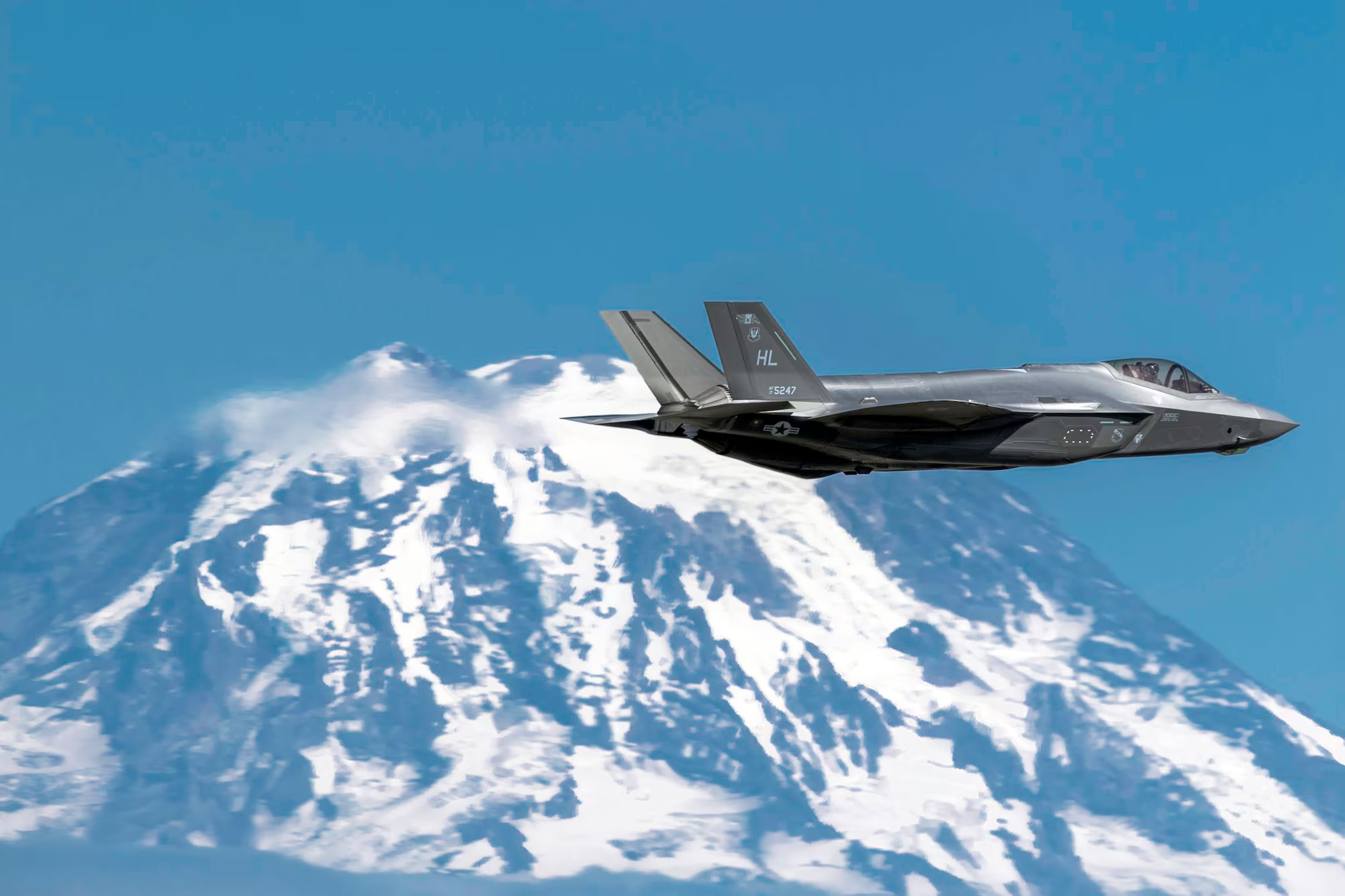
Inside the F-35’s Software Core — ALIS, ODIN, and the Strategic Power of Mission Data Files
The F-35’s revolutionary combat edge derives from more than stealth geometry, as its eight million lines of software code orchestrate flight controls, sensor fusion, electronic warfare, and weapons employment in a tightly integrated digital ecosystem.
Originally sustained through the Autonomic Logistics Information System (ALIS), the fleet relied on a centralised network for maintenance diagnostics and mission planning, but operational shortcomings prompted its replacement by the cloud-based Operational Data Integrated Network (ODIN).
ODIN promises accelerated data processing and reduced maintenance burden, yet it maintains U.S.-centric oversight, reinforcing the centralised governance of updates, cyber security, and configuration management.
Mission Data Files, generated primarily at Eglin Air Force Base, function as electronic combat manuals that enable the aircraft to identify and counter specific radar signatures, missile seekers, and adversary tactics with precision.
Without regular updates to these files, the aircraft’s survivability in contested airspace erodes as threat libraries become outdated, rendering stealth and sensor fusion less effective against evolving adversary systems.
Foreign operators generally lack independent authority to generate or upload bespoke mission data without U.S. approval, a restriction embedded in programme agreements and export-control frameworks.
Israel’s F-35I “Adir” remains the sole exception, incorporating indigenous avionics and operating outside standard ALIS/ODIN frameworks following hard-fought negotiations that secured a degree of software autonomy unmatched by other partners.
Tuinman’s “jailbreak” analogy implies bypassing onboard security to upload alternative software or data, yet such action would require overcoming encrypted secure boot processes and hardware root-of-trust safeguards designed to prevent tampering.
Even if technically feasible, circumventing these protections risks voiding warranties, triggering legal repercussions under U.S. export law, and disrupting interoperability within NATO or coalition networks.
The controversy thus reveals that the true power centre of fifth-generation warfare lies not merely in stealth coatings but in the encrypted digital pipelines that continuously adapt aircraft to an evolving threat matrix.
Trump 2.0, Strategic Autonomy, and Europe’s Software Reckoning
Tuinman’s comments unfolded against a backdrop of renewed transatlantic tension under President Trump’s second administration, which has intensified pressure on NATO burden-sharing and revived debates over U.S. strategic commitments.
European leaders have responded by accelerating initiatives such as the Future Combat Air System (FCAS) and the Global Combat Air Programme (GCAP), aiming to secure indigenous sixth-generation capabilities insulated from external software control.
Spain, Switzerland, and Portugal have publicly debated the financial and sovereignty implications of F-35 participation, citing “black box” software constraints and sustainment costs measured in billions of euros, equivalent to tens of billions of Malaysian Ringgit.
The United Kingdom, a Tier 1 partner, previously secured assurances of an “unbroken British chain of command,” yet even London operates within the broader U.S.-managed digital framework.
The Netherlands is coordinating with Norway and Poland to explore European-centric sustainment solutions within the next 18–24 months, suggesting the emergence of a continental approach to software risk mitigation.
Tuinman’s assertion that Europe would “see whether the Americans will show their true colors” signals a strategic test of alliance reliability rather than a declaration of defiance.
The debate is therefore not about literal sabotage or unilateral modification, but about negotiating the boundaries of operational sovereignty within an alliance built on mutual trust.
European rearmament, accelerated by the war in Ukraine and Russian force modernisation, has pushed defence spending beyond NATO’s two-percent benchmark, amounting to hundreds of billions of euros annually across the continent.
Within this fiscal surge, the question of software independence has evolved from theoretical concern to strategic imperative.
The F-35 debate thus mirrors a broader European recalibration in which sovereignty over digital defence infrastructure becomes central to long-term deterrence credibility.
Asia-Pacific Reverberations — Lessons for Japan, Australia, South Korea, and Singapore
For Asia-Pacific operators, Tuinman’s remarks resonate in a theatre where high-intensity conflict scenarios involving China would demand rapid software updates and real-time threat library integration.
Japan operates the F-35A and is investing heavily in the F-X programme, seeking greater domestic control over mission systems to hedge against long-term dependency.
Australia’s sovereign industrial strategy similarly aims to maximise local sustainment capacity, recognising that delays in cryptographic keys or mission data updates could constrain operational tempo in a regional contingency.
South Korea, operating F-35As alongside its indigenous KF-21, has positioned domestic development as a parallel pathway toward technological autonomy.
Singapore’s acquisition of the F-35 integrates the city-state deeper into U.S.-centric networks, yet the software sovereignty debate introduces new strategic calculations.
In an Indo-Pacific crisis, denial or delay of mission data updates could degrade effectiveness without any literal “kill switch,” demonstrating how logistical and software levers can shape combat readiness.
Israel’s precedent shows that negotiated autonomy is possible but politically complex, requiring leverage, industrial capacity, and strategic alignment.
The Indo-Pacific theatre’s rapid threat evolution — including advanced Chinese radar systems, long-range surface-to-air missiles, and electronic warfare platforms — magnifies the importance of timely MDF refresh cycles.
Tuinman’s metaphor therefore serves as a catalyst for regional operators to accelerate indigenous data generation and cyber resilience capabilities.
In a region defined by great-power rivalry, control over code may prove as decisive as control over sea lanes or airspace.
Technical Feasibility, Legal Fallout, and the Strategic Meaning of a “Jailbreak”
Defence technologists caution that the F-35’s secure boot architecture, encrypted communications, and remote attestation mechanisms render unauthorised modification extraordinarily complex and potentially destabilising.
Any attempt to bypass protections could trigger fail-safes, degrade performance, or render aircraft incompatible with coalition datalinks and intelligence feeds.
Legal consequences under U.S. export-control law could include sanctions, suspension of support, and damage to industrial partnerships worth billions of US dollars, equivalent to tens of billions of Malaysian Ringgit.
Moreover, Block 4 upgrades — representing the next major capability leap in electronic warfare and weapons integration — depend on U.S.-managed channels, making isolation strategically costly.
Tuinman’s acknowledgment that the aircraft remains superior “in its current state” suggests the jailbreak notion as contingency rhetoric rather than imminent policy.
Yet the willingness of a NATO official to articulate such a concept publicly reflects shifting alliance dynamics and growing emphasis on sovereign control of digital warfare systems.
The global F-35 enterprise must now confront a reality in which partners demand not only performance but autonomy, challenging the centralised governance model that underpinned the programme’s rapid expansion.
Whether through negotiated exemptions, collaborative European sustainment frameworks, or enhanced domestic mission data capabilities, allies are signalling that indefinite digital dependence is no longer politically sustainable.
In the software-defined battlespace of the 21st century, sovereignty extends beyond airframes to algorithms, encryption keys, and threat databases.
Gijs Tuinman’s explosive metaphor has therefore crystallised a defining question of modern alliance warfare: who ultimately controls the code that decides life, death, and deterrence in the skies above Europe and the Indo-Pacific. — DEFENCE SECURITY ASIA
