China’s ‘Moving Arsenal Ship’: Heavily Armed Container Vessel Signals a New Era of Naval Warfare
Satellite imagery and open-source intelligence suggest China is testing a missile-armed container ship capable of reshaping naval warfare, saturation strike doctrine and civil–military fusion in the Indo-Pacific.
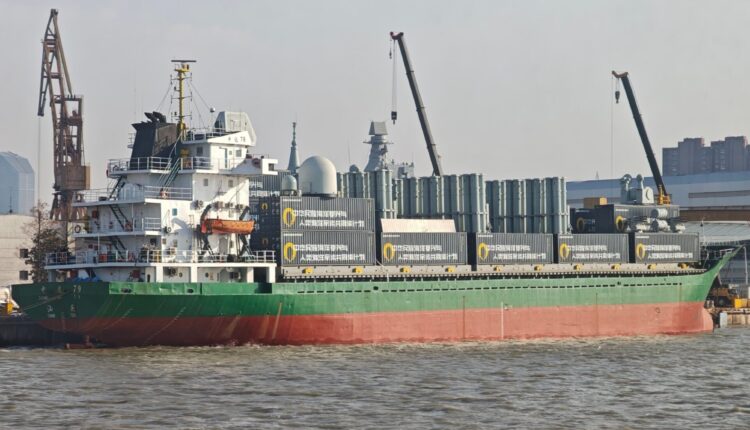
(DEFENCE SECURITY ASIA) — In the opaque and fast-evolving battlespace of modern naval warfare—where innovation increasingly unfolds beyond official announcements—the sudden emergence of imagery depicting a Chinese container ship refitted into what appears to be a heavily armed, sensor-rich floating arsenal has sent ripples through global defence circles, with viral reactions encapsulated in the stark declaration, “IT IS A MOVING ARSENAL SHIP!!!!!”, a phrase that now symbolises the shock value of Beijing’s latest apparent maritime experiment.
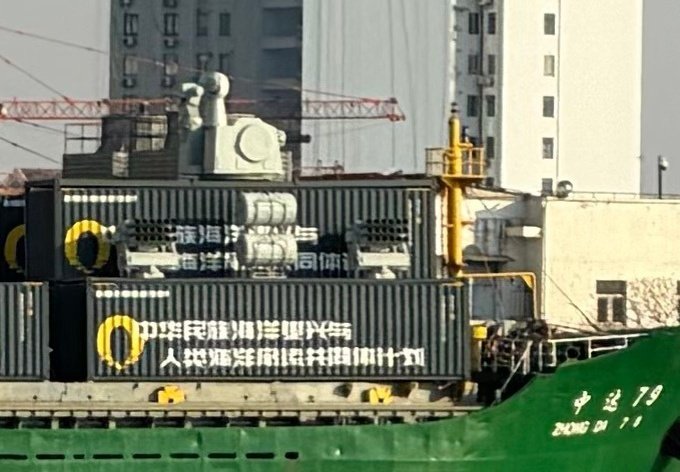
The vessel, visually transformed from a benign commercial platform into a militarised combat adjunct through the installation of advanced active electronically scanned array (AESA) radars, close-in weapon systems (CIWS), electronic decoy launchers and a dense array of containerised vertical launch system (VLS) missile cells, represents not merely a technical curiosity but a potential doctrinal inflection point in how sea power could be generated, distributed and disguised in an era of intensifying great-power rivalry.
Circulating first through specialised military forums and open-source intelligence ecosystems before spilling into wider strategic discourse, the photographs—whose precise geographic origin remains unverified but are widely speculated to place the ship near the strategically critical Dalian Shipyard—have elevated concerns that China is operationalising a concept long theorised but never fielded at scale: the rapid conversion of civilian shipping into missile-armed combat platforms capable of altering naval force ratios almost overnight.
This sighting arrives at a moment when maritime competition in the Indo-Pacific is accelerating toward higher intensity, with the People’s Liberation Army Navy (PLAN) pursuing asymmetric, saturation-based approaches designed to blunt the advantages of technologically superior adversaries, particularly the United States Navy, whose carrier strike groups remain the cornerstone of American sea control doctrine.
The blurred boundary between civilian and military domains implicit in this vessel’s design injects a new layer of ambiguity into regional security calculations, challenging long-standing assumptions about escalation control, rules of engagement and the identification of legitimate targets in congested maritime theatres.
The appearance of such a platform suggests that Beijing is actively exploring ways to externalise missile capacity beyond traditional surface combatants, effectively decoupling offensive firepower from high-value hulls in order to preserve fleet survivability while expanding launch density across the maritime battlespace.
From a strategic signalling perspective, the visibility of this armed container ship—rather than its concealment—may itself be intentional, functioning as a psychological and doctrinal message that China is prepared to weaponise ambiguity and commercial ubiquity as instruments of deterrence and coercion in contested waters.
The platform also reflects a growing Chinese emphasis on “quantity as a strategic variable,” where the ability to field numerous missile-capable nodes, even if individually expendable, could overwhelm adversary sensor-shooter chains through sheer saturation rather than qualitative overmatch.
In operational terms, such vessels could serve as distributed missile magazines supporting PLAN task groups, allowing frontline destroyers and cruisers to conserve vertical launch cells for air-defence and command roles while auxiliary platforms absorb the burden of long-range strike missions.
Collectively, this development reinforces the assessment that future naval conflict in the Indo-Pacific is likely to be characterised not by linear fleet engagements, but by complex, multi-domain contests in which the distinction between warship, auxiliary and civilian platform becomes increasingly blurred, contested and operationally consequential.
A Container Ship Reimagined as a Missile-Heavy Combat Platform
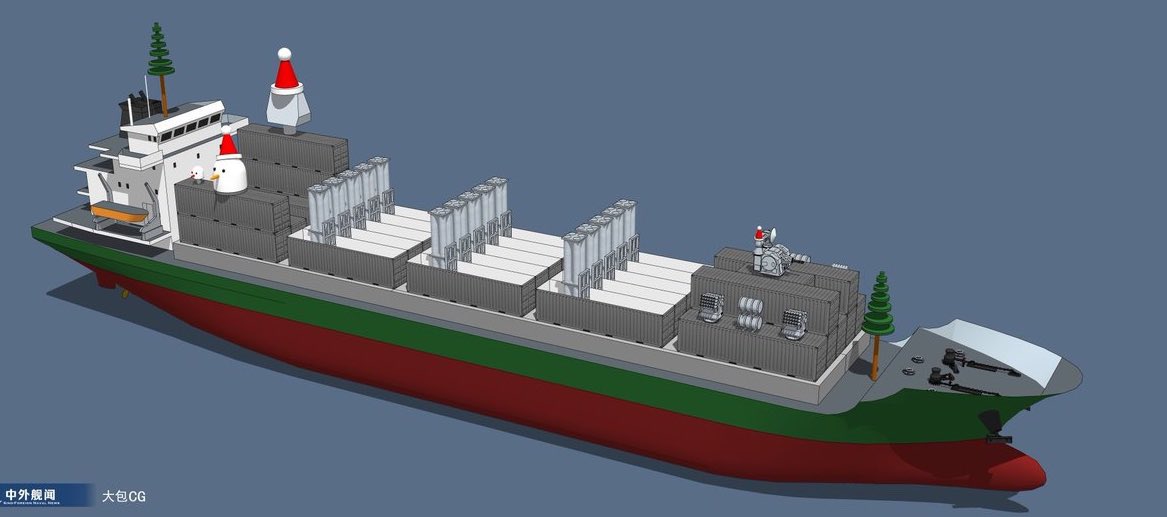
At first glance, the platform appears deceptively ordinary—a medium-sized commercial container ship—but closer examination reveals a deck crowded with modular weapon and sensor packages that collectively transform the vessel into a floating missile battery with combat potential rivaling that of a dedicated surface combatant.
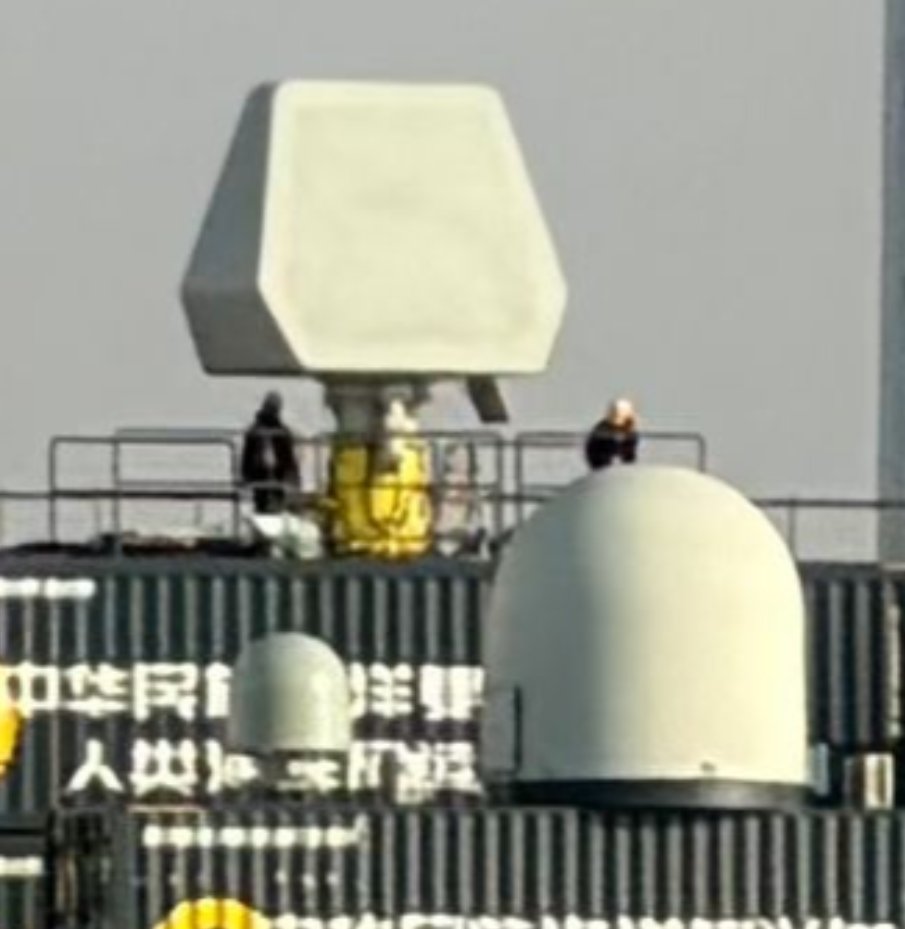
Dominating the forward superstructure is a large rotating phased-array AESA radar mounted atop three stacked containers, a configuration that strongly suggests lineage with radar systems deployed aboard PLAN Type 052D and Type 055 destroyers, granting the ship wide-area surveillance, target tracking and fire-control capabilities essential for modern missile warfare.
Adjacent to this primary sensor is a domed array positioned on twin containers, likely serving electronic warfare, satellite communications or integrated command-and-control functions, enabling the vessel to operate as an active node within a broader network-centric battlespace rather than a passive missile barge.
The most visually arresting element, however, is the estimated 60 containerised VLS cells arranged in a compact grid, a figure that equates to roughly two-thirds of the missile capacity of an early Arleigh Burke-class Flight I or II destroyer, a comparison repeatedly highlighted in commentary noting, “China has packed the deck of a medium-sized cargo ship with 60 containerized vertical launch cells, radar, and close-in weapons.”
These VLS cells, by virtue of China’s mature missile ecosystem, could theoretically accommodate a diverse payload mix including long-range surface-to-air missiles, anti-ship cruise missiles, land-attack weapons or even emerging hypersonic systems, granting the platform extraordinary flexibility despite its improvised origins.
Forward of the VLS array, a Type 1130 CIWS—capable of firing up to 10,000 rounds per minute—has been mounted atop elevated containers near the bow, optimising its engagement envelope against incoming cruise missiles, unmanned aerial vehicles and low-flying aircraft, while four decoy launchers positioned on lower containers provide layered soft-kill defence through chaff, flares and active countermeasures.
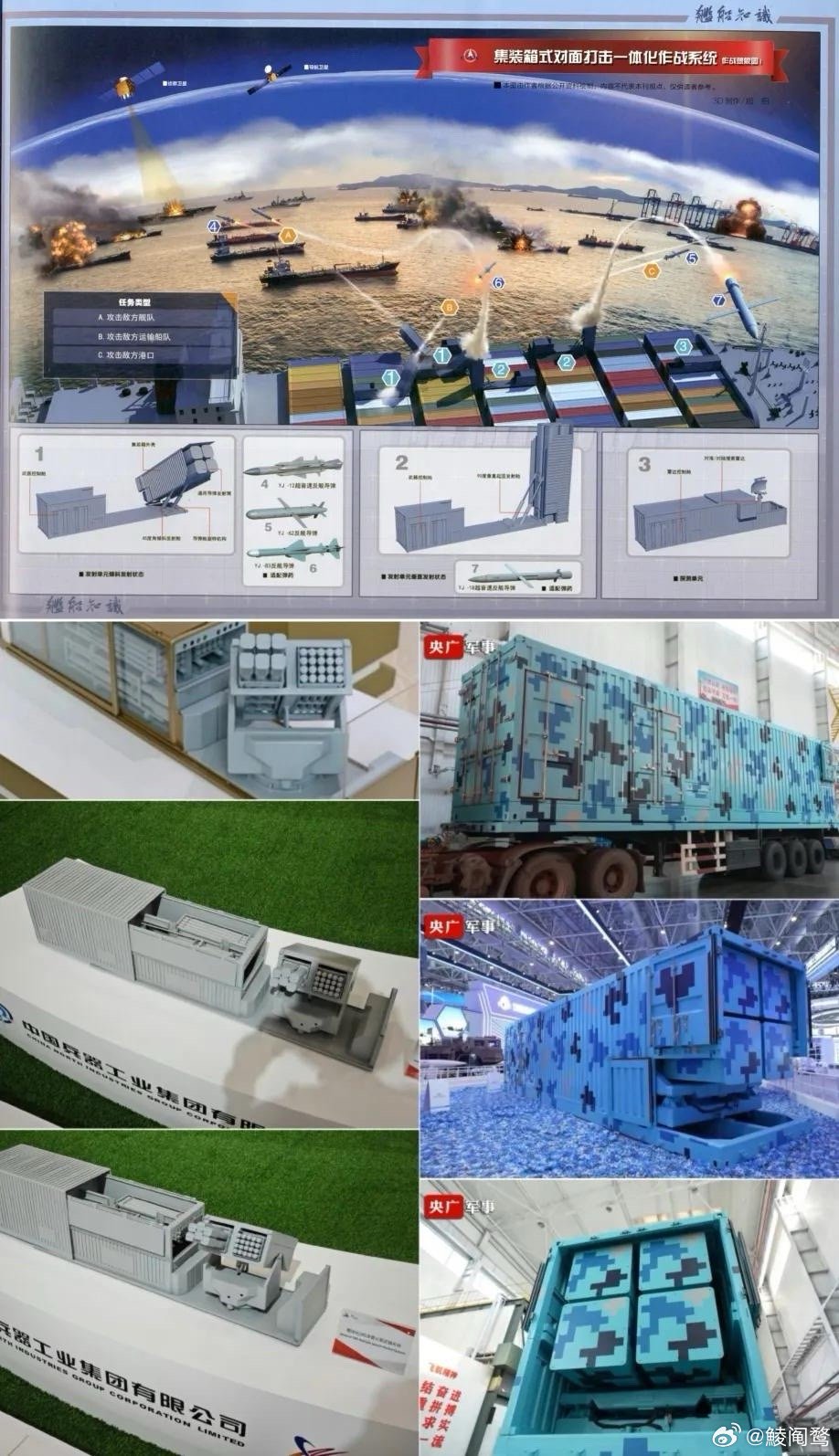
The use of standard shipping containers as both structural and functional elements of the ship’s combat architecture underscores a modular philosophy that prioritises rapid installation, removal and reconfiguration, allowing Beijing to tailor each vessel’s loadout to specific mission profiles or threat environments with minimal shipyard time.
This container-centric architecture also hints at an intentional embrace of logistical deception, whereby the outward visual similarity to commercial shipping could complicate adversary targeting cycles and delay positive identification in cluttered maritime environments.
From a force-generation perspective, the design suggests that China is prioritising speed of conversion and numerical scalability over platform elegance, enabling rapid wartime expansion of missile-carrying capacity without diverting scarce shipyard resources away from frontline destroyer and cruiser production.
Critically, the platform’s very lack of traditional naval survivability may be doctrinally acceptable within a saturation-attack framework, in which the expendability of individual hulls is outweighed by their contribution to overwhelming adversary air- and missile-defence networks through distributed, high-volume fires.
Civil–Military Fusion and the Strategic Logic Behind the Design
The apparent transformation of a commercial hull into a missile-armed surface combatant aligns seamlessly with China’s long-standing doctrine of civil–military fusion, a strategy that seeks to harness civilian industrial capacity, logistics networks and platforms in support of military objectives during both peacetime competition and wartime mobilisation.
The suspected proximity of the vessel to Dalian Shipyard—widely recognised as the cradle of China’s aircraft carrier programme, including the Liaoning, Shandong, Fujian and the under-construction Type 004—adds further weight to the argument that this platform is not an isolated curiosity but part of a broader ecosystem of experimentation surrounding next-generation naval warfare concepts.
The logic is compelling from a strategic perspective, as China possesses the world’s largest merchant fleet, numbering over 5,000 vessels, creating a latent reserve of hulls that could, in theory, be rapidly converted into auxiliary combat platforms, missile carriers or sensor nodes in the early stages of a high-intensity conflict.
Such an approach offers Beijing the ability to generate combat mass at scale without the long lead times and exorbitant costs associated with building traditional warships, particularly when a modern guided-missile destroyer can cost between USD 1.8–2.2 billion (approximately MYR 8.4–10.3 billion) per hull when accounting for sensors, weapons and lifecycle expenses.
By contrast, the conversion of a commercial container ship—whose base cost might fall below USD 100–150 million (around MYR 470–705 million)—into a missile-armed arsenal ship represents a radically different cost-exchange ratio, especially when deployed in numbers sufficient to saturate enemy defences.
The vessel’s design implicitly accepts vulnerability and expendability as trade-offs for volume and surprise, reflecting a wartime calculus in which overwhelming an adversary’s intercept capacity matters more than preserving individual platforms.
This model effectively converts China’s vast commercial shipbuilding and logistics ecosystem into a force-multiplication reserve, enabling peacetime economic infrastructure to function as a latent wartime strike asset without overtly violating force posture transparency norms.
The containerised nature of the combat systems further suggests a deliberate effort to standardise weapon integration across disparate hull types, reducing training and sustainment burdens while maximising cross-platform interoperability within the People’s Liberation Army Navy’s expanding kill-chain architecture.
From an industrial-strategic standpoint, the approach insulates China’s frontline naval production from attritional stress, allowing high-end shipyards to continue building complex combatants while auxiliary conversion work is dispersed across civilian facilities nationwide.
Taken together, these factors indicate that Beijing is not merely experimenting with an unconventional ship type, but systematically engineering a scalable mobilisation framework in which economic capacity, maritime logistics and missile warfare are fused into a single, adaptive instrument of state power.
Operational Roles in an Indo-Pacific Contingency
In a Taiwan Strait or South China Sea contingency, a fleet of such containerised arsenal ships could fundamentally alter the geometry of naval engagements by providing dispersed, mobile missile launch capacity that complicates targeting and strains adversary intelligence, surveillance and reconnaissance assets.
Operating within or adjacent to dense commercial shipping lanes, these vessels could exploit the cluttered maritime environment to mask their movements, forcing opposing navies to devote disproportionate resources to tracking and classification while raising the political and legal risks associated with engaging targets that outwardly resemble civilian ships.
From an operational standpoint, these platforms could serve as forward missile magazines supporting manned surface combatants, submarines and aircraft, enabling the PLAN to conserve the limited VLS capacity of its high-value destroyers for critical engagements while offloading volume fires to lower-cost auxiliaries.
The platform’s onboard AESA radar and defensive systems suggest a degree of autonomy that reduces reliance on external targeting, addressing one of the key weaknesses that doomed earlier arsenal ship concepts and allowing these vessels to operate semi-independently within a contested electromagnetic environment.
In saturation attack scenarios, even a handful of such ships positioned along key maritime approaches could launch massed salvos designed to overwhelm layered defences around carrier strike groups or amphibious task forces, forcing adversaries into unfavourable cost-exchange dynamics where expensive interceptors are expended against relatively low-cost missiles.
The strategic ambiguity inherent in such deployments also serves a psychological function, reinforcing uncertainty about the true scale and disposition of China’s maritime strike assets at any given moment.
In a crisis escalation ladder, these vessels could be forward-positioned during peacetime under the guise of routine commercial activity, enabling rapid transition from strategic ambiguity to kinetic relevance with minimal observable mobilisation indicators.
Their employment would likely be synchronised with cyber, electronic warfare and space-based effects, exploiting moments of sensor degradation or information overload to maximise the lethality and surprise of missile salvos launched from unexpected vectors.
Such platforms could also function as decoys or sacrificial nodes within a broader distributed maritime operations construct, absorbing adversary attention and munitions while higher-value PLAN assets manoeuvre or prosecute decisive engagements elsewhere.
Collectively, these roles suggest that the containerised arsenal ship is best understood not as a standalone combatant, but as an enabling element within a layered, multi-domain offensive system designed to impose complexity, cost and decision paralysis on opposing commanders.
Comparisons, Limitations and Vulnerabilities
Despite their apparent firepower, these improvised arsenal ships are not without significant limitations that could constrain their effectiveness in sustained combat operations, particularly when confronted by a technologically sophisticated adversary.
Unlike purpose-built warships, commercial hulls lack compartmentalisation, armour and damage-control features designed to absorb combat damage, rendering them highly vulnerable to precision strikes once positively identified.
The exposed nature of their radar arrays and weapon mounts raises questions about survivability under intense electronic warfare or anti-radiation missile attack, especially against opponents capable of degrading sensor performance and disrupting command-and-control links.
Stability in high sea states, power generation for energy-hungry sensors, electromagnetic compatibility between modular systems and integration with the PLAN’s C4ISR architecture all represent technical hurdles that must be overcome before such vessels can be considered fully operational.
Critics have also noted that the platform’s overt armament undermines any notion of true concealment, echoing sceptical reactions questioning whether it is “really arming merchant ships in disguise” or merely creating an easily identifiable auxiliary combatant with fewer protections than a conventional warship.
Yet, these shortcomings may be irrelevant within the framework of China’s broader anti-access/area denial strategy, where the objective is not to preserve every platform but to impose prohibitive costs, uncertainty and delay on an adversary’s ability to project power.
From an adversary’s targeting perspective, the destruction of such vessels may offer favourable cost-exchange ratios in isolation, but the cumulative expenditure of precision-guided munitions required to neutralise them at scale could still impose disproportionate operational and logistical strain.
The reliance on modular, containerised systems may also introduce integration fragility, where failures in power distribution, cooling or data-link synchronisation could cascade across the ship’s combat systems under combat stress.
Moreover, the absence of organic area air-defence coverage beyond point-defence systems like CIWS suggests a dependence on external protective umbrellas, exposing these platforms to attrition if isolated or if friendly air and surface escorts are degraded.
Ultimately, the vulnerability of individual hulls appears to be an accepted design trade-off within a concept that prioritises strategic effect over tactical survivability, reinforcing the view that these ships are intended to be expended in pursuit of broader operational objectives rather than preserved as enduring combat assets.
Strategic Implications for Regional and Global Naval Balance
The emergence of this containerised arsenal ship concept underscores a deeper transformation in naval warfare, where mass, modularity and ambiguity increasingly challenge the dominance of traditional capital ships and rigid fleet architectures.
For regional actors in Southeast Asia, the prospect of missile-armed commercial vessels operating in disputed waters raises profound concerns about escalation control, maritime law and the protection of civilian shipping in already congested sea lanes.
For major naval powers, it highlights the need to adapt targeting doctrines, sensor fusion and engagement rules to an environment where combat power may be distributed across platforms that defy conventional classification.
The concept also reinforces China’s reputation for pragmatic, systems-level innovation, blending existing technologies into novel configurations that exploit adversary assumptions and institutional inertia.
Whether this vessel represents a one-off prototype, a technology demonstrator or the vanguard of a new class of auxiliary combatants remains uncertain, but its very appearance signals Beijing’s willingness to challenge established norms in pursuit of maritime advantage.
In the volatile strategic climate of the Indo-Pacific, where miscalculation carries global consequences, the sight of a container ship bristling with missiles serves as a stark reminder that the future of naval power may be shaped as much by improvisation and scale as by stealth and sophistication, echoing the viral warning that now frames the debate: “Viral claims surface of mysterious Chinese containership armed…”, a phrase that captures both the intrigue and the unease surrounding this floating fortress.
The deployment of such platforms threatens to erode the long-standing assumption that offensive naval firepower is inherently tied to clearly identifiable military hulls, thereby complicating deterrence signalling and increasing the risk of inadvertent escalation during periods of heightened tension.
From a global balance-of-power perspective, the concept favours states with large commercial fleets and integrated shipbuilding ecosystems, potentially allowing China to translate its economic and industrial dominance directly into latent maritime strike capacity.
The precedent set by weaponised commercial vessels may also incentivise adversaries and middle powers alike to pursue similar hybrid solutions, accelerating a destabilising diffusion of containerised missile technologies across contested maritime regions.
Collectively, these dynamics suggest that future naval competition will be defined less by the absolute number of destroyers and carriers in commission, and more by a state’s ability to mobilise, arm and integrate civilian maritime assets into coherent, networked combat systems at scale. — DEFENCE SECURITY ASIA