
Australia Arms HMAS Hobart With Tomahawk, Aegis BMD in Major Indo-Pacific Power Shift
Australia’s HMAS Hobart is being transformed with Tomahawk long-range strike, Aegis Baseline 9 and SM-6 ballistic missile defence, strengthening Canberra’s maritime denial posture and allied combat integration across the Indo-Pacific.

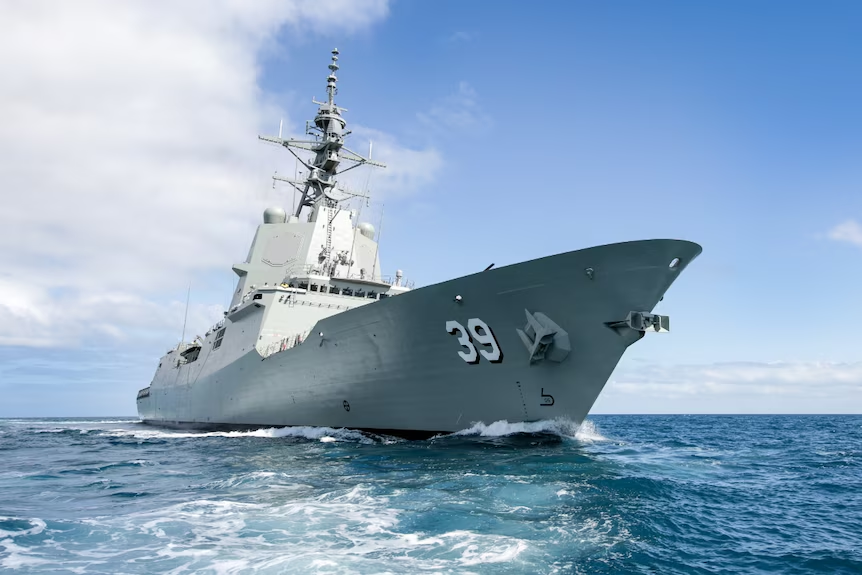
(DEFENCE SECURITY ASIA) — HMAS Hobart has completed the dry-dock phase of Australia’s most consequential destroyer modernisation, beginning its transformation from a specialised air-defence escort into a networked long-range strike and integrated missile-defence combatant.
The milestone at Osborne Naval Shipyard moves the lead Hobart-class destroyer toward Aegis Baseline 9, Tomahawk land-attack capability, SM-6 missile defence and a substantially reconstructed combat architecture designed for high-intensity warfare.

Vice Admiral Matthew Buckley described the undocking milestone as the first significant step in a complex upgrade intended to return Hobart with greater lethality, although extensive activation, harbour testing and sea trials remain.
Strategically, the transformation addresses a fundamental Australian defence problem: long-range precision weapons have reduced the protection traditionally provided by geography, forcing Canberra to build credible maritime denial capabilities across its northern approaches.
Tomahawk fundamentally extends that defensive geometry because an upgraded Hobart can potentially threaten airfields, command infrastructure, missile positions and logistics nodes more than 1,500 kilometres away while remaining outside traditional anti-ship engagement envelopes.
Aegis Baseline 9 simultaneously changes the defensive equation by integrating aircraft, cruise-missile and ballistic-missile tracks within a common battlespace, reducing the separation between air warfare and missile defence that characterised earlier configurations.
Combined with SM-6, that architecture gives the Royal Australian Navy a sea-based terminal ballistic-missile defence capability while expanding long-range air warfare and providing another anti-surface option against hostile naval forces.
Naval Strike Missile adds another layer by shifting the primary anti-ship weapon outside Hobart’s 48-cell Mk 41 Vertical Launching System, preserving strategically valuable cells for Tomahawk, SM-2 Block IIIC and SM-6.
These capabilities nevertheless create an unavoidable magazine-management problem because every Tomahawk loaded reduces available defensive capacity, while every SM-6 committed to ballistic-missile defence removes space otherwise available for long-range conventional strike.
That limitation matters because Australia operates only three Hobart-class destroyers, meaning their strategic influence depends less upon overwhelming missile mass than positioning, networking, survivability, allied integration and intelligent allocation of scarce interceptors.
The upgrade consequently represents something larger than additional missiles: it converts Hobart into a maritime node connecting Australian sensors, American-designed weapons and allied Aegis networks across an increasingly contested Indo-Pacific battlespace.
Its geopolitical significance therefore rests upon strategic signalling as much as firepower, demonstrating that Australia is implementing its Strategy of Denial before future nuclear-powered submarines become available for sustained undersea deterrence.
(CLICK HERE): Australia Becomes Third Country Globally to Acquire and Launch Tomahawk Missiles
Tomahawk Gives Australia a New Long-Range Maritime Strike Geometry
Tomahawk introduces a land-attack capability exceeding 1,500 kilometres, allowing Australian destroyers to hold fixed strategic targets at risk from maritime operating areas far beyond the reach associated with their previous Harpoon-centred offensive architecture.
Potential wartime targets include air bases, command-and-control nodes, missile positions and logistics hubs, giving naval commanders an additional strike pathway against infrastructure supporting hostile operations toward Australia’s northern approaches and deployed allied forces.
This does not automatically transform Australia into an independent long-range maritime strike power because three destroyers cannot generate the missile volume, persistence or distributed presence associated with substantially larger surface combatant fleets.
Instead, Tomahawk complicates adversary operational planning by forcing military staffs to consider Australian surface combatants as potential strike platforms rather than treating them primarily as escorts protecting higher-value ships from aircraft and anti-ship missiles.
A Hobart operating from the Timor, Arafura or Coral Sea could consequently influence land-based operational planning across a significantly expanded battlespace, potentially forcing adversaries to disperse assets, harden infrastructure or strengthen defensive coverage.
That geographic leverage directly supports Australia’s Strategy of Denial, whose logic emphasises increasing the military cost and operational difficulty of projecting hostile power toward Australia rather than attempting symmetrical force-for-force competition.
Tomahawk also expands coalition options because Australian commanders can contribute maritime land attack alongside allied forces, broadening the number of platforms capable of prosecuting fixed targets during coordinated high-intensity operations.
The capability remains bounded by magazine depth because Hobart retains only 48 Mk 41 cells, forcing commanders to balance offensive Tomahawk loads against SM-6 and SM-2 weapons required to survive contested missile environments.
Reloading further constrains sustained operations because expenditure of substantial missile inventories would eventually require port access, creating a logistics vulnerability precisely when high-intensity warfare could place fixed maritime infrastructure under persistent surveillance or attack.
Tomahawk therefore changes Australian deterrence most effectively through uncertainty: adversary planners must account for another mobile launch platform whose position, missile allocation and potential targeting contribution may remain uncertain during crisis escalation.
Aegis Baseline 9 and SM-6 Create Australia’s Sea-Based Missile Defence Layer
Hobart’s original Aegis architecture was principally optimised for fleet air defence, whereas Baseline 9 introduces Integrated Air and Missile Defence capable of processing aircraft, cruise missiles and ballistic threats within one operational environment.
A new Multi-Mission Signal Processor supports that transition, while upgraded computing, signal-processing equipment, consoles and extensive recabling shorten engagement timelines and create the computational foundation necessary for simultaneous multi-domain defensive operations.
The Combat Information Centre was effectively rebuilt, requiring replacement foundations, equipment mounts, cooling, electrical distribution and cabling before new Aegis and Australian-specific consoles could be integrated into the protected internal combat space.
SM-6 then supplies the kinetic component, combining extended-range anti-air warfare, anti-surface capability and terminal-phase ballistic-missile defence in a weapon using an active-radar seeker capable of supporting more flexible engagement sequences.
For Australian force protection, the ballistic-missile mission is strategically important because an appropriately positioned Hobart could provide a terminal defensive layer around a task group, coastal location or selected deployed military infrastructure.
That capability should not be confused with national ballistic-missile defence because sea-based terminal interception cannot provide continent-wide coverage and does not replicate the mid-course defensive mission associated with different interceptors and sensor architectures.
Its military value instead emerges from mobility, allowing commanders to reposition a missile-defence node according to operational priorities while simultaneously maintaining air defence, maritime strike and surface-warfare functions aboard the same hull.
This creates another magazine dilemma because SM-6 consumes the same Mk 41 cells required by Tomahawk and SM-2, turning weapons allocation into a mission-planning decision shaped by expected threat density and operational objectives.
Against sophisticated missile salvos, defensive endurance may become more strategically important than theoretical engagement range, particularly when simultaneous ballistic, cruise-missile and aircraft threats force commanders to preserve interceptors across prolonged operations.
Baseline 9 therefore changes Hobart less by creating an impenetrable shield than by making the destroyer a more adaptable defensive node capable of participating within a wider distributed allied air-and-missile-defence architecture.
Networked Aegis Warfare Tightens Australia’s Integration With US-Led Forces
Baseline 9 places Australia on a combat-system modernisation pathway closely aligned with American Aegis forces and related Japanese and South Korean capabilities, strengthening interoperability during coalition missile defence and high-end maritime operations.
The architecture supports networked warfare in which sensor information can be distributed across multiple platforms, reducing dependence upon a single ship’s organic detection picture and expanding opportunities for cooperative engagements across geographically separated forces.
That concept is strategically more significant than Hobart’s raw missile-cell count because distributed sensors and shooters can magnify the operational value of a comparatively small Australian surface fleet during multinational high-intensity operations.
Australia’s sovereign interface, derived from Saab’s 9LV architecture, connects Australian-specific sensors and effectors with Aegis without requiring fundamental alteration of the core American combat-system software underpinning the destroyer’s primary warfare functions.
The interface integrates electronic warfare, sonar, selected radars and close-in defensive systems, while creating combat-system commonality intended to extend into Australia’s future Hunter-class frigates and broader Tier-1 surface combatant force.
That common architecture has important logistics consequences because shared software, operator environments, training pipelines and support arrangements can reduce integration friction while creating a more sustainable pathway for future combat-system upgrades.
HMAS Sydney has already operated within multinational Aegis environments alongside American, Japanese and South Korean ships, illustrating the coalition framework within which the upgraded Hobart-class destroyers are expected to generate disproportionate strategic value.
For Washington, Australia therefore becomes more than a basing and logistics partner, contributing interoperable maritime strike, air defence and terminal ballistic-missile defence capabilities capable of reinforcing distributed allied operations across the Indo-Pacific.
For Beijing, the development creates additional planning complexity without fundamentally changing regional force ratios, because three Australian destroyers remain numerically constrained compared with the missile capacity available across China’s expanding surface combatant fleet.
The geopolitical effect is consequently cumulative rather than decisive: Australia adds another interoperable Aegis node to an allied network whose strategic strength derives from distributed sensors, common weapons, shared operating concepts and geographic dispersion.
The 48-Cell Constraint Exposes Australia’s Missile-Magazine Problem
The central physical limitation remains unchanged because each Hobart-class destroyer still carries only 48 Mk 41 cells, meaning the modernisation increases the variety and sophistication of available weapons without expanding the underlying vertical-launch magazine.
Commanders must therefore determine how many cells should carry Tomahawk for land attack, SM-6 for extended air and terminal missile defence, and SM-2 Block IIIC for conventional fleet air-defence requirements.
This competition becomes severe during high-intensity warfare because a destroyer configured heavily for strike may sacrifice defensive endurance, while a ship carrying predominantly interceptors could contribute relatively little long-range offensive missile mass.
NSM partially mitigates that pressure because deck-mounted launchers keep the anti-ship mission outside the vertical-launch magazine, preserving Mk 41 capacity while providing a sea-skimming weapon with more than 300 kilometres of reported range.
Yet separate NSM launchers cannot solve the deeper magazine problem because ballistic-missile defence and long-range land attack remain dependent upon finite Mk 41 capacity aboard only three operationally valuable destroyers.
Fleet availability further magnifies the constraint because the destroyers are being modernised sequentially, avoiding the severe force-generation consequences that would result from withdrawing two of Australia’s three principal air-warfare ships simultaneously.
Missile replenishment represents another operational vulnerability because Tomahawk, SM-6 and associated interceptors depend upon American production, linking Australian wartime endurance to allied industrial capacity, delivery schedules and competing demands during broader conflict.
Consequently, Australia’s effective missile inventory cannot be measured solely through procurement numbers because combat persistence also depends upon transportation, secure storage, port infrastructure, reload cycles, maintenance capacity and uninterrupted allied supply chains.
A peer comparison reinforces the asymmetry because China’s Type 055 carries more than twice Hobart’s vertical-launch capacity, demonstrating why Canberra’s strategy cannot realistically depend upon matching larger regional fleets ship-for-ship.
Australia instead seeks cumulative denial through submarines, aircraft, long-range missiles, future surface combatants, optionally crewed systems and alliances, making Hobart an important bridge toward a larger distributed force rather than a standalone solution.
(CLICK HERE): Australia Sends MC-55A Spy Plane Near China’s South China Sea Flashpoints
Osborne Upgrade Becomes Industrial Test for Australia’s Future Warship Force
The Hobart modernisation is simultaneously an industrial mobilisation exercise because Osborne Naval Shipyard is integrating complex American, Australian and European technologies while supporting Australia’s transition toward continuous naval shipbuilding and sustainment.
The Destroyer Enterprise brings government and major defence companies into a coordinated sustainment structure intended to replace fragmented docking-based support with persistent engineering, maintenance, supply-chain and capability-management arrangements throughout the ships’ service lives.
More than 130 defence and industry personnel participate in the combat-system integration organisation responsible for testing, installation and certification, creating sovereign expertise intended to support future Australian Aegis-equipped surface combatants.
Lockheed Martin Australia provides Aegis Baseline 9 integration, Saab Australia supplies the sovereign Australian Interface, while BAE Systems Australia manages program delivery and platform-combat-system integration across the destroyer enhancement effort.
Navantia Australia provides the platform-system design necessary to fit revised combat architecture and Tomahawk equipment within the existing F100-derived hull, demonstrating the engineering complexity hidden beneath apparently straightforward missile modernisation.
Osborne is simultaneously supporting destroyer enhancement, Hunter-class frigate construction, Collins-class submarine sustainment and preparations associated with the future SSN-AUKUS enterprise, concentrating strategically important maritime-industrial activity within one national shipbuilding ecosystem.
That concentration creates efficiency and workforce advantages but also makes industrial resilience strategically important because Australia’s ability to regenerate naval combat power increasingly depends upon specialised infrastructure, skilled personnel and sophisticated supply chains.
Skills generated through Hobart’s reconstruction—including fabrication, electrical integration and combat-system installation—can migrate into Hunter and future warship programs, making the destroyer upgrade a practical training ground for Australia’s expanding maritime industrial base.
The sequential upgrade model additionally protects force posture because removing multiple Hobart-class ships simultaneously would dramatically reduce available air-warfare destroyers before normal training, maintenance and readiness cycles were considered.
Ultimately, Hobart’s transformation is strategically important not because three destroyers can dominate Indo-Pacific missile warfare, but because Tomahawk, Aegis Baseline 9, SM-6 and networked warfare make Australia substantially harder to disregard in coalition operational planning.
