
Six US F-35 Stealth Fighters Head to India as Tarang Shakti Tests Regional Airpower
Six F-35As and two KC-135 tankers are scheduled for India’s multinational exercise, where stealth tactics, aerial refuelling and interoperability will face a practical test.

(DEFENCE SECURITY ASIA) — Six US Air Force F-35A Lightning II stealth fighters are scheduled to join India’s Tarang Shakti 2026 exercise, giving the Indian Air Force its first opportunity to train with the aircraft in tactical missions on Indian soil.
The planned deployment also includes two KC-135 Stratotankers, making aerial refuelling part of the US contingent’s operating footprint and allowing planners to examine how fifth-generation fighters depend on support aircraft during sustained multinational operations.
Scheduled for September 26 to October 12 at Air Force Station Jodhpur in Rajasthan, the exercise places that package near India’s western approaches while giving participating forces access to airspace suited to complex air combat training.
The distinction is operational: F-35s previously appeared at Indian air shows, but Tarang Shakti would bring them into mission planning, tactical flying and debriefing alongside Indian crews and aircraft from several partner air forces.
Indian Air Force Vice Chief Air Marshal Ashutosh Dixit has drawn that distinction between earlier exhibitions and an exercise, framing the event as an opportunity to identify what the service still needs to learn.
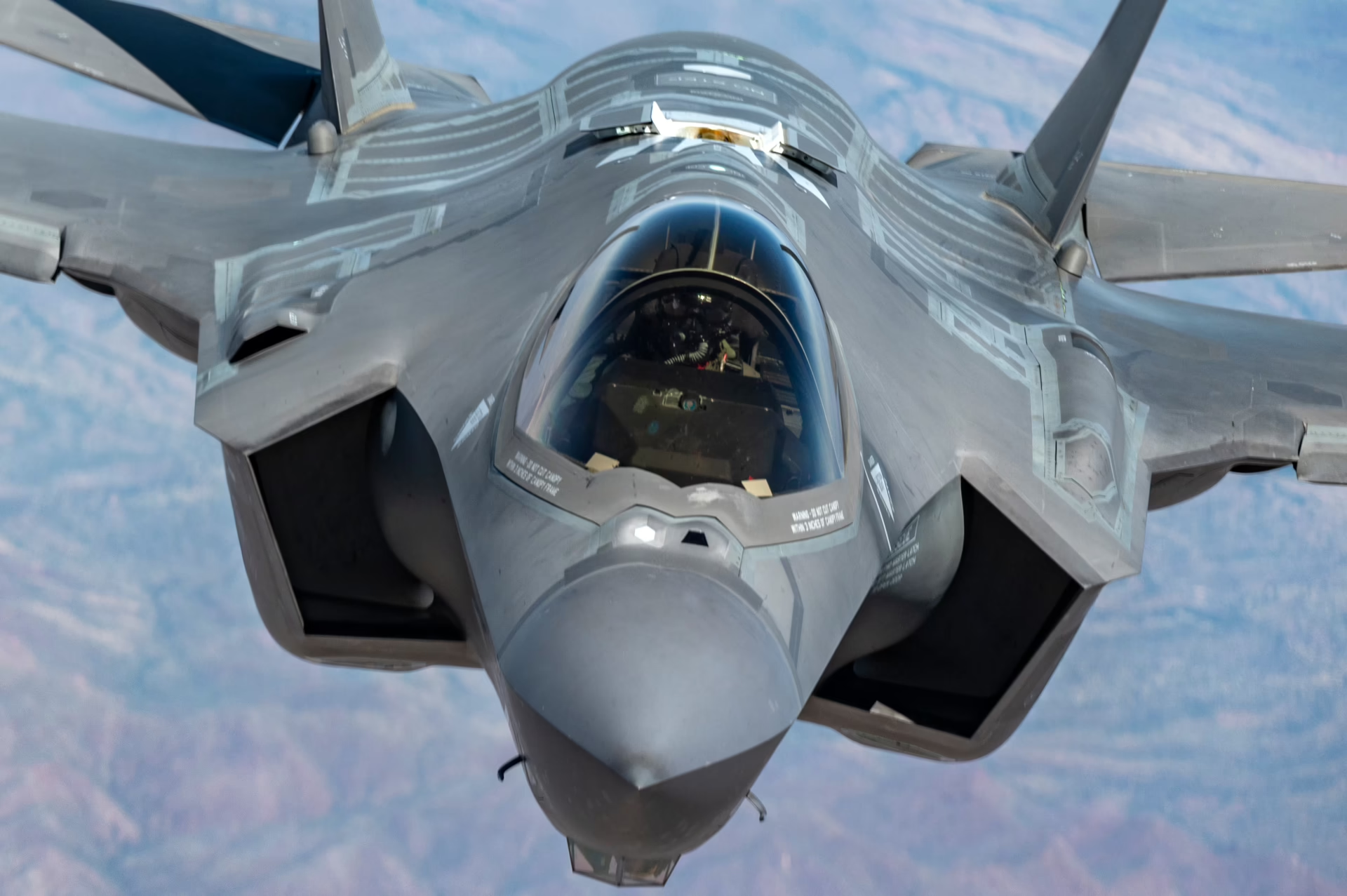
For India, the immediate value lies in testing how Rafales, Su-30MKIs and other conventional fighters operate around an aircraft designed to combine low observability, sensor fusion and networked information during contested air missions.
For Pakistan, Jodhpur’s location gives the deployment visible significance, although an exercise near the border does not establish that its scenarios target Pakistan or reveal how either air force would perform in a confrontation.
For China, the relevant question is whether Indian crews can turn exposure to fifth-generation tactics into better planning against stealth aircraft, including threats associated with Beijing’s expanding advanced fighter fleet.
Neither conclusion should outrun the evidence: participation can improve familiarity and reveal integration problems, but a two-week exercise cannot establish combat effectiveness, transfer restricted F-35 capabilities or resolve India’s wider force-structure challenges.
Tarang Shakti’s multinational format matters because the aircraft mix spans stealth fighters, multirole jets, transports, tankers and surveillance platforms, forcing planners to coordinate capabilities built around different procedures, sensors and national restrictions.
Indian officials describe interoperability as a central objective, while the exercise’s “Power in Partnership” theme gives New Delhi a diplomatic platform to demonstrate that cooperation with the United States fits within a broader network of partners.
The strategic test is therefore practical: whether India can host, support and coordinate a diverse air package while extracting lessons useful for air defence, counter-air operations and future fighter development without mistaking access for integration.
(CLICK): Lockheed Martin Shuts Door on Direct India F-35 Talks as Washington Tightens Control Over Fifth-Generation Fighter Exports
A Stealth Fighter Changes the Training Problem
The F-35A introduces a different tactical problem from the one posed by India’s existing fighter fleet, because its low-observable design and fused sensor picture can change when aircraft detect threats and how they share that information.
Indian Rafales, Su-30MKIs, Tejas fighters, Mirage 2000s, Jaguars and MiG-29s give planners varied aircraft for the exercise, but each brings different sensors, communications equipment and mission practices into the same airspace.
Flying alongside an F-35 can show Indian crews how a stealth fighter contributes to a larger formation, including which aircraft receive useful information and which coordination tasks become harder when networks are incompatible.
Flying against one could sharpen questions about detection, identification and interception, although any resulting lesson would depend heavily on exercise rules, disclosed capabilities and the restrictions placed on the visiting US aircraft.
The F-35’s sensor fusion may improve a formation’s understanding of the battlespace, but the operational benefit depends on whether information can move securely and promptly to other aircraft and command elements.
That limitation is especially relevant to India’s mixed-origin inventory, where Russian, French, Israeli and indigenous equipment must be brought into workable procedures before crews can exploit a common picture during a fast-moving engagement.
The F-35 uses restricted communications capabilities, including the Multifunction Advanced Data Link, so tactical cooperation at Jodhpur should not be read as evidence that Indian aircraft can access every element of its network.
Mission planners can still gain insight by comparing what each aircraft can observe, how crews describe uncertain tracks and where differences in information delay decisions during counter-air or air defence scenarios.
The exercise may also help India examine assumptions drawn from recent operations, including the value of precision targeting, integrated air defence and intelligence-led planning, without proving that a particular wartime tactic will succeed.
Its strongest technical outcome would be a clearer account of where procedures, communications and training need work, because learning an integration limit before a crisis has greater value than displaying aircraft together in a formation.
(CLICK): Pakistan Urges U.S. to Block F-35 Sale to India Amid Stealth Jet Race in South Asia

Jodhpur’s Logistics Carry Their Own Signal
Six F-35As cannot operate as an isolated symbol of airpower; their deployment requires maintenance personnel, equipment, protected working arrangements and a reliable flow of fuel and support across an Indian-hosted exercise.
The two KC-135 tankers make that support structure visible, while giving participating crews an opportunity to practise the scheduling and coordination needed to refuel aircraft without disrupting other missions in crowded exercise airspace.
France’s reported package of seven Rafales, three A400M transports and two A330 multirole tanker transports adds substantial lift and refuelling capacity, making the exercise a test of supporting systems as well as fighters.
The United Arab Emirates is expected to send six F-16s and a Global 6000 support aircraft, while German, Australian, Bangladeshi and Sri Lankan contributions broaden the range of transport and surveillance tasks requiring coordination.
India’s own contribution is described as a broad cross-section of its fleet, potentially including airborne early warning aircraft, IL-78 tankers and transports alongside fighters used for friendly and opposing-force roles.
These assets matter because realistic air operations depend on launch timing, airspace control, surveillance, refuelling and recovery, all of which can constrain a force even when its frontline fighters are available.
Hosting the package also tests the Indian Air Force’s ability to manage personnel, aircraft and national operating requirements at one base through a sustained single-phase exercise rather than a short diplomatic visit.
Some aircraft totals and variants remain subject to change, and published accounts differ over possible Greek participation, so the final flying roster should determine any assessment of how demanding the multinational package becomes.
Jodhpur follows the India-Japan Veer Guardian 2026 exercise at the same base, placing two partner engagements in sequence and increasing the importance of support capacity, scheduling and continuity for Indian personnel.
That footprint is itself a strategic signal: India is demonstrating the ability to convene and sustain advanced foreign air forces, while the United States is showing willingness to operate sensitive aircraft from an Indian base.
(CLICK): India Claims Record 314km S-400 Kill—Pakistan’s AEW&C Fleet in the Crosshairs
Pakistan and China Will Read Different Lessons
Jodhpur’s proximity to India’s western frontier gives Pakistan reason to watch the exercise, particularly how Indian fighters work around stealth aircraft and how tanker-supported missions are planned from a Rajasthan air base.
Yet Tarang Shakti is presented as a multinational training event, and its location alone cannot establish a Pakistan-specific scenario, an operational plan or an intention to change the military balance along that frontier.
Reports of a possible future Chinese J-35 sale to Pakistan add relevance to Indian interest in stealth tactics, but an unconfirmed acquisition cannot be treated as an aircraft already available to Pakistani forces.
For China, the exercise raises a different issue: India can observe how an operational fifth-generation fighter interacts with conventional aircraft while considering the challenge posed by China’s J-20 and emerging J-35 fleets.
That experience may inform Indian air defence planning, but a US F-35 training package cannot stand in directly for Chinese aircraft whose sensors, weapons, support networks and operating methods may differ.
The more useful lesson for a potential two-front contingency concerns decision-making under uncertainty: crews must identify threats, protect support aircraft and coordinate fighters even when they lack complete information about opposing forces.
Tankers and airborne early warning aircraft are particularly consequential in that assessment, because their availability influences mission reach and situational awareness while making their protection a central part of air campaign planning.
Pakistan and China can observe the political signal of Indo-US cooperation, but neither outside observer can infer classified exercise results or measure the combat capability of Indian formations from the announced participant list.
The deployment therefore strengthens India’s exposure to fifth-generation operations without automatically strengthening every part of its force posture, which remains dependent on training, communications, maintenance and available aircraft numbers.
Its geopolitical effect is clearest as a statement of access and sustained cooperation: New Delhi can host US stealth fighters for tactical flying while preserving the freedom to maintain other defence relationships.
Multinational Flying Tests India’s Strategic Autonomy
Tarang Shakti brings US aircraft together with French fighters, Emirati F-16s and Indian platforms that include Russian-origin Su-30MKIs, illustrating how New Delhi’s air force manages partnerships across a diverse equipment base.
That diversity gives India diplomatic reach, but it also creates a demanding operational task because aircraft supplied by different countries do not automatically share data, maintenance practices or mission-planning procedures.
The exercise offers a controlled setting to identify which cooperation can be achieved through common tactics and personnel relationships, and which problems require equipment changes or agreements beyond the scope of training.
Indian officials list seven foreign countries contributing air assets, with approximately 32 nations attending as observers, giving the event an audience whose interest extends beyond the aircraft flying over Jodhpur.
Reported invitations to 65 countries and expected attendance by around ten air chiefs add a diplomatic dimension, although observer numbers and senior-level participation should be distinguished from operational involvement in the flying programme.
For India, that audience creates an opportunity to demonstrate Tejas and its wider aerospace industry, while the multinational flying programme tests whether domestic capability and foreign cooperation can serve practical requirements together.
Dixit has presented self-reliance and international collaboration as complementary objectives, a position that leaves room for India to seek lessons from the F-35 while continuing work on its indigenous Advanced Medium Combat Aircraft.
No announced F-35 deployment or exercise scenario amounts to an Indian procurement decision, and the presence of sensitive US aircraft should not be confused with access to their protected technology.
Shared planning rooms and debriefs may nevertheless produce durable institutional value, because officers and technicians who learn one another’s procedures can coordinate more effectively during later exercises or multinational contingencies.
The significance of Tarang Shakti as airpower diplomacy will ultimately rest on execution: bringing partners together attracts attention, but sustaining safe, useful and technically demanding flying is what gives the event credibility.
What the Exercise Can Prove—and What It Cannot
The exercise can demonstrate that US F-35As and Indian aircraft can participate in the same planned air campaign, supported by tankers, transports and command arrangements under an agreed multinational training framework.
It can also reveal where mission planning becomes difficult, including differences in communications, information access and the procedures crews use to coordinate aircraft with unlike sensors and national operating restrictions.
It cannot show the full capabilities of the F-35, because sensitive systems and methods are unlikely to be exposed without limits in an exercise involving multiple foreign participants and observers.
Nor can a successful sortie establish that India has acquired a ready answer to Chinese stealth aircraft or any future Pakistani capability, since combat outcomes depend on force size, weapons, surveillance and sustained support.
Comparisons between platforms will be shaped by exercise design, making public claims about which fighter “won” especially weak unless the missions, rules, starting conditions and available information are disclosed.
India’s most consequential gain may instead be a more precise understanding of its own gaps: which crews need additional training, which networks impede coordination and which support aircraft require greater protection.
The US deployment has value beyond the F-35s themselves because it lets both air forces practise the logistics and working relationships needed to sustain complex activity at an Indian base.
For regional observers, the credible signal is that India can attract and coordinate advanced partners without committing to an exclusive alignment, while the limits of that cooperation remain a matter of technical and political choice.
For planners, the question after October 12 will be which findings become revised procedures, further exercises or capability decisions, since lessons identified at Jodhpur will matter only if they shape future force development.
Tarang Shakti 2026 could give India a clearer view of fifth-generation air warfare and its multinational logistics footprint; its lasting strategic weight will depend on what the participating forces learn, verify and put into practice.
