
US Navy REMUS 600 Washes Ashore in Iran, Exposing the Undersea Battle for Hormuz
An apparent US Navy Mk 18 Mod 2 Kingfish recovered on Iran’s coastline exposes the operational vulnerabilities, intelligence risks and escalating mine-warfare contest surrounding the Strait of Hormuz.

(DEFENCE SECURITY ASIA) — A photograph circulating through Iranian-linked social-media accounts since 19 September 2026 appears to show a US Navy REMUS 600 autonomous underwater vehicle stranded on an Iranian beach, potentially exposing another dimension of Washington’s continuing mine-reconnaissance operations around the Strait of Hormuz.
The vehicle’s cylindrical grey-and-white hull, black banding, compact sensor housing and distinctive orange tail assembly correspond closely with official imagery of the REMUS 600, designated by the US Navy as the Mk 18 Mod 2 “Kingfish.”
Iranian-linked accounts described the system as a malfunctioning American “spy drone” that washed ashore after operating near Iran, although neither the incident’s precise date nor the vehicle’s original mission has been independently established through the information presently available.
No publicly identified US Central Command statement specifically addressing this REMUS 600 had emerged by 19 September, leaving its ownership, launch platform, navigational history and recovery circumstances officially unconfirmed despite the vehicle’s strong visual resemblance to an American Kingfish.
The discovery is operationally significant because the US Navy employs Mk 18 Mod 2 vehicles for mine countermeasures, hydrographic surveying and underwater reconnaissance, missions fundamental to preserving naval manoeuvre and commercial access through the strategically indispensable Strait of Hormuz.
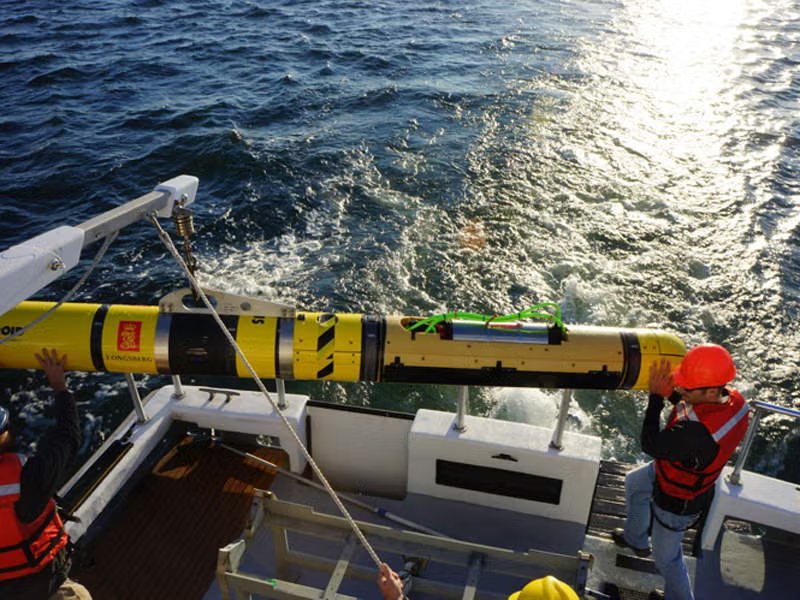
Rather than destroying mines directly, the vehicle’s side-scan sonar examines the seabed for mine-like objects, enabling divers or expendable neutralisation systems to investigate confirmed threats while reducing human exposure during the dangerous initial search and classification phase.
A disabled vehicle reaching Iranian territory could reveal where American forces were conducting seabed surveys, testing transit routes or monitoring renewed mining activity, although any such intelligence value would depend heavily upon whether usable mission logs survived onboard protections.
The incident also follows Iran’s recovery of the substantially larger Anduril Dive-LD near the Strait of Hormuz on 8 September 2026, creating a powerful narrative that American undersea systems remain operationally active yet recoverable within contested littoral waters.
However, the two vehicles should not be conflated because the REMUS 600 represents a mature, medium-sized mine-warfare platform, whereas the large-displacement Dive-LD embodies a newer category offering greater payload capacity, endurance and mission-growth potential.
The apparent loss therefore constitutes neither evidence that Iran intercepted the vehicle nor proof that American mine-countermeasure operations were penetrated, because the photograph remains equally consistent with propulsion, battery or navigation failure followed by an uncontrolled surface drift.
Strong currents, congested operating areas and shallow littoral geography make the strait exceptionally unforgiving for autonomous underwater vehicles, meaning a relatively minor technical malfunction can become an intelligence, operational-security and strategic-communications problem once the platform reaches hostile territory.
For Washington and Tehran, the episode demonstrates how even an older uncrewed platform can influence deterrence perceptions, because physical possession allows Iran to combine limited technical exploitation with high-impact imagery portraying American forces as vulnerable across the undersea battlespace.
(CLICK HERE): Iran’s Dive-LD Capture Puts US Underwater Secrets at Risk
Kingfish’s Mine-Hunting Mission in the Strait of Hormuz
Originally developed by the Woods Hole Oceanographic Institution and subsequently produced by Hydroid, now associated with Kongsberg and HII, the REMUS 600 was designed to conduct sustained autonomous missions at depths reaching approximately 600 metres.
Published characteristics place the platform’s length between roughly 3.25 and 3.8 metres, its diameter at 32.4 centimetres and its weight near 240–250 kilograms, producing a transportable system deployable without the logistics footprint required by larger underwater vehicles.
The REMUS 600 can reportedly operate for as long as 70 hours at three knots, reach approximately five knots and cover around 286 nautical miles, although endurance varies according to payload, speed, environmental conditions and battery configuration.
Its sensor architecture can include side-scan sonar, a downward-looking camera, an acoustic Doppler current profiler, GPS and additional mission-specific equipment, allowing operators to map bottom conditions, classify anomalies and reconstruct underwater terrain without continuously controlling the vehicle.
Because GPS signals cannot penetrate seawater, the vehicle must navigate primarily through onboard inertial, acoustic and environmental inputs before surfacing periodically for satellite positioning, making accurate mission execution dependent upon software, sensor calibration and predictable underwater conditions.
Any failure affecting propulsion, energy management, navigation or command sequencing could force the vehicle to surface, where currents and winds would determine its movement until operators recovered it or the disabled system reached a shoreline.
The US Navy has operated Kingfish vehicles in the Persian Gulf since 2012, commonly deploying them from rigid-hull inflatable boats whose mobility permits small expeditionary teams to survey constrained waters without exposing major mine-warfare vessels.
Production of the Mk 18 Mod 2 reportedly continued from 2012 until 2023, establishing it as an operationally mature design whose fundamental characteristics are better understood internationally than those of newly introduced large-displacement autonomous underwater systems.
That maturity reduces the probability that Iran obtained revolutionary engineering knowledge, yet it does not eliminate intelligence value because individual mission configurations, software versions, sensor integration and manufacturing refinements may differ from publicly documented baseline specifications.
The strategic importance consequently lies less in the hull’s basic design than in what the recovered configuration might disclose about American mine-clearing priorities, expeditionary deployment practices and the underwater routes considered operationally critical around Hormuz.
(CLICK HERE): Iran Deploys ‘Trigger-Ready’ Ghadir Submarines to Strait of Hormuz as Tehran Signals Underwater Threat to Global Oil Routes

Mine Warfare and the Logistics Contest Beneath Hormuz
The supplied account places REMUS vehicles within 2026 Strait of Hormuz mine-hunting and survey operations undertaken amid elevated tensions and reported Iranian mining activity around shipping lanes carrying globally consequential volumes of energy and commercial traffic.
An International Maritime Organization estimate cited in the provided information placed approximately 80 mines within key navigation routes, although the number, emplacement chronology and responsible units remain consequential claims requiring authoritative confirmation before definitive operational conclusions are drawn.
Mine clearance reportedly developed into a four-month campaign conducted largely at night, combining underwater reconnaissance vehicles, Common Uncrewed Surface Vessels, small teams of US Navy divers operating from inflatable craft and multiservice air support.
That force package demonstrates that mine countermeasures are not merely a sonar problem, because every detected object requires classification, neutralisation, route marking, command coordination, force protection and repeated surveying before maritime authorities can confidently reopen contested passages.
REMUS 600 vehicles support the initial search layer by producing high-resolution seabed imagery, while divers or expendable systems such as SeaFox investigate and neutralise confirmed hazards, distributing risk across machines, specialists and remotely operated effectors.
CENTCOM subsequently stated that the principal international transit routes had been cleared, but follow-on hydrographic surveys would remain necessary because seabed conditions change, additional mines could be introduced and previously ambiguous contacts might require renewed examination.
Continued Kingfish operations would therefore support both route assurance and strategic warning, enabling commanders to compare new sonar imagery against earlier surveys and identify disturbances suggesting fresh mine emplacement or deliberate manipulation of the underwater environment.
Operating these vehicles from small boats creates a comparatively light tactical footprint, yet the wider enterprise still depends upon batteries, mission planning, sonar analysis, secure communications, maintenance personnel, recovery equipment and protection against Iranian surveillance or interference.
The apparent beaching highlights a critical logistics vulnerability because deployable autonomous systems remain recoverable assets, and every malfunction can compel commanders to choose between hazardous retrieval, possible escalation near Iranian waters or abandonment of sensitive equipment.
Consequently, the undersea contest in Hormuz involves endurance and sustainment as much as advanced technology, with both sides seeking to preserve persistent surveillance while imposing disproportionate recovery, escort and clearance burdens upon the opposing force.
(CLICK HERE): US Navy’s New Strait of Hormuz Nightmare: Iran’s ‘Azhdar’ Stealth Underwater Drone Could Disrupt Global Shipping and Redefine Naval Warfare
What Iran Could Learn From a Recovered REMUS 600
A recovered Kingfish could permit Iranian engineers to examine hull construction, sealing methods, propulsion arrangements, battery placement, sonar mounting, internal modularity, acoustic treatments and production techniques, even when the platform’s broad specifications are already publicly understood.
Those findings could be compared with Iran’s Tareq, Nahang and other autonomous underwater vehicle programmes, supporting incremental improvements in mine reconnaissance, seabed surveying or potentially one-way attack systems adapted for confined and heavily monitored maritime approaches.
The intelligence benefit would nevertheless depend upon the vehicle’s physical condition because saltwater intrusion, battery damage, impact forces or automatic security procedures could destroy the electronic evidence most valuable for reconstructing American tactics and mission priorities.
Software, navigation algorithms and sensor-processing methods would generally offer greater intelligence value than external dimensions, but they are also more difficult to exploit when memory is encrypted, data are compartmentalised or onboard protections erase operationally sensitive records.
US officials addressing previous recoveries reportedly maintained that similar vehicles carried neither classified sonar nor radar and collected no sensitive information, an important qualification that reduces expectations of a transformative intelligence windfall without eliminating all exploitation possibilities.
If mission logs remained accessible, Iran could potentially identify surveyed corridors, launch patterns, search spacing or recurring areas of interest, allowing its forces to infer which shipping lanes and underwater approaches receive the highest American operational priority.
Even incomplete data could support countermeasure development by showing typical operating depth, speed, navigation intervals or sonar geometry, information that might help Iranian forces design decoys, seabed clutter or ambush patterns intended to complicate future searches.
However, possession of one damaged platform would not automatically provide Iran with the supporting software, training, quality control, battery production or acoustic-processing infrastructure required to reproduce the complete US Navy mine-countermeasure capability at operational scale.
Iran’s likely gain is therefore cumulative rather than decisive, adding physical evidence to knowledge reportedly acquired after Houthi divers recovered one REMUS 600 near Yemen in 2018 and another possible example surfaced in footage during 2024.
The analytical distinction matters because describing the recovery as a technological breakthrough would exaggerate its probable military effect, whereas dismissing it entirely would overlook how modest engineering insights can improve indigenous systems through sustained reverse-engineering programmes.
Propaganda Victory, Operational Failure or Unverified Claim?
Iranian-linked accounts have presented the beached vehicle as evidence that Iranian forces recovered an American system operating within waters Tehran considers strategically sensitive, transforming an apparent malfunction into a broader claim of maritime awareness and sovereign control.
Yet the available photograph does not demonstrate that the Islamic Revolutionary Guard Corps Navy detected, tracked or captured the REMUS 600 while submerged, meaning assertions of an active interception remain unverified and should not be treated as established fact.
The visible condition instead appears compatible with a vehicle that lost propulsion or navigational control, surfaced according to an emergency routine and subsequently drifted ashore, although imagery alone cannot establish its exact failure sequence or previous location.
This distinction separates operational achievement from opportunistic recovery because intercepting an underwater vehicle would indicate a meaningful counter-autonomy capability, while finding one on a beach would primarily demonstrate geographical fortune and effective exploitation of strategic communications.
Nevertheless, propaganda effectiveness does not depend upon the recovery method being tactically sophisticated, since an intact American-marked system photographed on Iranian territory gives Tehran a visually persuasive object around which to construct claims of defensive competence.
The episode reinforces messaging created by the Dive-LD recovery eleven days earlier, enabling Iranian outlets to portray separate American vehicle losses as a pattern rather than isolated events, regardless of the substantial technological differences between the platforms.
For domestic audiences, physical display of recovered equipment can reinforce confidence in Iran’s capacity to contest US military operations, while regional partners may interpret the imagery as evidence that American technological advantages remain vulnerable to asymmetric persistence.
For Washington, the principal reputational danger is cumulative because recurring recoveries can create an impression of operational carelessness, even when the vehicles were conducting inherently hazardous missions and carried little classified technology or irreplaceable mission data.
The absence of a specific CENTCOM acknowledgement leaves an information vacuum that Iranian accounts can exploit, although American silence could equally reflect operational security, uncertainty over ownership or a judgement that public engagement would amplify Tehran’s narrative.
DSA assesses that the immediate propaganda value is high, the probable intelligence value is moderate and the demonstrated Iranian interception capability remains unproven, making careful terminology essential when evaluating the incident’s genuine military significance.
Strategic Lessons for US Undersea Force Posture
The apparent Kingfish loss confirms, if its US Navy identity is ultimately established, that medium-sized autonomous vehicles remain central to America’s persistent mine-reconnaissance posture despite the arrival of larger and more capable uncrewed underwater platforms.
Their compact logistics footprint allows dispersed teams to deploy rapidly from small craft, but that advantage also places operators and recovery crews near hostile surveillance, electronic interference, surface patrols and geographically constrained Iranian maritime approaches.
Future operations may require more robust lost-vehicle procedures, including improved location beacons, accelerated recovery forces, stricter mission-data sanitisation and navigation safeguards designed to prevent disabled systems drifting toward territory controlled by a strategic competitor.
Commanders must nevertheless balance security against mission effectiveness because aggressive self-protection measures, restricted routes or premature data deletion could reduce endurance, survey quality and operational flexibility during time-sensitive efforts to reopen mined shipping corridors.
Iran, meanwhile, may respond by expanding coastal observation, patrol coverage and systematic searches for surfaced autonomous vehicles, recognising that recovering malfunctioning systems can generate intelligence and political returns without requiring technically demanding underwater interception.
Tehran could also distribute recovered components or engineering findings among aligned partners, although the extent of any transfer remains unknown and the mature Kingfish design limits the novelty of information available from its basic hardware architecture.
The more consequential possibility is doctrinal adaptation, whereby Iran studies American search procedures and then modifies mine placement, deception objects or seabed concealment methods to increase false contacts and consume scarce clearance time during another crisis.
Such adaptation would exploit cost and tempo rather than technological superiority, forcing US-led forces to resurvey wider areas, deploy additional divers and expend more neutralisation assets while commercial pressure mounts to restore confidence in maritime transit.
Washington’s advantage remains its integrated force structure, combining autonomous sensing, surface platforms, explosive-ordnance specialists, air support and command networks, whereas possession of individual recovered vehicles does not provide Iran with an equivalent operational mine-countermeasure system.
Ultimately, the stranded REMUS 600 represents a limited hardware loss but a strategically revealing event, demonstrating that undersea autonomy, mine warfare, expeditionary logistics and narrative competition have become inseparable components of deterrence around the Strait of Hormuz.
