
HAL Completes Tejas Mk-1 Order Decade Late as IAF Fighter Crisis Deepens
HAL has completed the Indian Air Force’s original 40-aircraft Tejas Mk-1 order, but the decade-late milestone intensifies scrutiny of India’s widening fighter-squadron deficit and delayed Tejas Mk-1A programme.
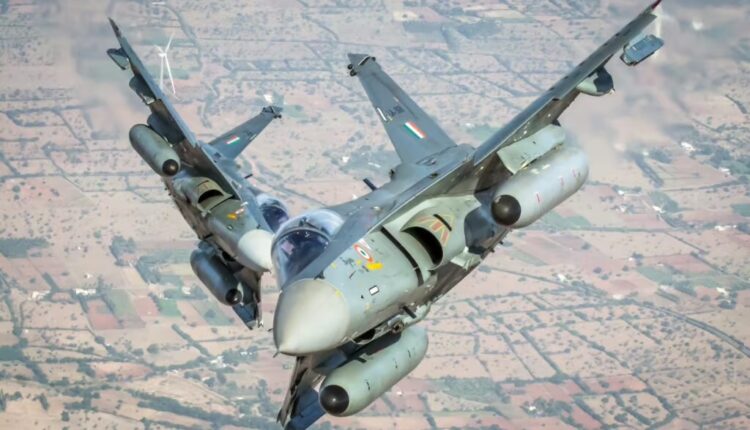
(DEFENCE SECURITY ASIA) — Hindustan Aeronautics Limited completed the Indian Air Force’s original 40-aircraft Tejas Mk-1 order on 18 September 2026, closing a foundational fighter programme whose final two trainers arrived approximately one decade after their contractual deadline.
The handover in Bengaluru represented an industrial milestone for India, but its greater strategic significance lies in exposing the persistent gap between designing a capable combat aircraft and delivering fully cleared fighters at operationally relevant production rates.
Defence Minister Rajnath Singh, Civil Aviation Minister K. Rammohan Naidu, Air Chief Marshal A.P. Singh and HAL Chairman Ravi K. attended a ceremony that simultaneously showcased indigenous aerospace progress and highlighted unresolved delivery pressures.
The completed order comprises 32 single-seat fighters and eight twin-seat trainers, providing combat and conversion capacity for the Indian Air Force’s two operational Tejas formations, No. 45 Squadron “Flying Daggers” and No. 18 Squadron “Flying Bullets.”
However, completion of the Tejas Mk-1 contract does not resolve India’s fighter force deficit, because the service reportedly operates approximately 29 squadrons against an authorised strength of 42 following the retirement of its remaining MiG-21 aircraft.

That shortfall transforms every production delay into a force-posture problem, limiting the Indian Air Force’s ability to regenerate squadrons, distribute combat mass across multiple fronts and sustain aircraft availability during prolonged high-intensity operations.
HAL delivered all 32 single-seat Tejas fighters by August 2023, but the final trainers remained outstanding as the company and air force prioritised operational squadrons while attempting to close technical and qualitative requirements on the delayed aircraft.
The last two aircraft, identified as SPT7 and SPT8, were reported ready in September 2026 after remaining short of Indian Air Force Air Staff Qualitative Requirements during early 2025, according to information provided about the programme.
Their acceptance closes the original Mk-1 production chapter, yet it also sharpens scrutiny of the Tejas Mk-1A, the enhanced variant expected to carry India’s light-fighter recapitalisation strategy through a much larger and operationally consequential production cycle.
HAL’s central challenge is therefore no longer proving that Tejas can fly or fight, but demonstrating that India can repeatedly manufacture, integrate, certify and deliver complete combat aircraft according to an air force timetable shaped by deteriorating squadron numbers.
This distinction matters because modern fighter capability depends upon a functioning industrial ecosystem encompassing engines, radar, electronic warfare, software, weapons integration, training aircraft, maintenance capacity and resilient logistics rather than the airframe alone.
The September ceremony consequently delivered two competing strategic messages: India has sustained a difficult indigenous fighter programme to completion, while the decade-long delay confirms that aerospace self-reliance remains constrained by production discipline, supplier dependence and systems integration.
(CLICK HERE): India Races to Field First Tejas Mk1A Squadron by March 2027 as Airpower Gap Widens
A 40-Aircraft Order That Took Two Decades to Close
The original Tejas Mk-1 requirement was divided between a March 2006 contract for 20 Initial Operational Clearance aircraft and a December 2010 agreement covering 20 Final Operational Clearance aircraft, each containing fighters and twin-seat trainers.
The first batch comprised 16 IOC fighters and four trainers, with completion originally targeted for December 2011, while the second contained 16 FOC fighters and four trainers scheduled for completion by December 2016.
Taken together, these contracts created a modest fleet of 32 fighters and eight trainers, but their limited scale also restricted the commercial justification for immediately establishing the high-rate, multi-line manufacturing architecture required for rapid squadron regeneration.
HAL and the Indian Air Force gave production priority to single-seat fighters so No. 45 and No. 18 Squadrons could become operational, making trainer delays an accepted consequence of generating frontline combat capacity first.
That sequencing had operational logic, because combat squadrons required aircraft to establish tactics, maintenance routines and deployment experience, but postponing trainers also constrained the pipeline for converting pilots onto Tejas-specific avionics, handling characteristics and mission systems.
The twin-seat prototype PV-5 first flew in November 2009, PV-6 followed in November 2014, and the first series-production trainer completed its maiden flight only in April 2023 before entering Indian Air Force service that October.
By January 2025, HAL had delivered 38 aircraft from the original order, leaving two trainers unresolved because they had not fully satisfied qualitative requirements associated with a standard intended to establish India’s baseline indigenous light-combat capability.
The final handover therefore carried significance beyond two airframes, because it removed a longstanding contractual liability while allowing HAL to redirect production attention, engineering resources and factory capacity towards the delayed and substantially larger Tejas Mk-1A programme.
Nevertheless, closing an old order cannot recover the operational time already lost, since delayed trainers reduce conversion throughput, complicate squadron manpower planning and postpone the creation of experienced instructors needed to expand a fighter fleet efficiently.
For defence planners, the programme demonstrates how seemingly secondary aircraft categories can influence force readiness, because trainers, simulators, instructors and maintenance systems determine whether newly manufactured fighters translate into sustainable combat sorties rather than static inventory.
(CLICK HERE): India’s Tejas Mk1A Crisis Deepens: IAF May Waive Electronic Warfare Automation as Delays Threaten Regional Airpower Balance

Combat-Capable Trainers Strengthen the Tejas Pipeline
The Tejas twin-seat trainer incorporates a lengthened forward fuselage, tandem cockpits and a larger canopy, positioning the student forward and instructor behind while retaining the flight-control architecture and combat systems associated with the single-seat aircraft.
Unlike a basic or intermediate training platform, the aircraft remains combat-capable, allowing pilots to learn operational procedures using the same quadruplex fly-by-wire controls, glass cockpit, digital avionics and composite structure that define the frontline Tejas fleet.
The final FOC trainers reportedly introduce improved radar performance, refined autopilot handling, fuel-system enhancements, software-defined radios and air-to-air refuelling probes, collectively reducing the technological gap between training missions and operational conversion onto combat-configured aircraft.
This commonality strengthens training efficiency because pilots can practise sensor management, communications, refuelling procedures and weapons-related cockpit workflows without transitioning through a separate conversion type whose systems or handling characteristics differ from frontline fighters.
The trainer’s value extends into combat-force resilience, since an aircraft retaining operational sensors and weapons compatibility can support continuation training, tactical development or limited combat tasks when squadron availability becomes constrained during a crisis.
Eight original trainers must support two Tejas Mk-1 squadrons, creating a relatively narrow conversion resource whose serviceability, instructor allocation and maintenance scheduling will directly affect the number of pilots available for sustained operational flying.
No. 45 Squadron became the first Tejas unit in July 2016 at Sulur Air Force Station, while No. 18 Squadron was resurrected in April 2020 with FOC-standard aircraft before subsequently operating from Naliya.
Those locations give Tejas a geographically relevant role in India’s force posture, but the operational effect depends upon maintenance support, spare engines, trained technicians and deployable ground equipment accompanying aircraft beyond their established home-station infrastructure.
The trainer fleet consequently forms part of the Tejas logistics footprint rather than merely its flying syllabus, because every additional pilot requires recurring simulator access, instructional sorties, technical support and exposure to squadron-level mission planning.
Completing the trainer order closes a critical gap within the existing Mk-1 ecosystem, but it cannot independently expand combat mass because India’s larger squadron problem requires substantially faster delivery of radar-equipped, electronically protected and fully weapon-integrated Mk-1A aircraft.
(CLICK HERE): “18 Tejas Fighters, 10 Without Engines”: HAL Image Exposes India’s Deepening Tejas Mk1A Crisis
Engines, Radar and Software Define the Mk-1A Bottleneck
The Tejas programme originated in 1983 as India sought an indigenous replacement for the MiG-21, requiring its aerospace sector to master fly-by-wire controls, digital avionics, composite structures and radar integration after a prolonged interruption in fighter development.
Post-1998 sanctions, changing requirements, engine difficulties and a comparatively thin industrial base slowed development, while Final Operational Clearance demanded additional work involving the cannon, refuelling probe, higher angle-of-attack performance and updated flight-control software.
India’s unsuccessful Kaveri engine effort left every Tejas dependent upon the American GE F404, creating a foreign-supplier vulnerability capable of slowing completed airframes, disrupting production sequencing and weakening the programme’s claim to comprehensive aerospace self-reliance.
Supply difficulties became publicly associated with rows of Mk-1A airframes awaiting engines, illustrating how a single imported subsystem can govern the output of an otherwise domestic manufacturing programme and shape the Indian Air Force’s squadron-replacement timetable.
Information provided for this article indicates HAL possessed approximately 27 Mk-1A airframes and around ten engines by September 2026, but the remaining challenge extended beyond propulsion into radar, electronic warfare, weapons and software integration.
HAL Chairman Ravi K. described the aircraft as approximately 90 to 95 percent ready but avoided committing to a firm delivery date because substantial software work remained, highlighting the disproportionate difficulty of certifying a modern fighter’s final configuration.
The unresolved portion reportedly includes interactions between the active electronically scanned array radar and electronic warfare suite, alongside weapons integration and software refinement requiring repeated cycles of flight testing, analysis, correction and recertification.
These activities cannot be treated as administrative finishing work, because radar stability, electronic protection, weapons compatibility and mission-computer reliability determine whether an aircraft can survive contested airspace and employ its armament under operational conditions.
Accepting incomplete aircraft could increase nominal fleet numbers while transferring integration risk, retrofit costs and configuration-management burdens to operational squadrons, potentially reducing mission availability and complicating maintenance across aircraft carrying different hardware or software standards.
The Mk-1A crisis therefore demonstrates that contemporary fighter production is principally an integration enterprise, where industrial success depends upon synchronising propulsion, sensors, electronic warfare, weapons, software certification and supply chains around a stable delivery configuration.
Production Capacity Versus India’s Squadron Emergency
Early Tejas orders of only 20 aircraft each did not provide HAL with sustained demand comparable to mature international fighter programmes, limiting incentives to establish multiple high-rate production lines while the company simultaneously managed licensed Su-30 manufacturing.
Audits had previously identified delayed factory establishment and output of approximately four aircraft annually instead of eight, revealing a manufacturing system unable to generate replacements quickly enough for an air force confronting simultaneous retirement and modernisation pressures.
Air Chief Marshal A.P. Singh publicly criticised HAL’s delivery performance and questioned whether the company was operating in “mission mode,” reflecting institutional frustration over promised Mk-1A aircraft that remained unavailable even when engine shortages were considered separately.
HAL has since expanded production across Bengaluru and Nashik, targeting annual output of approximately 24 aircraft before potentially reaching 30, but factory capacity alone cannot guarantee deliveries when engines, radar, software or certification remain unsynchronised.
The production challenge is therefore governed by the slowest critical subsystem, meaning unused assembly capacity may coexist with incomplete aircraft whenever propulsion deliveries, electronic integration or flight-test clearances fall behind the physical manufacture of airframes.
India’s logistics footprint must expand alongside output because a larger Tejas fleet requires engines, replacement modules, radar support, software-management facilities, trained maintainers, test equipment and weapons stocks distributed across multiple operational bases.
Without that parallel investment, higher production could create a numerically larger but unevenly supported fleet whose deployability remains constrained by centralised maintenance, limited spares or dependence upon contractors and specialised facilities at established locations.
The Indian Air Force’s reported strength of approximately 29 fighter squadrons against 42 authorised makes time the decisive variable, because every delayed Tejas delivery extends reliance upon ageing aircraft or increases pressure for additional imported combat platforms.
A production rate approaching 30 aircraft annually could begin altering that trajectory, but only if HAL delivers aircraft in a common, combat-cleared configuration rather than accumulating partially completed airframes awaiting engines, software or mission-system validation.
Tejas Mk-1A has consequently become a test of Indian defence-industrial credibility, linking factory performance directly with deterrence, procurement autonomy and New Delhi’s ability to signal that indigenous aerospace programmes can meet urgent operational requirements.
From Mk-1 Closure to the Larger Mk-1A Test
The completed Mk-1 fleet should not be characterised as a failed aircraft, because two squadrons already operate the type and its fly-by-wire controls, composite construction, digital avionics and weapons capability represent a substantial advance over the MiG-21.
However, the aircraft entered service with reported waivers involving weight, internal fuel, thrust, electronic warfare and pilot protection, meaning operational acceptance reflected both useful capability and compromises intended for correction through subsequent Tejas variants.
That distinction separates airframe performance from programme execution, allowing analysts to recognise Tejas as a viable light fighter while assessing its acquisition history as chronically delayed, supplier-dependent and vulnerable during last-mile systems integration.
Recent safety incidents, including the March 2024 Jaisalmer crash, the fatal November 2025 Dubai Airshow accident and a February 2026 runway incident, increased scrutiny without independently establishing that the overall aircraft design is fundamentally unsafe.
Information provided associates those events with differing circumstances involving possible fuel-feed or engine factors, an airshow crash and a later incident linked to software, underscoring why each occurrence requires separate investigation rather than politically convenient generalisation.
Nevertheless, three incidents within two years inevitably affect institutional confidence and acceptance behaviour, encouraging the Indian Air Force to demand stronger evidence that Mk-1A aircraft are complete, stable and safe before incorporating them into frontline operations.
The 2021 contract for 83 Mk-1A aircraft includes ten trainers, while the later 97-aircraft programme reportedly contains 29 twin-seat aircraft, extending the training pipeline towards 2033–2034 alongside AESA radar, electronic warfare and expanded weapons capability.
These larger orders could provide the production continuity absent from the original Mk-1 programme, supporting workforce retention, supplier investment and factory utilisation while giving HAL stronger economic incentives to institutionalise repeatable high-rate manufacturing.
Yet scale also magnifies risk, because delays affecting engines or integrated mission systems across 180 aircraft would have substantially greater consequences for squadron readiness, procurement expenditure and India’s broader force-modernisation schedule than problems within the original fleet.
The strategic question is therefore not whether Tejas Mk-1A will eventually enter service, but whether India can deliver complete aircraft in sufficient numbers before declining fighter strength forces further capability compromises, emergency imports or extended reliance upon ageing platforms.
Strategic Signalling, Industrial Sovereignty and the Wartime Clock
The September handover allowed India to signal continuity in indigenous aerospace development, demonstrating that HAL and the Indian Air Force ultimately completed a technically demanding programme despite sanctions, subsystem failures, shifting requirements and an immature supplier network.
That achievement carries diplomatic and industrial value because prospective partners assess not only aircraft performance but also production reliability, delivery schedules, upgrade pathways, training capacity and long-term logistical support before committing to a combat-aircraft ecosystem.
Conversely, a ten-year delay affecting the final trainers weakens strategic messaging by showing that contractual completion can lag far behind operational need, raising questions about whether future customers could receive aircraft and support according to predictable timelines.
For India, the more urgent audience is domestic defence planning, because the Tejas programme anchors ambitions to reduce import dependence while generating affordable combat mass against increasingly sophisticated regional air forces and layered air-defence networks.
Achieving that ambition requires an industrial posture capable of operating on what may be described as a wartime clock, where production resilience, alternate suppliers, spare inventories and rapid software certification become components of national combat power.
The HTT-40 handover conducted during the same ceremony, involving the first three aircraft from a 70-aircraft contract, broadened the event’s message by connecting basic training, fighter conversion and frontline force generation within one indigenous aviation pipeline.
HAL plans to deliver the remaining HTT-40 aircraft over four to five years using combined Bengaluru and Nashik capacity of approximately 20 aircraft annually, creating another test of whether expanded manufacturing can sustain predictable output.
Together, HTT-40, Tejas Mk-1 and Tejas Mk-1A illustrate that air-power regeneration begins before pilots reach fighter squadrons, linking basic training, conversion capacity, combat aircraft availability and maintenance manpower through an interdependent force-generation system.
The final Mk-1 trainers therefore close one delayed chapter without resolving the central vulnerability: India can design and operate an indigenous fighter, but it has not yet demonstrated consistently timely delivery of fully integrated aircraft at scale.
Tejas Mk-1A will determine whether the September milestone represents a transition towards reliable aerospace production or another cycle of delayed acceptance, incomplete configurations and shrinking squadrons confronting operational requirements that industrial timelines cannot match.
