
Did China’s J-16 Really Crush Egypt’s Rafale 7–1?
An explosive 7–1 victory claim has placed China’s J-16 and Egypt’s Rafale under global scrutiny, but the unverified score conceals a more consequential demonstration of Beijing’s expanding expeditionary airpower.
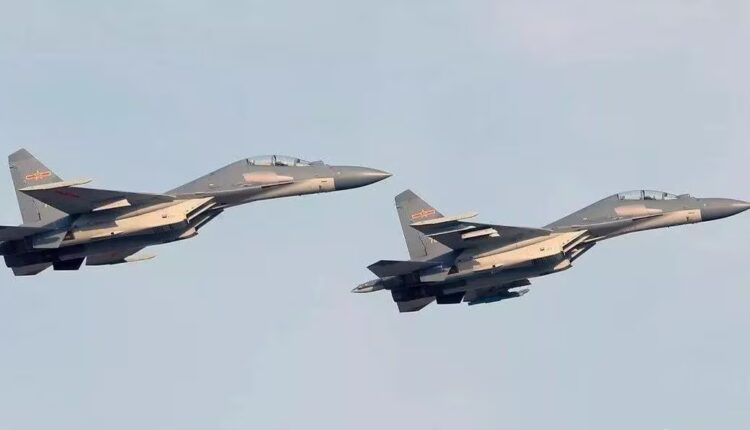
(DEFENCE SECURITY ASIA) — China’s reported 7–1 simulated victory over Egyptian Rafales has electrified military forums, yet no official evidence confirms the score, making Beijing’s unprecedented J-16 expeditionary deployment—not an unverifiable dogfight tally—the strategically consequential development demanding global scrutiny.
The claim emerged from Chinese social-media accounts and military blogs after J-16 fighters encountered Egyptian Rafales during Exercise Eagles of Civilization 2026, but neither the Chinese nor Egyptian armed forces released kill ratios, engagement records, adjudication criteria, or supporting telemetry.

Official disclosures established only that one-on-one aerial combat occurred under combat-realistic conditions, involving medium-range and close-range manoeuvring against Rafales and MiG-29M2s, while carefully edited cockpit footage revealed neither missile employment nor head-up-display symbology confirming simulated kills.
Consequently, the viral score must be separated from verifiable operational activity because undisclosed starting geometry, altitude, radar restrictions, electronic-warfare parameters, weapons modelling, pilot objectives, and termination rules prevent any credible comparison between the J-16 and Dassault Rafale.
The exercise nevertheless marked the J-16’s first deployment to Africa, transforming Eagles of Civilization from bilateral training into a demonstration that the People’s Liberation Army Air Force can project heavy fighters, tankers, transports, airborne surveillance, and electronic support across continents.
At least six J-16s reportedly travelled through Karachi alongside a KJ-500 airborne early-warning aircraft and Y-20 transport, before completing a journey exceeding 6,000 kilometres with YY-20A aerial refuelling, thereby exposing the logistical architecture underpinning China’s expanding expeditionary airpower ambitions.
China’s defence authorities described the deployment as lasting nearly nine hours across two continents and four countries, signalling that operational endurance, multinational transit coordination, tanker integration, maintenance readiness, and rapid force regeneration mattered more strategically than any unverified tactical scoreboard.
Egypt confirmed that Rafales and MiG-29M2s participated across several unnamed air bases, but its limited disclosure contrasted sharply with China’s imagery-led narrative, allowing military bloggers to convert informational asymmetry into an emotionally powerful but evidentially unsupported victory story.
That narrative possesses global resonance because the Rafale anchors French combat-aircraft exports, equips India’s frontline squadrons, and represents a Western multirole fighter family whose perceived combat effectiveness carries geopolitical consequences extending from Europe and Africa to the Indo-Pacific.
For India, any structured Chinese exposure to Rafale flight characteristics holds operational interest, although Egyptian configurations, weapons, electronic-warfare systems, software standards, training doctrines, and mission priorities differ substantially from those employed by the Indian Air Force.
For France and Dassault Aviation, the controversy illustrates how peacetime exercises can become competitive information operations in which dramatic cockpit imagery, selective disclosure, algorithmically amplified speculation, and export-market rivalry shape public perceptions before technical evidence becomes available.
The enduring story is therefore not whether the J-16 defeated the Rafale 7–1, but whether China demonstrated a repeatable capacity to deploy an integrated combat-air package into Africa, sustain operations abroad, exploit foreign training, and dominate the accompanying information environment.
(CLICK HERE): China Sends J-16 Fighters 6,000km to Egypt, Expanding Airpower Reach Into Middle East
The Unverified 7–1 Score and Anatomy of an Airpower Rumour
The 7–1 figure originated within Chinese digital commentary rather than an official government communiqué, and its repetition by overseas outlets did not independently validate the claim because most reports ultimately traced the number back to the same speculative online ecosystem.
Neither air force disclosed how many engagements occurred, whether each encounter began from neutral or advantaged positions, what constituted a valid simulated kill, or whether separate defensive and offensive training objectives produced outcomes unsuitable for direct fighter-performance comparisons.
The official video showed J-16 departures, an Egyptian Rafale manoeuvring near a rear-seat cockpit viewpoint, another Rafale conducting a high-speed pass, MiG-29 landings using brake parachutes, and bilateral briefings conducted before and after the training serials.
Although visually compelling, the footage contained no missile launches, radar displays, adjudication overlays, weapons-impact simulations, debriefing charts, or pilot testimony establishing victories, leaving analysts unable to determine whether the recorded sequence represented engagement, repositioning, scripted manoeuvring, or exercise termination.
The viral claim gained credibility through numerical precision because 7–1 sounded decisive without appearing impossibly absolute, while the single attributed Rafale success created superficial balance and helped speculative commentary imitate the language of restricted military reporting.
A supplementary 2–0 beyond-visual-range rumour strengthened that construction by offering separate scores for dogfighting and missile combat, even though available imagery did not establish BVR engagement geometry, simulated weapon types, sensor employment, or rules governing electronic countermeasures.
China’s official title, “Shenyang J-16 VS Dassault Rafale,” encouraged audiences to interpret cooperative training as a competitive contest, while the absence of an authorised score created an information vacuum readily occupied by nationalistic commentary and commercially motivated military-content producers.
Some accounts claimed the Rafale’s solitary victory was intentionally conceded to protect Egyptian prestige, but that conveniently unfalsifiable explanation offered no evidence and instead revealed how invented operational details can immunise a rumour against scrutiny while reinforcing predetermined conclusions.
Chinese officers publicly praised Egyptian pilots’ tactics and professionalism, language inconsistent with an authorised humiliation narrative, although diplomatic courtesy alone cannot establish combat outcomes and should not be treated as technical evidence favouring either aircraft.
Without engagement tapes, agreed exercise parameters, mission-data files, or official adjudication, the responsible conclusion remains that J-16s conducted meaningful dissimilar air-combat training against Rafales and MiG-29M2s, while every published victory ratio remains unverified speculation rather than established military fact.

Inside China’s 6,000-Kilometre Expeditionary Airpower Demonstration
China deployed considerably more than six fighters because the visible force package included YY-20A tankers, Y-20 transports, KJ-500 airborne early-warning support, reportedly a Y-9LG stand-off jammer, and Z-20 helicopters, creating the framework of an expeditionary air operation.
The J-16’s heavy airframe, substantial fuel requirement, two-person crew, complex sensors, and maintenance burden made its African deployment more demanding than dispatching lighter fighters, thereby testing ground support, spare-parts planning, technician endurance, and overseas sortie-generation procedures.
A transit stop at Karachi highlighted Pakistan’s geographic importance within China’s westward air-access network, although one temporary staging movement does not constitute permanent basing or prove that identical routes would remain politically available during an international crisis.
YY-20A aerial refuelling extended the package’s reach while testing rendezvous planning, fuel transfer, navigation, communications, and contingency procedures, capabilities essential for moving Chinese combat aircraft beyond nearby theatres surrounding Taiwan, the East China Sea, and South China Sea.
The KJ-500 introduced an airborne command-and-control dimension capable of expanding radar coverage, coordinating fighters, managing airspace, and distributing tactical information, although public disclosures did not establish whether it directly controlled the contested training serials against Egyptian aircraft.
Reported Y-9LG participation would add stand-off electronic-warfare relevance by supporting electromagnetic surveillance, jamming, or force protection, but its precise activities remain undisclosed and should not be conflated with proven suppression of Rafale sensors during simulated combat.
Y-20 transports carried personnel, equipment, consumables, and potentially maintenance modules required to recover aircraft quickly after arrival, making strategic airlift the enabling mechanism connecting long-range deployment theatre access with credible operational availability on Egyptian ramps.
Chinese crews reportedly began coordination and unloaded equipment immediately after reaching Egypt, suggesting the exercise tested reception, staging, onward integration, and rapid readiness rather than merely showcasing aircraft during a ceremonial foreign visit.
The package demonstrated limited expeditionary competence, not a sustained Mediterranean force posture, because six fighters supported for an exercise cannot replicate the munitions consumption, attrition replacement, hardened infrastructure, intelligence coverage, and continuous tanker demand required during major combat.
Nevertheless, repeated deployments can institutionalise route planning, foreign-airfield integration, maintenance routines, and command relationships, gradually converting exceptional missions into familiar procedures while widening the geographical range within which Chinese airpower can support diplomacy, partnerships, signalling, and future contingency operations.
What the J-16–Rafale Encounter Reveals About Modern Air Combat
The exercise provided Chinese pilots with their first publicly acknowledged structured flying exposure against an operational Rafale, creating opportunities to observe energy management, turn performance, acceleration, visual signatures, pilot habits, and tactical responses under negotiated training conditions.
Close-range manoeuvring can reveal how rapidly an opponent loses energy, reverses direction, sustains turns, manages vertical geometry, and exploits visibility, but isolated dogfights cannot determine overall combat superiority between multirole fighters designed for networked sensor-and-missile warfare.
Modern air combat normally depends upon airborne early warning, secure datalinks, electronic warfare, radar detection, passive sensing, missile kinematics, identification protocols, tanker availability, and command decisions long before opposing pilots enter the visual arena shown in promotional footage.
The J-16 combines a large payload, long range, powerful radar, two-person cockpit, and electronic-warfare potential, making it particularly relevant to long-range interception, maritime strike, escort, and air-superiority missions around China’s expanding western Pacific operational perimeter.
The Rafale offers a smaller multirole platform with sophisticated sensors, electronic self-protection, high agility, and diverse precision weapons, but Egyptian aircraft were not delivered with Meteor missiles, limiting comparisons with differently configured French or Indian fleets.
Exercise outcomes can be deliberately shaped by training objectives because instructors may place one fighter at a disadvantage to test defensive recovery, deny specific sensors, restrict missile employment, rotate pilot experience levels, or rehearse predetermined tactical problems.
Even authentic kill ratios would therefore describe performance under specific exercise conditions rather than establish universal platform superiority, particularly when pilot proficiency, mission planning, numerical balance, support assets, software standards, and weapons assumptions remain unknown.
Dissimilar air-combat training still produces valuable intelligence because repeated encounters allow aircrew and analysts to build behavioural libraries, refine tactical assumptions, test counter-manoeuvres, and identify questions requiring further collection during later two-versus-two or system-level operations.
Egyptian personnel simultaneously gained access to Chinese tanker procedures, deployment practices, J-16 handling patterns, command arrangements, and ground-support tempo, demonstrating that operational learning flowed in both directions despite Beijing’s dominance of the exercise’s public narrative.
The encounter therefore changed the battlespace indirectly, not by proving a victor, but by giving both participants previously unavailable tactical exposure while allowing China to integrate lessons into future training against Rafale-equipped or similarly capable regional air forces.
India, France and Egypt Confront the Wider Geopolitical Consequences
India must examine the exercise because its Rafales could encounter Chinese J-16s or J-20s during a future border crisis, while Egyptian Rafale and MiG-29M2 participation offered Beijing an imperfect analogue of India’s diverse combat-aircraft inventory.
That relevance has firm limits because Indian Rafales incorporate customised equipment, weapons, electronic-warfare arrangements, operational procedures, and locally developed mission planning, preventing Egyptian exercise results from serving as a reliable rehearsal for combat against the Indian Air Force.
China can nonetheless accumulate useful partial observations because tactical databases emerge from multiple imperfect encounters, allowing analysts to compare manoeuvring tendencies, radar behaviour, communications patterns, and crew responses rather than waiting for access to an exact Indian configuration.
France faces a different challenge because repeated online claims involving Chinese fighters and Rafales can affect export perceptions even without verification, forcing technical reputation, strategic communication, combat evidence, and misinformation resilience into the same increasingly contested marketplace.
The controversy followed earlier narratives surrounding alleged J-10C successes against Indian Rafales and a reported 9–0 J-10CE result against Qatari Typhoons, creating a recognisable online template in which Chinese aircraft appear to dominate prominent Western competitors.
Those previous cases cannot validate the Egyptian score because different aircraft, crews, weapons assumptions, exercise controls, and political circumstances make direct comparison methodologically unsound, while incomplete disclosure continues to prevent independent technical assessment of every claimed result.
Egypt benefits from diversified military relationships by operating American F-16s, French Rafales, and Russian MiG-29M2s while training with China, thereby preserving diplomatic flexibility and reducing dependence upon any single external security partner or defence-industrial supply chain.
However, greater Chinese access may concern Washington, Paris, and Israel because recurring exercises could expose operating practices, strengthen Beijing’s defence relationships, support future aircraft sales, and reduce Western exclusivity within a strategically positioned Arab military.
Egypt’s choice to identify only multiple air bases protected operational security but limited external assessment of infrastructure, deployment patterns, and training geography, while China’s comparatively detailed visual campaign ensured Beijing shaped international interpretation of the exercise.
The resulting geopolitical contest extends beyond fighter specifications because China seeks influence, France protects export credibility, India evaluates threat knowledge, Egypt safeguards strategic autonomy, and digital audiences increasingly determine reputational effects before governments publish authoritative evidence.
(CLICK HERE): Egypt Reportedly Acquires Chinese-Made HD-1A Cruise Missiles: Paired with Rafale Jets?
Beyond the Dogfight: China’s Expanding Global Airpower Strategy
Eagles of Civilization 2026 represents the second edition following the 2025 exercise, indicating an emerging institutional relationship rather than an isolated deployment and enabling both air forces to progress from familiarisation toward increasingly complex bilateral operations.
Planned evolution from one-versus-one engagements to two-versus-two formations and system-level joint operations would test coordination, situational awareness, command structures, force employment, and tactical adaptation more effectively than individual dogfights, although detailed later-stage results remained unavailable.
The training programme also included air-superiority operations, combat search and rescue, and broader force-employment drills, linking fighter activity with personnel recovery, rotary-wing support, command-and-control, and the logistical mechanisms required to sustain combat operations.
China’s overseas training portfolio already includes exercises with Pakistan, Russia, Thailand, and the United Arab Emirates, allowing the People’s Liberation Army Air Force to encounter foreign platforms, climates, procedures, airspace systems, and command cultures unavailable during exclusively domestic training.
Such engagement resembles a gradual effort to acquire the multinational operational familiarity that American and NATO air forces developed over decades, although China still lacks the alliance infrastructure, permanent overseas bases, combat experience, and global access supporting Western expeditionary aviation.
Operating near the edge of tanker range imposes planning discipline relevant to contingencies beyond China’s immediate coastline, where fuel margins, diversion airfields, maintenance failures, diplomatic clearance, and transport capacity can determine whether theoretically capable aircraft generate meaningful combat power.
The deployment also functioned as strategic signalling toward African and Middle Eastern governments by presenting China as a defence partner capable of delivering advanced aircraft, operational training, supporting enablers, and politically visible military engagement without establishing a permanent presence.
For prospective customers, the J-16 itself is not the principal export proposition, but its performance narrative can strengthen confidence in China’s wider fighter, radar, missile, tanker, transport, and electronic-warfare ecosystem within intensely competitive global defence markets.
For military planners, the crucial indicators are deployment frequency, package complexity, turnaround speed, foreign-airfield access, aerial-refuelling proficiency, airborne command integration, and maintenance resilience because those variables reveal whether episodic demonstrations are maturing into sustainable expeditionary capability.
Discarding the unsupported 7–1 claim therefore does not diminish the exercise’s importance, because China still demonstrated growing operational reach, harvested experience against a Western fighter family, strengthened Egyptian defence ties, and converted a limited training event into worldwide strategic messaging.

Article tres interessant dans son contenu et analyse.
Mais je n ai pas souvenirs que l on ai pris autant de reserves et precautions lorsqu on nous a informé de victoired aeriennes de nos Rafales Francais contre les F-22 et F-35 americain.
Nous nous sommes felicités et n avons pas emis le moindre doute quand aux configurations des duels aeriens ou nos Rafales ont brillé……
Faut il en deduire que ce qui nous (la France, l occident et alliés) est favorable est veridique et ce qui nous est defavorable est mensonger ?
A mediter!!!